admin
admin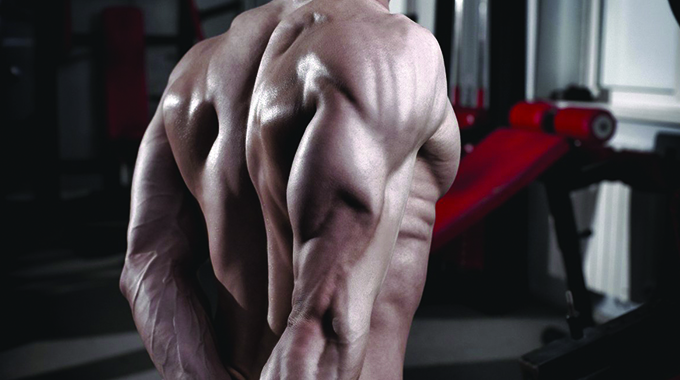
Simon Gama
Bodybuilders normally do triceps kickback in one motion, swinging the forearm backward to straighten the arm and then letting it rise up and back on its momentum.
However, if you do the exercise in two separate motions, you will get different muscular contractions. When done in two parts, the triceps kickback is excellent exercise for the long head of the triceps (usually difficult to develop), together with the medial and lateral heads as well as the posterior deltoid.
Two major muscles are involved in the two-part execution of the triceps kickback. In the first action elbow-joint extension involves the triceps brachia, a large muscle covering the entire back of the upper arm. Its divided into three parts, the lateral, medial and long head. At the upper end, the long head of the triceps is attached to the spatula just below the shoulder joint. However, the lateral and medical heads do not cross the shoulder joint. The lateral heads attaches to the upper half of the humerus, the medial head to a wider area of the lower back part of the humerus. At the lower end, all three heads run into a common tendon that inserts on the olecranon process of the ulna bone in the forearm.
In the second part of the movement, shoulder-joint hyper-extension involves mainly the upper latissimus dorsi and posterior deltoid. The latissimus dorsi is situated on the lower half of the back. However, in this exercise only the upper portion, which originates on the spinous process of the six lower thoracic vertebrae, is involved. The latissimus dorsi inserts on the intertubercular groove of the pectoralis major.
The deltoid is a triangular muscle located on the shoulder with one angle pointing down the arm and the other two bent around the shoulder to the front and rear. Origin is on the clavicle (collarbone), top of the acromion and posterior border of the scapulae spine, and insertion is on the deltoid tuberosity of the humerus.
When learning to do the triceps kickback in the two parts, pause when you complete the first part(i.e, when the arm is fully extended and alongside the body). To get the feel of the second position, look in a mirror or have someone check your arm position after it is straightened. If the arm is in proper position, complete the second position half of the exercise by raising the arm as high as possible. Do not rotate the shoulders to maximize height. The shoulders should stay level with the floor, as should the entire trunk. Only the arm should rise above the level of the back.
For best results, maintain your trunk in the horizontal position so that your muscles work against your gravity and have effective resistance during the execution. To ensure this keep your lower back in a slightly arched position and the trunk level. If you raise the trunk the exercise becomes easier, but less effective in developing the posterior deltoid and long head of the triceps.
The use of excessively heavy weights prevents you from correctly executing both parts of the exercise. In most cases, you will be unable to raise the weights above the level of your back, which defects the main purpose for doing this exercise. In addition, the heavy resistance can force you to swing the weights at the beginning to get the arm back in one motion. When this happens, the long head of the triceps and posterior deltoid do not undergo a maximum contraction. Swinging the weight undermines the effectiveness of the exercise.
The two part triceps kickback is more difficult than other triceps — extension exercise — but only if you do the exercise in two parts! If you pause momentarily after the arm is straightened and then raise it you will experience a strong burn in the long head and in the posterior deltoid. Don’t cheat.
When executing the latter part of the movement, only the head of the triceps is actively involved. The medial and lateral heads remain under isometric contraction (as does the lower end of the long head) to keep the elbow joint extended. As a result, you get a double contraction of the long head first the lower end shortens and remains contracted and then the upper end shortens contracted and then the upper end shortens providing you with maximal shortening of the muscle. As a result you produce the greatest muscle construction intensity. This is the key to more effective muscle development and why you should execute the exercise in two phases.
–Additional information from online sources. The writer, Simon Gama is a fitness coach at Body Works Gym in Bulawayo.


 Online Reporter