Online Reporter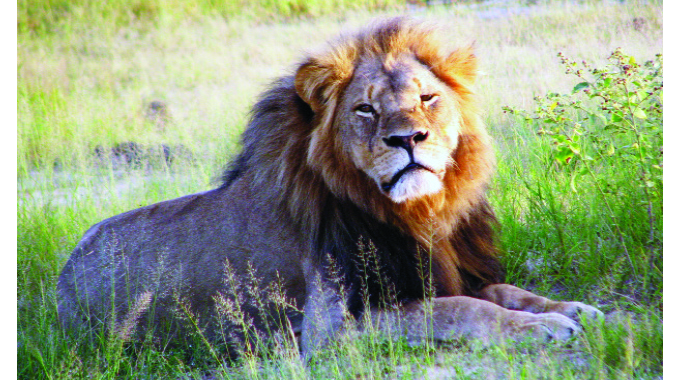
Johnson Siamachira
THIS July marks exactly 10 years after Cecil the Lion was killed on the fringes of Hwange National Park in north-western Zimbabwe.
Cecil was a male African lion (Panthera leo), who lived in Hwange National Park and was being studied and tracked by a research team from Oxford University in the UK as part of a long-term experiment.
Hwange National Park is home to at least 500 lions.
Once again this month, his image is everywhere — headlines, hashtags, and fresh calls to ban trophy hunting.
Animal rights organisations such as the Campaign to Ban Trophy Hunting and Born Free are using this anniversary to reignite outrage. Their messages are emotionally charged — but dangerously out of touch with realities Zimbabweans living adjacent to wildlife areas face.
“Because for many of us in Zimbabwe, where lions still roam outside our national parks, Cecil wasn’t a global symbol. He was just one of hundreds of lions that live — and sometimes kill — in our rural districts,” says Lungile Sibanda, director of the Communal Areas Management Programme for Indigenous Resources (CAMPFIRE) Association in Zimbabwe and vice chairperson of the Community Leaders Network.
She has worked in community-based conservation since 2003 and hails from rural Matobo District, in Matabeleland South Province, where human-wildlife conflict shaped her early experiences.
When Cecil died, the world mourned. But in Sibanda’s community, people were losing livestock and sometimes even human lives to lions long before, and after Cecil’s death.
Sibanda says: “I’ve seen what happens when conservation policies are shaped by people who have never lived with wildlife. And I’ve watched, year after year, as campaigns built around animals like Cecil continue to ignore — and actively undermine — the people who share their land with lions.”
After Cecil’s death, there was global pressure to ban trophy hunting.
Donations flowed to international non-governmental organisations and researchers. But in Zimbabwe, local communities saw no benefit from this wave of international concern.
In fact, rural people living adjacent to protected areas faced increasing hostility towards a system —CAMPFIRE — that has helped them coexist with wildlife for decades.
CAMPFIRE operates in 58 districts and affects the lives of nearly 2,4 million people, either directly or indirectly. It helps the local people manage over 50 000 km² of land — nearly half the size of England — for both wildlife and livelihoods. Trophy hunting revenues make up around 90 percent of CAMPFIRE income.
“This isn’t a theoretical debate for us — it’s how we sustain our way of life,” Sibanda explains.
Between 2015 and 2025, in districts like Tsholotsho and Binga in Matabeleland North Province, lions killed more than 1 500 livestock.
People were injured. Some died. These are not statistics in a campaign brochure — they are affected community members. And, each cow or goat lost is not just a number — it may be a child’s school fees, a family’s only source of protein, or the cushion that helps a household survive a difficult year.
Zimbabwe has one of the largest remaining lion populations in Africa — estimated at between 1 000 and 1 700. The Government’s Lion Conservation Strategy focuses on securing viable lion populations, mitigating human-wildlife conflict, and ensuring benefits reach local people. But without revenue, these goals become almost impossible to achieve.
“I find it remarkable that in the UK, it’s often celebrities — not scientists or community leaders — who are given the most space in public debates about African wildlife,” says Sibanda.
“Meanwhile, those who have dedicated their lives to understanding these complex conservation dynamics are sidelined.”
The wildlife economy – including trophy hunting – is an important part of the overall economy in Africa, especially in rural areas where natural resources are important for livelihoods and local development.
That’s why trophy hunting import bans — like the one committed to in the UK government’s current manifesto — are so concerning. They claim they will protect wildlife, but in practice, they will strip communities of income, make conservation less viable, and increase risks for both people and animals.
“These bans are not just misguided — they are hypocritical. The UK allows recreational deer stalking and game bird shooting at home, yet seeks to outlaw practices that generate vital funds for conservation in Africa,” added Sibanda.
“Conservation is my life’s work – and I know trophy hunting helps protect wildlife and isn’t making species extinct. Removing trophy hunting without providing a suitable alternative of revenue will expose those underfunded protected areas to further risks, such as poaching,” said Amy Dickman, a professor of wildlife conservation at the University of Oxford.
“There’s a feeling in the West that once you give commercial value to wildlife, this encourages people to go and shoot the animals,” says Pascal Mpofu, a CAMPFIRE Association board member, and chairperson of Hwange Rural District Council.
“But that is not true.” When the Nile crocodile was totally protected, it faced extinction, he says, but after a limited trade in it was allowed, “the numbers increased and now we have too many crocodiles.” There is, he says, no known species that has suffered extinction as a result of trade. – New Ziana.