admin
admin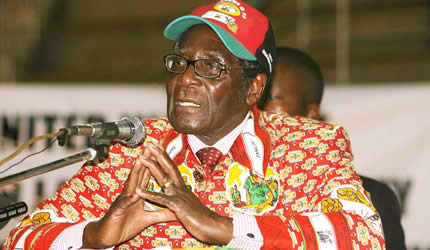
Tichaona Zindoga
ON August 6, the United States Attorney Office announced that federal charges had been unsealed for two Chicago men for allegedly violating US sanctions in late 2008 and 2009, by agreeing to assist President Mugabe and others in an effort to lift sanctions against Zimbabwe. US sanctions against Zimbabwe fall under the banner of the Zimbabwe Transition to Democracy Act (formerly the Zimbabwe Democracy and Economic Recovery Act) which was signed into law by then president George W. Bush in 2001.
The statement said: “The sanctions neither bar travel to Zimbabwe nor prohibit public officials from meeting with specially designated nationals to discuss removing sanctions, but (US) individuals may not provide lobbying, public relations, or media consulting services on behalf of or for the benefit of specially designated nationals.”
So Prince Asiel Ben Israel and C. Gregory Turner were charged for breaching the International Emergency Economic Powers.
Violating IEEPA carries a maximum of 20 years in prison and US$1 million fine, said American prosecutors, adding: “If convicted, the court must impose a reasonable sentence under federal statutes and the advisory United States Sentencing Guidelines.”
This is what the hard-nosed ones do.
You have to give the Devil his due: America knows how to protect its interests and they have put in place systems to do so as ruthlessly and as efficiently as a grinding machine.
Perhaps you have to admire them, too, for that.
That they have indicated they will not remove sanctions against Zimbabwe, for which they rejected the just-ended election results which everybody except themselves, their friends and their quislings in Zimbabwe Okayed, adds to their ruthless efficiency.
And a very informative piece was written this week, most probably for European and Americans that may want to do with Zimbabwe, especially in the mining industry.
The piece, entitled “The Zimbabwe elections and the current state of sanctions” for corporate counsel appeared in a journal called Lexology.
It noted that the mining industry is “accustomed to monitoring elections in Zimbabwe” and the past election could provide a turning point depending on the international community’s (read the West) ultimate verdict.
“So those wishing to engage with the Zimbabwe’s mining sector,” said the authors, “need to remain strongly aware of the applicable sanctions regimes.”
These included EU’s Council regulation No. 314/2004 that binds every EU nationals, including both individual citizens and companies registered in an EU state while also affecting actions by non-EU nationals within the EU.
It also noted that individual countries within the EU, like the UK with the Zimbabwe (Financial Sanctions) Regulation 2009 and Zimbabwe (Financial Sanctions) (Suspension) Regulation 2013, had their own implementation legislation.
Here are some pertinent issues that were raised in the piece, with respect to sanctioned individuals and entities (such as the Zimbabwe Mining Development Corporation and the Zimbabwe Defence Industries); that EU nationals may not:
l deal with funds or economic resources owned, controlled, held or controlled directly or indirectly, by a restricted person or entity, or a person acting on his behalf;
l make available, directly, funds or economic resources to or for the benefit of restricted persons or entities; or
l participate, knowingly and intentionally, in activities the object or effect of which is, directly or indirectly, to promote the transactions referred to above
The authors also referred to US sanctions, arguing that “even if the EU sanctions regime is lifted in its entirety, the industry will continue to suffer constraints in international business”.
The purpose of this exposé is to show how western countries have given legal as well as moral force to their opposition to Zimbabwe’s efforts to share economic rights between a minority white population and the deprived black majority, which process has had an impact on the white capitalist interests in the country.
You have to admire the Western countries for their pragmatism and cold reality.
And it reminds one of what New African Editor Baffour Ankomah once said that African countries need to copy and imitate what has worked for the West!
In light of the recent elections, Zimbabwe needs to copy the West — the west is the best, is it not?
They have put sanctions in place to make sure their interests are protected principally by trying to make Zimbabwe abandon its course, which, when and if successful, can have a domino effect.
With a two-thirds parliamentary majority on his side, President Mugabe is thus called upon, just as he swore on August 22, that he will “promote whatever will advance, and oppose whatever may harm Zimbabwe . . .”, to take measures that will give legal force and effect to the anti-sanctions drive.
Zimbabwe, a small Southern African nation, that is being punished by powerful Western nations for the ‘crime’ of trying to economically empower its 12 million citizens by giving them access to land and control of industry, already has the moral standing, as well as the support of the progressive world.
Sanctions have been the single biggest threat to Zimbabwe over the past decade and more.
Zimbabwe initially put on a brave face, then moaned and mourned, then petitioned but it has not worked.
Simply because those who imposed the sanctions when aggrieved did not follow our rather puerile course.
They were hard-nosed.
The task ought to be simple, even for a non-lawyer or non-rocket scientist like this humble writer.
First, there should be recognition that sanctions present a present and continuing danger to Zimbabwe and its people thereby necessitating what should be termed a National Response To Sanctions.
Second, a law must crystallise this position, making it an offence to canvass for, or aid existing sanctions and making it mandatory for everyone to participate in a national response to sanctions.
Third, a policy must be designed to crystallise this national response.
The policy must impel and compel; reward and sanction — just like they do in the West.
For example, if the sanctions deny Zimbabwe access to offshore lines of credit at traditional lenders, there should be a deliberate policy that renders access to alternative markets a priority.
The same would go for the mining industry, shown as constrained, above.
How about making a deliberate policy that stipulates that banks, especially the big foreign ones, should be compelled and impelled to support agriculture.
Foreign banks like Barclays have reportedly been unsympathetic to new farmers and supporting agriculture — almost playing to external sanctions that sought to bring down this agro-economy of Zimbabwe.
Since limitation to foreign trade and access to lines of credit means diminished financial availability and capability of Zimbabwe, it should follow that measures will have to be effected that apart from the promotion of alternative access, measures will be effected for the retention of available resources.
This is where one sees the beauty of, for example, Zimbabwe having seen the back of Elton Mangoma on July 31.
Did we not hear reservations that, for example, Mangoma was stone-walling the Chisumbanje Ethanol Project? Now that he is gone, what can now stop the full operationalisation of the Chisumbanje Ethanol Plant and mandatory blending of ethanol?
Besides, the project also feeds other activities, among them provision of electricity for the whole city of Mutare and its surrounds.
If sanctions, for example, encourage the flight of nurses and other professionals who would have finished training under our constrained environment, what is not insensible for asking them to work a couple of years at home and make up for their education?
Zimbabwe, at least for the next five years, and hopefully more, will not have internal contradictions as that subsisted under the dysfunctional inclusive Government.
That should make the National Response to Sanctions, among other things, easy to implement.
So will be the synchronisation of various economic, social and political apparatus that feeds into a renewed Zimbabwe that has survived sanctions for as much as it has.
Yet it has to be borne in mind that those who have imposed sanctions will sit by and watch Zimbabwe undoing the measures; they will respond, perhaps even more harshly, but Zimbabwe should be equal to the task.
This is what one would expect was in the mind of President Mugabe when he solemnly asked, “So help me God.”


 Online Reporter