Chronicle Editor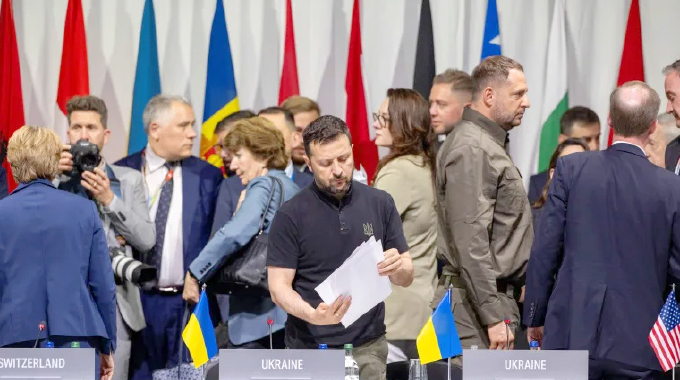
Correspondent
This last June could go down as one of the most significant periods in recent times when global peace was shown at its most fragile, but also at its greatest potential for resolution.
That does sound counter-intuitive. Right.
Four separate but interconnected events took place that, when examined critically , demonstrate both the perils to and the promise of peace.
First, between May 31 and June 2, the Shangri-La Dialogue, Asia’s premier defence summit, was held in Singapore. The Shangri-La Dialogue, hosted by the International Institute for Strategic Studies (IISS), is considered the most influential meeting where ministers debate the region’s most pressing security challenges, engage in important bilateral talks and come up with fresh approaches together. This year, it attracted a number of notable politicians and defence chiefs including Ferdinand Marcos Jr, President of the Philippines, Prabowo Subianto, President-elect of Indonesia, Lloyd Austin, U.S. Secretary of Defense, Dong Jun, China’s Defence Minister, Minoru Kihara, Japan’s Defence Minister, Shin Won-sik, South Korean Defence Minister, Richard Marles, Australia’s Deputy Prime Minister and Defence Minister, Josep Borrell, EU High Representative, among others.
This year’s edition was notorious for the appearance of President Volodymyr Zelenskyy who infamously blamed China for the Ukraine crisis, while he pitched his “World Peace Summit”, which was held in Switzerland. The Summit, also known as Summit on Peace in Ukraine, was held in Bürgenstock Resort in Switzerland on June 15-16, with the notable absence of Ukraine, which was largely considered a failure.
The Ukraine summit was preceded by the G7 meeting held on June 13-15, 2024, in Apulia, Italy hosted by Italian Prime Minister, Giorgia Meloni and featured the leaders of the seven member states, namely Canada, France, Germany, Italy, Japan, Britain and the US. Further, Ukraine and Japan signed a 10-year security agreement and Britain announced new sanctions against Russia, aimed at degrading Russia’s ability to wage war in Ukraine, during the G7 summit. The President of the European Council and the President of the European Commission representing the European Union also attended.
Away from the Western bloc and in deep, another key event took place. On June 28, China celebrated the 70th anniversary of the Five Principles of Peaceful Co-existence, with President Xi Jinping hosting political leaders from 20 countries in attendance.
Perhaps, a fifth development to add to this mix, is the ongoing Israel’s war on Palestine whose continuation signifies failures of the global system and destruction of the rules based order and failure by the US to rein in on Israel, which is defiant of not just the United Nations General Assembly membership, the biggest multilateral institution for world peace and security, but also key institutions such as the International Court of Justice and the International Criminal Court.
Failed “peace formula”
The objective of this article is to demonstrate the deep chasm between a war-mongering US-led Western bloc and an emerging consensus led by China, which could lead to sustainable global peace and security.
What emerged from the former three events (Shangri-La Dialogue, G7 Summit and Ukraine peace summit), was that the Western world was willing to throw everything into war and plunge deeper into crisis, driven by the desire to “win” against and damn Russia. On the Israel question, it has been equally demonstrated that Western powers led by the US are unwilling and unable to effect peace against their preferred side based on ideology and complex military and economic interests.
Critically, the Ukraine peace summit and the G7 came under heavy scrutiny and even ridicule for their sabre-rattling and engendering of conflict rather than seeking sustainable peace.
“Interconnecting the two summits demonstrates the dominant camp, confrontation and alliance thinking of the West in handling international affairs,” Li Haidong, a professor at the China Foreign Affairs University, told the Global Times. “They are trying to divide the world into different camps using the Ukraine crisis as an opportunity. In fact, this approach not only fails to solve the Ukraine crisis itself, but also poses a threat to global security in a broader region. Such an arrangement by the West is actually very inappropriate.”
Leonid Ragozin, commenting in a piece on Al Jazeera, said: “In the end, the only outcome of this perplexing event, which attempted to resolve an armed conflict without the involvement of the side that started it, was the death of the very ‘peace formula’ it strove to promote.”
He highlighted that key players like Brazil, India and Saudi Arabia avoided signing it, arguing that a forum aiming to achieve peace with Russia makes little sense in Russia’s absence; while China “flatly refused to participate” as even United States President Joe Biden “chose not to throw his weight behind the forum” as he sent Vice President Kamala Harris to represent his administration.
“It is not entirely Ukraine’s fault that it failed to secure the support of the Global South for its war aims at this summit,” Ragozin explains.
“The global majority’s cold-shouldering of the summit reflects the ongoing decline of America’s global influence, which accelerated significantly in the past eight months in light of the humanitarian catastrophe in Gaza and President Biden’s continued backing of Israel in the face of it.”
It is crucial at this point to relate to the fact that in early July, US hosted the Nato Summit, where more support was pledged for Ukraine as Western leaders dug in on their positions and obsessive warmongering based on the “win-at-all-costs-against-Putin” agenda. Some commentators called the latest developments “Trump-proofing” in reference to credible fears that Donald Trump might take power in Washington and reverse the Ukraine policy.
This is cold comfort, though, as there is likely to be no perceivable Ukraine victory even with the force of Western arms and money, while Trump’s return to Washington is looming ever so large given the fast evolving political developments in the US.
GSI: China’s comprehensive proposal
That Ragozin pointed out the failure of Ukraine’s “peace formula” is instructive. The imagery evokes a strong sense of something that lacks depth and intended to bring quick results – which the West wants.
This also reflects the calibre of Western leaders of today who lack strong moral, thought, diplomatic and leadership acumen, which is why this vacuity of statesmen has landed the world where it is now. President Xi Jinping thus emerges as the best foot forward following his proposal of the Global Security Initiative as the solution to the crisis that the world is facing at the moment.
In 2023, President Xi propounded the idea of the GSI and called on countries to adapt to the profoundly changing international landscape in the spirit of solidarity and address the complex and intertwined security challenges with a win-win mindset.
The GSI aims to eliminate the root causes of international conflicts, improve global security governance, encourage joint international efforts to bring more stability and certainty to a volatile and changing era and promote durable peace and development in the world. It makes six commitments, among them underscoring the vision of common, comprehensive, co-operative and sustainable security provides conceptual guidance; respecting the sovereignty and territorial integrity of all countries and abiding by the purposes and principles of the UN Charter as a primary benchmark.
The GSI also advocates the recognition and promotion as legitimate security concerns of all countries seriously as an important principle.
All these core concepts of the GSI are the antithesis of what the US-led West have stood for hence the inevitable failures of the system at the moment, which have grave implications for the world. Illustratively, the West has approached major conflicts such as Israel war on Gaza with a closed mind, seeking the victory of Israel without addressing either historical issues or the legitimate concerns of Palestinians. The G7 further illustrated this zero sum game approach and camp mentality and have sought to “defeat Putin” at all costs, without regard to historical fundamentals, or Russia’s legitimate concerns, which include the need for Nato not to expand eastwards, which it attempted to do with the Ukraine, hence Russia’s attack of the country as a pre-emptive defence.
The majority of the world have sought to use the platform of the United Nations to stop both the Ukraine crisis and the Israeli war, but this has failed, precipitating an extra-ordinary crisis in which the once purported “rules-based order” has failed, leading to jeopardy and deepening crisis.
The jeopardy stems from one side – the West – seeking quick wins through dubious formulas rather than “common, comprehensive, co-operative and sustainable security” proposed by President Xi. It is not a surprise, therefore, that China refused to partake of the charade in Switzerland and has actively called on Israel and Palestine to respect the legitimate interests of each other, something that finds expression in the two-state solution, which is a prevailing consensus within the wider international community. China’s growing stature as a peace broker, which has seen solutions in the Middle East, for example, demonstrate the effectiveness of the GSI concepts on which China has approached global peace and security.
That the West has failed global peace is banal. The lack of leadership and volatility of Western governments seen in high turnover of leaders in major capitals of the West means that there is little room for long term planning and solutions by these leaders, most of them fly-by-night pretenders; and that is why they think about formulas rather than deeper, stable processes. It is no wonder, then, that the aforementioned G7 leaders was widely ridiculed with the influential US publication running the headline, “6 lame ducks and Giorgia Meloni: Meet the G7 class of 2024”, and opined that, “This week’s gathering of G7 leaders in Italy looks more like the last supper than a display of Western power”.
Beneath this charade lie the danger to world peace and security, which should not be taken for granted. Conflicts affect all people around the globe in one way or the other. The Israel war on Palestine has affected migrant workers from as far as Malawi, in Southern Africa; the Middle east regional conflict spawned by the same war has affected global logistics and passage of goods through the region, while the Russia-Ukraine war led to disruptions in oil and cereal supplies to as far flung places as Zimbabwe. Peace is thus imperative for real global statesmen to stand up for long term solutions, not shallow, failing formulas.
*The writer is a researcher with a local think tank, Ruzivo Media and Resource Centre which focuses on analysis of local and global issues.



 Online Reporter