

 Chronicle Editor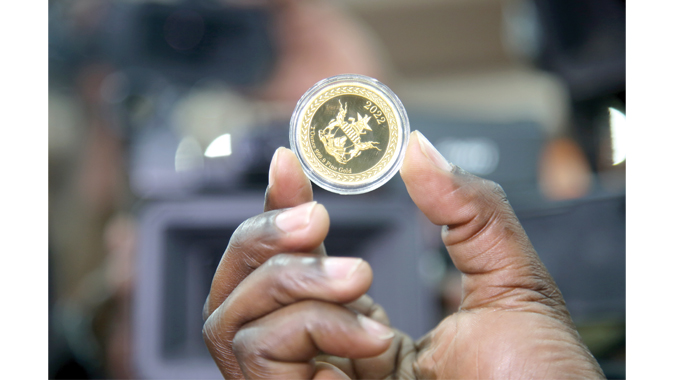
Nqobile Bhebhe, Senior Business Reporter
THE much anticipated Mosi-oa-Tunya gold coins went on sale yesterday with an opening selling price of US$1 823,80 or Z$805 745,35 per coin after their release by the Reserve Bank of Zimbabwe (RBZ).
Two thousand coins went into the market.
The adoption of the Mosi-Oa-Tunya gold coins follows a resolution of the bank’s Monetary Policy Committee (MPC) last month, as a new investment instrument that also doubles up as a store value for local investors.
The coins will be sold using both the local and foreign currency at the prevailing international gold price.
Outlining guidelines for buying the newly- introduced gold coins, the central bank last week said the gold price would be published daily in the morning and based on the previous day’s London Bullion Market Association (LBMA) PM Fix plus the cost of producing the coin.
Yesterday, the coin was selling at 30 753,60 in South African rand, Botswana pula (P23 115,30), British pound (£1 523,89), Australian dollar (AUD2 6405), Euro (€1 788,39) and $805 745,35 in local currency.
Dubbed the Mosi-oa-Tunya, each coin has a unique engraved serial number, weighs one troy ounce, has a purity of 22 carats and weighs 33,93 grammes.
Although several banks in Bulawayo indicated that they are yet to receive allocations for resale, there were people making inquiries on purchasing options.
Local banks are temporarily not allowed to buy the gold coins for their own portfolios until the RBZ decides otherwise in line with developments in the economy.
Banks can only receive the coins from the Reserve Bank for onward selling to their customers on behalf of the apex bank.
Speaking at the launch yesterday, RBZ Governor Dr John Mangudya said the coins would be released on a demand basis
“The bank shall be releasing the Gold coins on a demand basis depending on the needs of the agencies as they see fit in the market and we will be able to supply on a replenish basis,” he said.
“The banks and agencies are supposed to buy for themselves, sell to their customers either companies, individuals or corporations.
” The banks shall proceed to disburse those gold coins to their branches. Sometimes you could go to your bank and find that the branch does not have the coins, this is because there is a certain distribution channel that each bank or agent would use.”
He said the purchases of the gold coins would be in line with the “know your customer” (KYC) principles so that banks and agencies would know who they are selling to.
KYC standards are designed to protect financial institutions against fraud, corruption, money laundering and terrorist financing.
The KYC process serves to protect the controlling financial institution and protect the common good and the economy.
Dr Mangudya added that banks would not be allowed to lend for purposes of purchasing the coins as that would add pressure on the ability of banks to settle their transactions at the Central bank.
“If a commercial bank provides a loan to an individual or company to purchase gold coins, they are endangering themselves because at the end of the day the bank might not necessarily be able to meet their settlement platform at the bank to ensure that they clear their transactions.
“This is because they have other transactions they need to clear with the central bank,”
Zimbabwe has lately been battling high inflation and the introduction of gold coins is expected to provide an alternative to store value besides the most sought-after United States dollar amid rising inflation, which has driven demand for the greenback to hedge inflation.
Annual inflation surged to 191, 6 percent in June this year from 131, 7 percent a month earlier, which has largely been the result of local currency depreciation and the negative impact of the war in Ukraine.
In terms of liquidity and tradability, the coin will have liquid asset status, that is, it will be capable of being easily converted to cash, and will be tradable locally and internationally.
It can also be used as collateral.
The central bank said at the discretion of the holder of the gold coin, the bank or its agents will buy back the gold coins after “a vesting period of 180 days in line with the need to promote a savings culture in the country.”
It has been noted by analysts that price stability is an added advantage of buying gold coins for investment and when compared to other investment options in the market, the price of gold never falls by a significant margin and is rather always stable even during a global financial crisis.
Worldwide people look at gold as an alternative to currency, particularly where the local money is prone to losing value.
Gold is viewed as a real physical asset that tends to maintain its value in the market, which, in turn, proves that buying gold coins is a good investment option. -@nqobilebhebhe



 Online Reporter