Online Reporter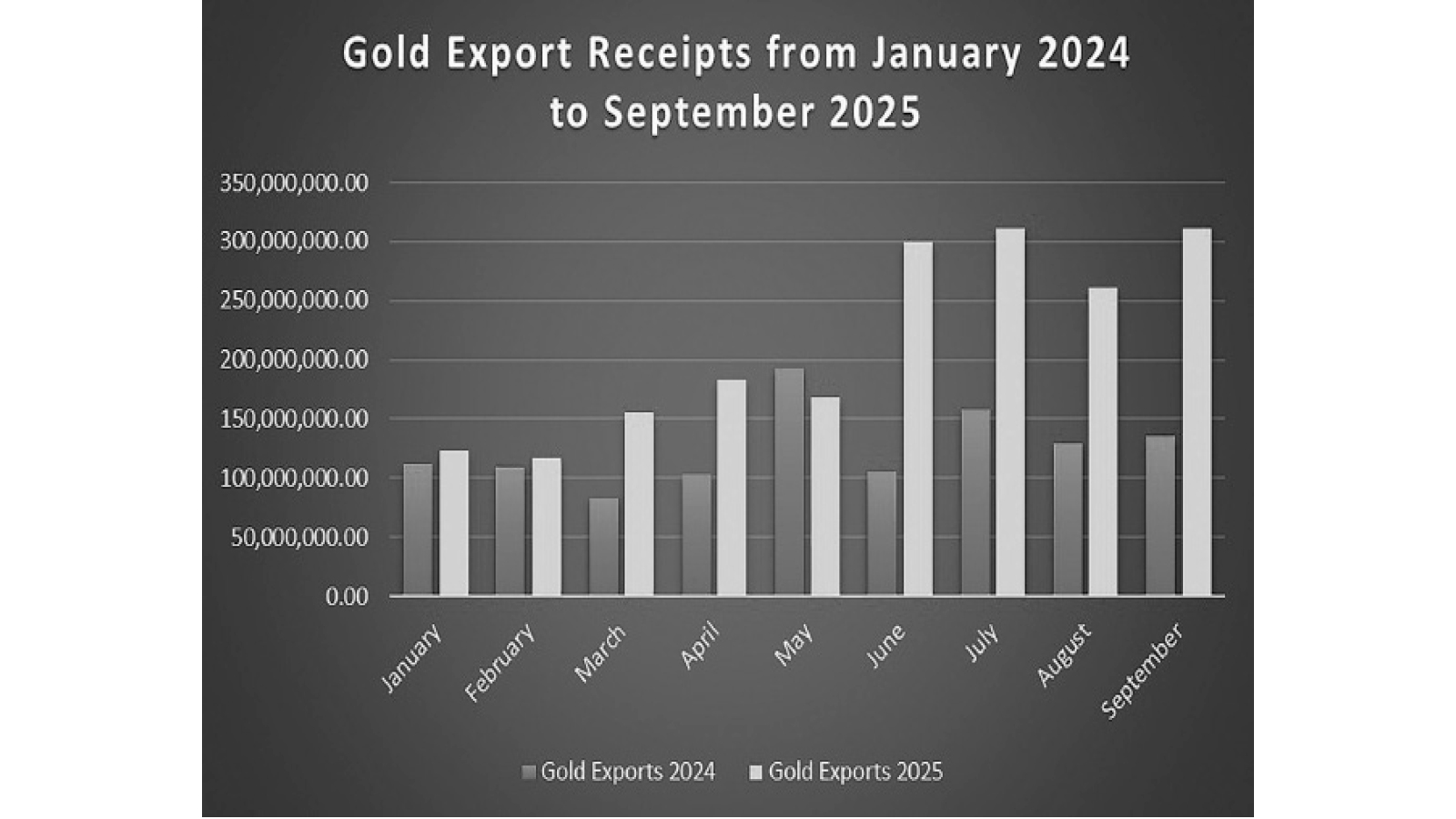
Martin Kadzere
Zimbabwe’s gold exports for the nine months to September 2025 surged 71 percent, according to the latest statistics from the Reserve Bank of Zimbabwe.
From January to September, gold exports reached a staggering US$1,93 billion, a massive jump from the US$1,1 billion recorded over the corresponding period in 2024.
The comparison between the two years shows a consistent upward trajectory, with 2025 figures surpassing 2024 in every month except May.
The months of June, August, and September were particularly strong, each recording an increase of over 100 percent compared to the previous year.
The massive year-on-year growth is largely attributed to a combination of factors.
Initiatives to formalise the artisanal and small-scale mining sector and prompt payment for gold deliveries appear to be paying off.
A significant portion of the growth is being channelled through legitimate export channels, reducing leakages.
Higher production volumes, particularly from the small-scale sector, have contributed substantially to the overall increase in export value.
Latest statistics from the Fidelity Gold Refinery (FGR) show that total gold deliveries for the first nine months of 2025 jumped 37 percent to 32.98 tonnes, compared to 24.02 tonnes in the same period last year.
Small-scale miners delivered 24.45 tonnes of that total through September, a massive 67 percent growth from the 14.6 tonnes produced in the corresponding period of the previous year.
The sector now accounts for nearly 75 percent of the country’s total output, cementing its position as the primary engine of the industry.
In contrast, deliveries from the large miners fell to 8.54 tonnes in the first nine months of 2025, a decline from the 9.55 tonnes produced a year earlier.
The Government’s provision of complementary policies, notably allowing small-scale miners to retain 100 percent of their foreign currency earnings, has been key in supporting and driving the upscaling of the gold sector.
International gold prices have also remained at elevated levels throughout 2025, significantly boosting the value of the exports.
Global demand for the safe-haven asset amidst geopolitical and economic uncertainty has also played a critical role.
Gold’s historic winning streak is projected to continue well into next year, with a Reuters poll of analysts and traders forecasting the annual average price to surpass US$4 000 per ounce for the first time.
The metal’s appeal as the ultimate safe-haven asset remains intact, fuelled by persistent global economic and geopolitical turmoil, which has underpinned its spectacular performance this year.
The median forecast from the Reuters survey places the 2025 average price of gold at US$3 400 per ounce, a significant increase from the US$3 220 predicted in a July poll.
The outlook for 2026 is even more bullish, with analysts projecting prices to average a record-breaking US$4 275, sharply up from the US$3 400 forecast just three months ago.
This reflects growing conviction that the fundamental drivers supporting gold’s value are structural and long-lasting.
Gold’s recent surge, which has seen it gain 54 percent so far this year and clear the US$4 000/oz mark, is rooted in deeply unsettling global dynamics.
Analysts cite an ongoing flight to safety driven by the persistent conflict in Ukraine, new US sanctions against Russia, and trade dispute risks with China that continue to generate uncertainty and drive investors toward the non-sovereign asset.
Elevated global inflation fears, combined with worries over slowing economic growth and high government debt levels — particularly in the US — are eroding confidence in fiat currencies and traditional debt instruments.
A structural shift in reserve management has been a major pillar of support, as central banks, especially in emerging markets, continue their aggressive gold-buying spree to diversify away from the US dollar following events like the freezing of Russian assets.
With prices averaging US$3 281 so far this year and the metal on track for its strongest annual performance since the 1979 oil crisis, the consensus is that the forces driving gold’s rally — uncertainty, de-dollarisation, and central bank demand — will not abate soon, positioning the metal for new record highs.