

 admin
admin
Mutsawashe Mashandure
Herald Correspondent
The Government is committed to creating an environment for harmonious and productive relationships between agricultural workers, employers, and stakeholders through its various legislative and policy interventions, the Minister of Public Service, Labour, and Social Welfare July Moyo said yesterday.
In a speech read on his behalf by the Ministry’s legal advisor, Mr Fredson Mabhena, during the launch of the translation of SI 41 of 2022 held in Harare, Minister July Moyo said job evaluation was formed and it improved the decent work agenda.
“It is noted that there has been an increase in the diversity of jobs in the industry that will now form part of the job grades list, and this shows that farming methods are evolving, and through government support in the form of farm mechanisation, input schemes, and other incentives and support that have been advanced, Zimbabwe is undergoing a new agrarian revolution.
“The job evaluation exercise is therefore timely in that it recognises the evolution that is ongoing in agriculture and the need to have fair remuneration, judged in accordance with objective factors, taking into consideration the nature of the work performed by the employee,” he said.
The minister urged the NEC to continue to improve inclusiveness in the agriculture industry to achieve an empowered, upper-middle-income society by 2030.
“We continue to encourage the NEC Agriculture along a path of innovation towards inclusivity, unity, harmony, and productivity in agriculture so that our agricultural industry will improve prosperous and empowered upper-middle-income society by 2030, ” he said.
Speaking at the same event, NEC Chief Executive Director David Madyausiko said that for the first time in the agriculture industry, they launched the translation of SI 41 of 2022, which seeks to assist in job evaluation.
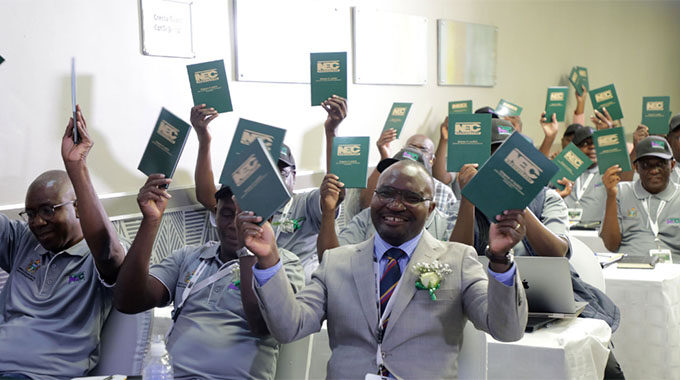
“In 2022, we began this journey with the consultants from Kubasa here, and you will hear a lot more about this journey. In all of 2023, we were busy with the job evaluation, and we are still busy with the job grading, which is a natural consequence of the evaluation.
In the process, we have walked hand in hand with Kubasa to all corners of the country, conducting interviews.
Mr Madyausiko said the translation of collective bargaining agreements into vernacular languages promotes inclusivity and diversity in the agricultural industry and meets the government’s policy towards an upper-middle-income economy by 2030.
“It sends a clear message that all employees and employers are valued and respected regardless of the language that they speak and leaving no one with a linguistics problem that meets the developmental goal vision 2030 of leaving no one and no place behind,” he said.



 Peter Tanyanyiwa
 Online Reporter