admin
admin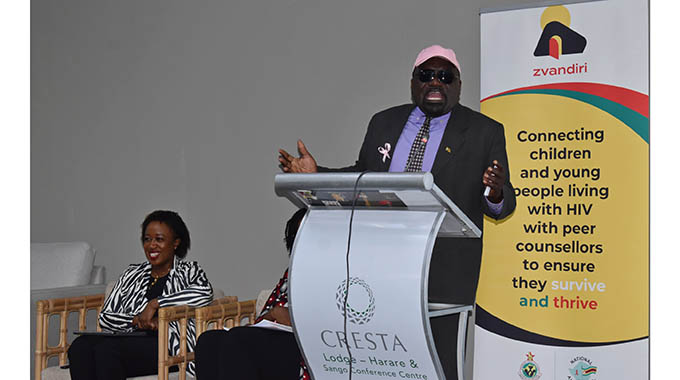
Trust Freddy-Herald Correspondent
The Government has reaffirmed its commitment to eradicate AIDS in children and adolescents by 2030.
This commitment is part of the Global Alliance for Ending AIDS in Children by 2030, launched in 2022 by the World Health Organisation (WHO) and UNICEF.
Speaking during the regional consultation meeting to review progress in scaling peer provider services towards ending AIDS in children and adolescents, Permanent Secretary in the Ministry of Health and Child Care, Dr Aspect Maunganidze who was represented by Harare Provincial Medical Director, Dr Innocent Hove said: “The Global Alliance to End AIDS in Children by 2030 was established to mobilise multi-sectoral stakeholders at global, regional, and national levels to ensure early testing, comprehensive treatment and care, close the treatment gap, prevent new infections, and address rights and gender-related barriers to care.

Speaking during the regional consultation meeting to review progress in scaling peer provider services towards ending AIDS in children and adolescents, Permanent Secretary in the Ministry of Health and Child Care, Dr Aspect Maunganidze who was represented by Harare Provincial Medical Director, Dr Innocent Hove said: “The Global Alliance to End AIDS in Children by 2030 was established to mobilise multi-sectoral stakeholders at global, regional, and national levels to ensure early testing, comprehensive treatment and care, close the treatment gap, prevent new infections, and address rights and gender-related barriers to care.
“Zimbabwe is an active member of this global alliance and is wholeheartedly committed to closing the gaps and ending AIDS in children and adolescents by 2030.”
He also highlighted that globally, 2.4 million children and adolescents living with HIV face stark disparities in healthcare access, particularly regarding the life-saving antiretroviral therapy (ART).
“Adolescents continue to experience the highest rates of treatment attrition, failure, morbidity, and mortality compared to both children and adults,” he said.
“This gap is further exacerbated by mental health challenges such as depression and anxiety, which significantly hinder treatment adherence and contribute to elevated mortality rates.
“It is crucial that we support children and adolescents living with HIV through focused service delivery, age-appropriate resources as well as psychosocial and mental health interventions to achieve positive health outcomes.”
In 2023, an estimated 55 percent of adolescents living with HIV were on ART, compared to 76 percent of adults.
Furthermore, only 48 percent of adolescents on ART achieved viral suppression, in contrast to 79 percent of adults.
The three-day meeting is being attended by several representatives from 14 different African countries, including Ghana, Namibia, South Sudan, Rwanda, South Africa, and Zambia, among others.
The Ministry of Health and Child Care is hosting the meeting in partnership with Zvandiri. Technical support is coming from WHO and UNICEF while financial support is coming from the Mulago Foundation and the ELMA Foundation.


 Online Reporter