Online Reporter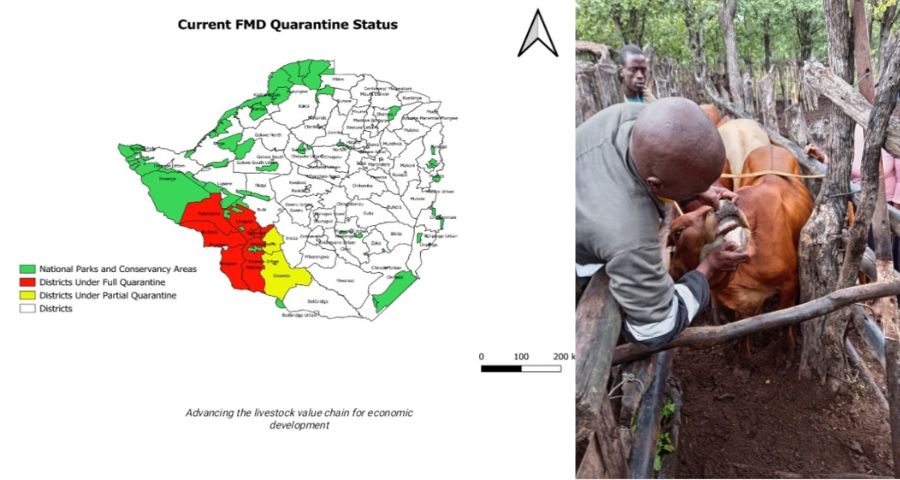
Judith Phiri, [email protected]
THE Government continues to strengthen national Foot and Mouth Disease (FMD) control strategies as part of a broader livestock recovery and growth initiative.
FMD remains one of the most economically damaging livestock diseases in Southern Africa, with outbreaks capable of affecting cattle productivity, farmer incomes and export opportunities.
In Zimbabwe, vaccination campaigns are underway, with 1.2 million FMD vaccine doses secured, alongside movement restrictions and quarantine measures in affected hotspot areas. These interventions come at a critical time as the country seeks to grow its national herd from 5.7 million recorded by late 2025 to 12 million by 2034.
Speaking at the recent second edition of the Zimbabwe International Trade Fair (ZITF) Company Livestock Conference in Bulawayo, Chief Director for the Directorate of Veterinary Services (DVS) in the Ministry of Lands, Agriculture, Fisheries, Water and Rural Development, Dr Pious Makaya, said four FMD-infected districts with a combined census of 316 000 cattle are under quarantine and excluded from local, regional and international trade in live animals and their products.
“These districts include Mangwe, Bulilima, Matobo and Tsholotsho. To minimise the impact, the measures currently in place include movement restrictions, including roadblocks, control and prophylactic vaccinations.
“As well as cattle/buffalo separation, construction of FMD control fences, relocation of buffaloes from insecure properties, while awareness and training on biosecurity for beef value chain players are also being rolled out,” he said.
He said the FMD Control Steering Committee, a multi-stakeholder body, has been established to synchronise efforts between DVS, the Zimbabwe Republic Police (ZRP) and local authorities.
Dr Makaya said intensified patrols and community-based surveillance are being conducted to intercept illegal night movements that bypass veterinary checkpoints and roadblocks.
On mitigating the wildlife-livestock-human interface, he noted that buffalo-to-cattle contact remains the primary driver of FMD outbreaks in Zimbabwe.
“Completion of the Gonarezhou National Park FMD game fence; planning and resource mobilisation are underway for the Hwange National Park FMD control fence,” he added.
“The FMD vaccination programme is ongoing in the zones adjacent to the Red Zones along national parks and conservancies. Ring vaccinations are 10 to 20 kilometres (km) around laboratory-confirmed infected areas, depending on the landscape of the area to be vaccinated.”
He said the Botswana Vaccine Institute (BVI) is currently the main FMD vaccine producer and supplier in the SADC region, while the recent launch of a new FMD vaccine in South Africa is expected to strengthen disease control efforts across the region.
BIOAFTOGEN FMD vaccine, produced by Argentine biotechnology firm Biogenesis Bagó, has already supplied one million doses to South Africa and is delivering additional quantities to meet rising demand.
Dr Makaya said it is critical to diversify vaccine procurement by engaging multiple suppliers to ensure quality, safety and competitive pricing.
“Establishing supply chains with Biogénesis Bagó (Argentina) and other international manufacturers is important to guarantee a consistent strategic vaccine supply,” he said.
“The buffalo is in the SADC region to stay because it is also an important tourism commodity bringing revenue to the region. The proposed strategies for facilitating trade while living with the buffalo include zoning the country (Red, Vaccination, Protection and Green Zones) and acquiring FMD freedom with vaccination (NSP ELISA Differentiation/DIVA Test), among others.”
Zimbabwe’s livestock sector is valued at over US$2 billion, contributing about 20 percent to the agricultural gross domestic product (GDP).
Ends