Online Reporter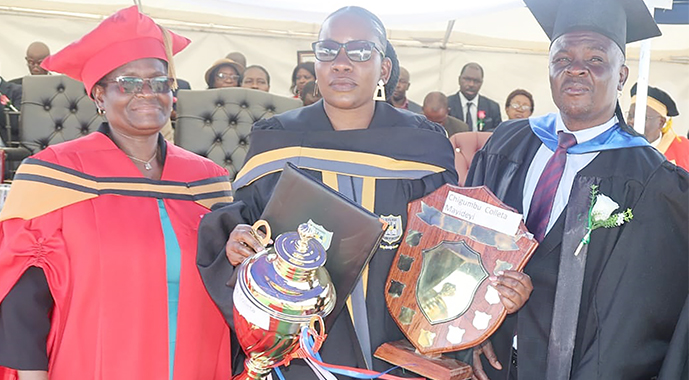
Fairness Moyana in Hwange
A TOTAL of 326 Nambya and Tonga teachers have been trained at Hwange College of Education in Matabeleland North Province as Government steps up efforts to strengthen the teaching and preservation of indigenous languages across Zimbabwe.
The development comes as the Ministry of Higher and Tertiary Education, Innovation, Science and Technology Development has directed teacher training colleges to waive
Mathematics entry requirements for secondary school teacher trainees specialising in indigenous languages. The move is aimed at addressing the shortage of teachers qualified to teach local languages.
The directive was announced by the Minister of Higher and Tertiary Education, Innovation, Science and Technology Development, Dr Fredrick Shava, during the fourth graduation ceremony of Hwange College of Education on Tuesday.
In a speech read on his behalf by Deputy Minister Simelisizwe Sibanda, Dr Shava said the decision forms part of Government efforts to strengthen indigenous language education and ensure communities have adequate access to teachers trained in local languages.
The announcement comes as Hwange College of Education continues to play a key role in developing teachers specialising in ChiNambya and ChiTonga. To date, the institution has trained 137 ChiNambya teachers and 189 ChiTonga teachers.
Dr Shava said the college’s mandate to produce teachers proficient in the two languages remains critical in addressing shortages of mother-tongue instruction, particularly at infant education level. He said the ministry had moved to remove barriers that could discourage prospective indigenous-language teachers from entering the profession.
“The ministry has directed that colleges waive the demand for Mathematics for secondary school teachers specialising in indigenous languages,” said Dr Shava.
He said the policy would ensure that talented students with a passion and aptitude for indigenous languages are not locked out of teacher training opportunities because they do not meet Mathematics requirements.
According to the minister, the initiative will also contribute towards culturally responsive education while helping preserve Zimbabwe’s rich linguistic heritage.
“Government has always been clear that the establishment of the college was largely
motivated by the need to produce teachers competent in teaching ChiNambya and
ChiTonga as part of efforts towards culturally responsive instruction,” he said.
Dr Shava said the measure would make it easier to integrate indigenous languages into the education system while helping to address the long-standing shortage of mother-tongue teachers.
He challenged the graduates to use their training to advance the Government’s Education 5.0 agenda, which seeks to integrate teaching, research, innovation, community service and industrialisation.
“Education 5.0 is not just a strategic imperative; it is a national priority whose aim is to arm our young people with the qualities that shall enable them to exploit entrepreneurial opportunities along the education value chain,” he said.
He urged teachers to become active participants in entrepreneurship and industrialisation rather than merely teaching the concepts in the classroom.
Dr Shava also encouraged the graduates to work closely with researchers in developing learning materials in indigenous languages, an area he said remains underdeveloped.
“Whenever you think of research and innovation, your goal should be the production of goods and services that solve community problems in real time,” he said.
The minister further encouraged students to embrace artificial intelligence (AI) as an educational tool, while cautioning against its misuse as a substitute for original work and critical thinking.
Dr Shava also expressed concern over the gender imbalance among teacher trainees, with women accounting for 117 of the 143 graduates who received qualifications during the ceremony.
He said the shortage of male teachers could have implications for schools, including limiting the availability of positive male role models for young boys. Since its establishment in 2019, Hwange College of Education has enrolled 1 216 students, with 535 having graduated.
The institution currently has an enrolment of 659 students, comprising 114 males and 535 females.
Meanwhile, college principal Mr Royal Ntini said the institution was contributing to rural industrialisation through the adoption of Magole Village, where it is providing free bridging courses in English and Mathematics to 13 youths.
As part of its Education 5.0 and rural industrialisation drive, the college also plans to establish a wire-mesh production project in partnership with the community.
In addition, the institution has established income-generating projects in garment manufacturing, catering and poultry production, while investing in Starlink internet connectivity to enhance research, innovation and digital learning opportunities.