Online Reporter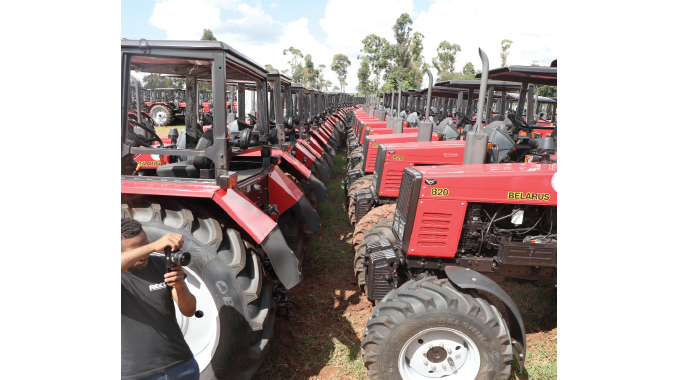
Theseus Shambare
Herald Correspondent
GOVERNMENT has unveiled a new agricultural mechanisation drive aimed at increasing production, improving productivity and strengthening national food security through easier farmer access to equipment financing facilities.
The programme targets smallholder, medium-scale and large-scale farmers, allowing beneficiaries to acquire tractors, attachments and other machinery through structured payment plans supported by financial institutions.
Unpacking of the ministry’s mechanisation facilities in Hatcliffe recently, Director in the Department of Agricultural Engineering, Mechanisation and Farm Infrastructure Development, Engineer Nhlanhla Magama said the initiative was designed to meet the diverse operational needs of farmers across the country.
He said facilities available included the Bain New Holland Mechanisation Facility, Belarus Facility, Zoomlion Facility and John Deere Facility.
“These facilities are meant to benefit farmers at different levels, from smallholder farmers to medium-scale and large-scale producers, through access to mechanisation services,” said Eng Magama.
The latest push comes as Zimbabwe’s main mechanisation facilities are now estimated to represent cumulative investments of more than US$350 million, underlining the Government’s drive to modernise agriculture and improve productivity.
Among the largest interventions is the Belarus mechanisation programme, whose third phase is valued at US$169 million and is expected to deliver more than 3 000 tractors and combine harvesters.
The second Belarus phase, worth US$66 million, brought in 1 635 tractors and 16 combine harvesters, while the first phase, valued at US$51 million, delivered 474 tractors, 60 combine harvesters and 210 planters.
Government’s John Deere Facility, valued at US$51 million, has also expanded access to equipment, with 1 300 tractors, 80 combine harvesters and 600 planters.
The Bain New Holland Facility, worth US$20 million, introduced high-performance tractors, ploughs and disc harrows, while local manufacturing has been boosted through a US$6 million facility producing disc harrows, ploughs, ridgers and boom sprayers.
Eng Magama said the Government was also preparing to launch a dedicated smallholder mechanisation package after beginning to receive equipment under the facility.
“The smallholder mechanisation facility will come as a package comprising a tractor and associated attachments,” he said.
To access the equipment, farmers are required to approach participating financial institutions, which will assess applications and conduct due diligence.
Institutions working with the Government under the programme include AFC Land Bank, CBZ, ZB Bank, Women’s Bank, Empower Bank, POSB and SMEDCO.
Successful applicants will pay a 15 percent deposit, while the equipment itself will serve as collateral, removing the need for additional security.
“These pieces of equipment will be paid for over three years, and instalments will not be monthly. Farmers are expected to pay seasonally because we recognise that their incomes are seasonal,” said Eng Magama.
He said the tailor-made repayment model was intended to make mechanisation more accessible and sustainable for farmers.
The Government also expects to launch another facility focusing on post-harvest equipment such as multi-crop threshers, oil expressers and chopper grinders to enhance value addition before produce reaches the market.
Looking ahead, authorities have identified strategic long-term investments that include an estimated US$81 million tractor assembly plant and a US$101 million plan for provincial mechanisation centres to improve servicing and maintenance.
Officials estimate Zimbabwe still requires about 32 000 additional tractors, with roughly US$544 million needed to fully close the national mechanisation gap.
Eng Magama said improved mechanisation remained central to the country’s fight against food insecurity.
“We expect the nation to be food secure through these mechanisation facilities,” he said.