

 admin
admin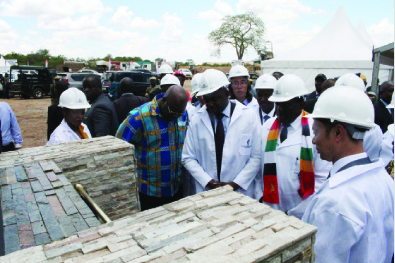
Samuel Kadungure
Senior Reporter
GOVERNMENT will use the Buhera lithium project model as a template to put good corporate citizenship at the centre of mining projects and correct past cases where some mining companies in Manicaland failed to promote tangible socio-economic development in areas they operated in.
Officiating at the groundbreaking ceremony of the Sabi Star Mine lithium project in Buhera on Wednesday, President Mnangagwa said some communities in the province resemble a case of poverty amidst plenty as companies that were awarded mining rights are superrich, while the people remain poor.
President Mnangagwa said there is no meaningful benefit or development the communities are realising from mining activities in their respective areas, and instead they are at the receiving end of negative impacts of mining like land degradation, water, air and noise pollution as well as sexual harassment and exploitation.
That these communities’ social service delivery and economic development remain shattered dreams is an affront to constitutional and legal instruments which provide for revenue sharing and community benefit sharing of proceeds from mining companies.
As a result, the miners are at loggerheads with grassroots communities demanding and claiming their environmental, economic, social, and cultural interests and rights, prompting Government to take corrective measures henceforth.
The US$130 million lithium project, with 55 claims straddling 3 800 hectares acquired in September 2021, is currently employing 600 locals and built 40 modern three-bedroomed houses for 40 families affected by its operations.
Though the mining company has not yet generated revenue from the lithium project, it rehabilitated a 32km road from Gaza Township to the mine, drilled 20 solar-powered boreholes for 10 schools and the communities.
Max Mind (Zimbabwe) Pvt Ltd has so far injected more than US$22 million, and by July 2023 it would have sunk another $108 million into the project, a feat that apart from improving both the district and provincial Gross Domestic Products, will also generate the much-needed foreign currency as well as feed into the Mine to EnergyPower Park in Mapinga.
President Mnangagwa said the project will set the country on an irreversible path of economic growth and development and should be emulated by other mining concerns.
President Mnangagwa said communities must benefit from their God-given resources.
“Gone are the days when communities merely bear the brunt and endure the sorry state of environmental degradation as a result of mining activities. I know some areas here in Manicaland suffered as a result of mining which did not benefit the community. We are addressing this. So let us all be responsible corporate citizens and guarantee a holistic development that leaves no one and no place behind,” he said.
The President said the mining companies should abide by the bio-physical environment, corporate and social responsibility frameworks to sustainably improve the life and social infrastructure of the surrounding communities.
The mining company built 22 housing units at Murambinda, 17 other housing units in the adjacent villages, and one unit in Mberengwa, where the affected family opted to be relocated, at a cost of US$1,2 million.
The affected families got a monetary compensation of US$1 900 upon taking occupation of their new houses, and will get US$150 for six months.
“I am happy that before the company has begun making money here, they are already improving the infrastructure in this area. They have upgraded the 30km earth road to this mine; built the state-of-the-art homes for families relocated from the mining area and are in the process of building a clinic for the people around this area. They will support schools in this area and that is commendable,” said President Mnangagwa.
Minister of State for Manicaland Provincial Affairs and Devolution, Honourable Nokhutula Matsikenyere said the mining project will ameliorate the economic growth of Manicaland, given its multiplier impacts of foreign currency generation through exports, employment creation and contribution to fiscal revenues.
Mines and Mining Development Minister, Honourable Winston Chitando said at its peak, the mine will produce 300 000 tonnes of lithium concentrate per year, with an annual turnover above US$1 billion.
Max Mind (Zimbabwe) Pvt Ltd project manager, Mr Elfas Mugova said they have already demonstrated commitment to uplift the local social infrastructure and economy in the district.
Mr Mugova said plans are at an advanced stage to operate a 15-Megawatt thermal power plant to provide power to its operations and local communities.
“The optimal power to run operations at Sabi Star is only 12MW and the excess 3MW will be channelled to the local grid to power local communities. Max Mind has not started generating revenue at Sabi Star Mine, but as a good corporate citizen we have seen it prudent to start social responsibility projects in consultation with the local communities and stakeholders. These include water, sanitation and health in the Mkwasi and Tagarira villages.
“Max Mind has also availed scholarships for Zimbabwean students to study in China and some of the products of this initiative are already employed at this mine,” he said, adding that the mine will also procure local products fitting in their beneficiation process.
“We will not only empower communities, but live in harmony with them, respecting their beliefs and cultures. As we did in our relocation plan, our corporate social responsibility will be participant driven. We will do what our local communities require us most to do. We will undertake projects that will result in perpetual sustainability for the local communities. The lithium we are mining here is a gift from God, and it is our duty to ensure that the benefits are enjoyed by every Zimbabwean,” he said.
Chief Nyashanu said they are co-existing with the mining company.
“I want to thank them for bringing socio-economic development to my area. We are working together with the company as local stakeholders and all decisions arrived at were through consensus.
“About 40 families were affected by the mining operations and were relocated through consensus. Nobody was forced out. We sat down with them to appreciate the nature of the investment and the company agreed to build standard houses for them. It is true that those who were relocated now have beautiful houses at Murambinda and in the villages for those who opted to maintain their communal links. They also built a three-bedroomed house for me at Murambinda, and together with my subjects, we are grateful,” said Chief Nyashanu.
The Dera family, which has for years been eking out a living through subsistence farming had its life transformed, thanks to the mining project.
“We are happy to be leading a modern lifestyle in Murambinda. We had a communal homestead that we shared as a family, but following the relocation, my two adult sons and their families were also allocated their own houses. We are no longer occupying one family house. My husband now works as a security officer at the mine alongside our eldest son who now works as a geologist’s assistant,” said Mrs Dera.


 Online Reporter