Online Reporter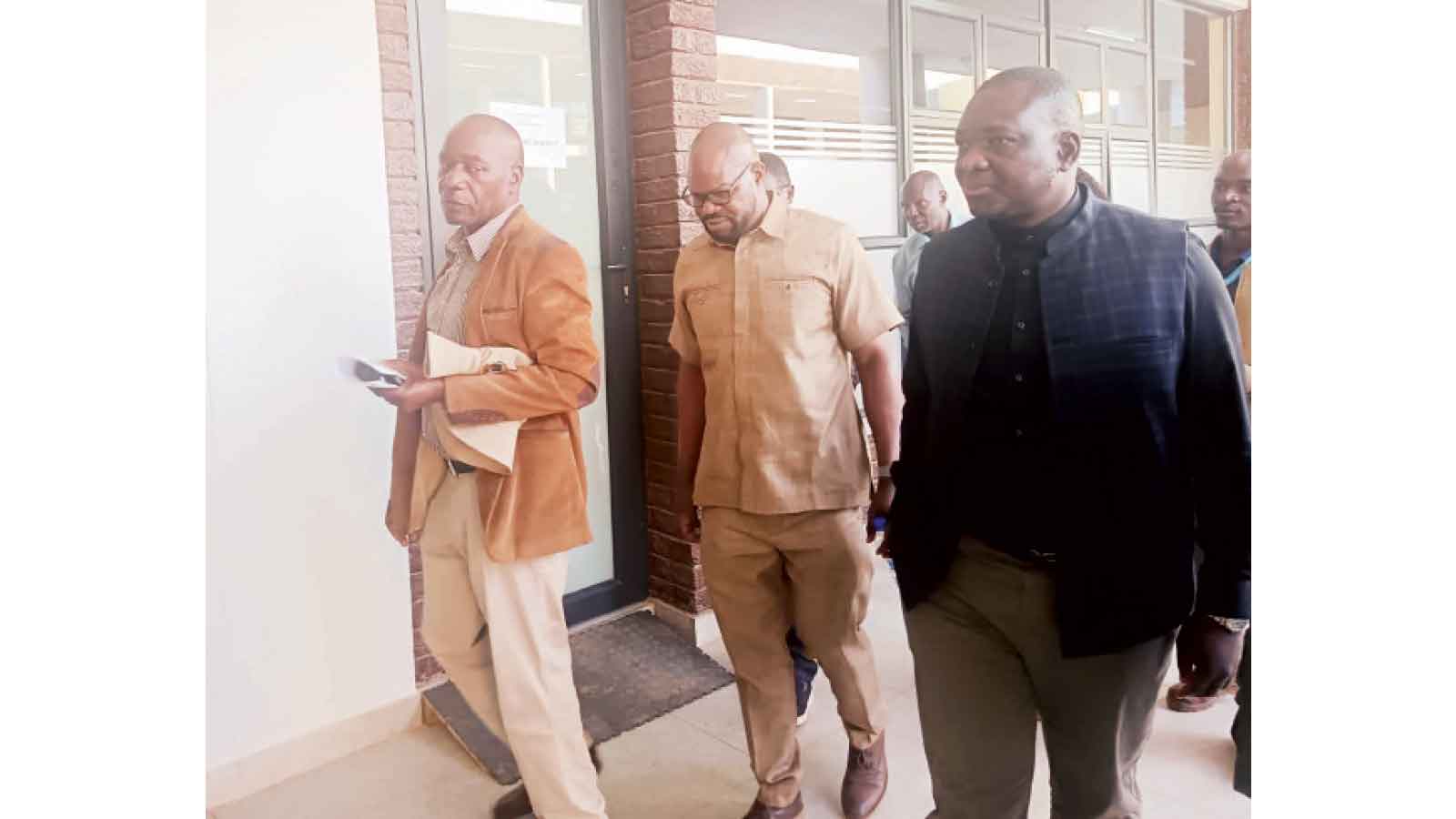
Patrick Chitumba recently in Kwekwe
The Government has said the expansion of university infrastructure should be matched by increased student intake rather than controlled higher education enrolment.
Minister of Information, Publicity and Broadcasting Services, Dr Zhemu Soda, said this as he emphasised Government’s heavy investment in expanding university infrastructure to drive a research and knowledge-driven economic growth in line with the country’s re-industrialisation agenda and Vision 2030.
He was speaking after a recent tour of the Midlands State University Emmerson Dambudzo Mnangagwa Law School Campus in Kwekwe, where he was told that during this semester alone, more than 1 000 prospective law students had applied, but only 100 were enrolled.
The university said enrolment figures are regulated by the Law Society of Zimbabwe.
“The Government is aiming at breaking the practice of self-serving by bodies such as the Law Society of Zimbabwe and the Institute of Chartered Accountants of Zimbabwe so that institutions like MSU can absorb more students,” said Dr Soda.
“The practice is self-serving by lawyers. Government is expanding facilities to break the self-serving practice. There are some restrictions they have put in place. It’s something that must be broken. We cannot have a facility that can absorb 1 000 students taking only 100.
“It’s something we have to look at further. The expansion has to have a corresponding increase in student intake,” said the minister.
Kwekwe campus director, Dr Gilbert Tarugarira, said the dream to establish MSU Law School was mooted in 2015, with President Mnangagwa chairing the founding planning committee alongside the late national heroes Cdes Cephas Msipa and Richard Hove.
“The dream started in 2015. There is a history behind this university, from the mooting of the idea to mobilising resources to have this institution. Now we have the Emmerson Dambudzo Mnangagwa Law School as part of the institution.”
He said naming the institution in honour of President Mnangagwa was in recognition of his leadership, vision and contribution to the growth of the law sector.
“We want to inspire the young so that they can become lawyers,” he said.
Dr Tarugarira said the Government has been the major funder of the campus, releasing ZiG262 million for the completion of structures.
“This has been done by MSU on its own. We did the construction, which is almost complete. We are still fixing one or two things here and there. We’ve obtained the certificate of occupancy. Now the facility is occupied and we’re attending to certain inadequacies,” he said.
Dr Tarugarira said the campus houses the Faculties of Law and Agriculture, with plans to introduce a third — the Faculty of Built Environment, Art and Design.
He said the completion of the campus has transformed Kwekwe through booming business in accommodation, transport and retail.
“A lot of innovation is coming through. The completion of Kwekwe Campus has changed the face of the town. New buildings are coming up. Businesses are flourishing,” he said.
The campus is also driving agriculture and innovation through projects including mushroom production, cannabis research, a piggery project, and research into declining cotton production and development of seed varieties suitable for the Midlands.
“We’ve received more than 1 000 applications from law students and not all of them can be absorbed. Only 100 were enrolled.
“In terms of the number we can enrol”, it is regulated by the Law Society of Zimbabwe. We have about 400 here and around 300 on attachment,” he said.
Dr Tarugarira said the decentralisation agenda is bringing education closer to communities that previously had limited access.
In a significant boost for the sector, the MSU Faculty of Law relocated from the main campus in Gweru to the new Kwekwe facility.
All law lectures, tutorials and administrative operations have now moved to the campus as the 2026 academic semester resumed on Monday.
The Emmerson Dambudzo Mnangagwa Law School is emerging as a centre for academic collaboration and legal education as Zimbabwe rolls out modern education infrastructure under the Heritage-Based Education 5.0 Model, which continues to draw regional attention.
The campus, named after President Mnangagwa, was constructed to expand capacity and provide modern teaching infrastructure for law students. Construction began in 2023.
The self-contained, double-storey campus will feature lecture rooms, moot courts, a library, hostels, a kitchen, a hospital and staff quarters, among other essential facilities.
President Mnangagwa officially commissioned the new campus last year in a historic ceremony that marked the first time the university had held a graduation ceremony outside its main campus in Gweru.
Situated on a 220-hectare site along the Old Gokwe Road in Kwekwe, the new Law School will serve as a hub for legal excellence, with capacity to accommodate 600 students.
The institution is expected to play a vital role in achieving Vision 2030 by equipping students with cutting-edge knowledge and skills to drive national development.
The tour was part of the Ministry of Information, Publicity and Broadcasting Services’ assessment of Midlands Province development projects.