admin
admin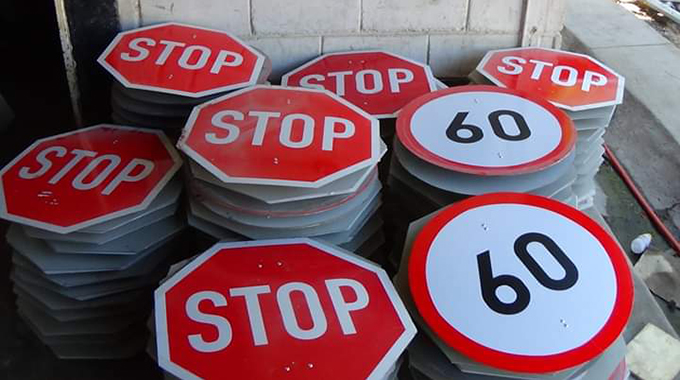
Freeman Razemba Senior Reporter
Government is in the process of installing new road signs in some of the roads that have so far been rehabilitated under the Emergency Road Rehabilitation Programme Phase 2 (ERRP2) in line with Sadc protocols.
The road signs in the SADC region make it easy for drivers to also navigate across neighbouring countries. In 2017, Government upgraded the Highway Code as part of a new road traffic system. The new Highway Code introduced Sadc road traffic signs and dual markings.
In an interview, Transport and Infrastructural Development Minister Felix Mhona confirmed the developments and said they will make sure that all road signage countrywide are in tandem with the dictates of the region.
“As soon as we rehabilitate a road, we then put signage that are in tandem with the dictates of the Sadc region, in terms of that signage that we would want to see within the Sadc region.
“And a good example is the Harare-Beitbridge Road where we have rehabilitated it and if you go through it you can actually see that the signage is now in compliance with the Sadc requirements,” he said.
Government has so far spent over $1 billion on road rehabilitation, gravelling and drainage structuring as part of the Second Republic’s ERRP2 launched by President Mnangagwa early this year.
Road construction falls under the infrastructure cluster and roads are regarded as key economic enablers in line with the vision of attaining an upper-middle-income society by 2030.
Government has since revived road maintenance units countrywide to ensure consistent monitoring and maintenance of all roads rehabilitated.
In 2017, Traffic Safety Council of Zimbabwe (TSCZ) spokesperson Mr Ernest Muchena was quoted saying the updated Highway Code was aimed at taming road carnage and would replace the old Highway Code developed in the early 1970s.
This came after Sadc countries had agreed that it would be better to have uniform signage in the region, as they acknowledge the fact that there were a lot of people who do enter the country driving.
The country officially adopted the new road signs on April 8, 2016. The Sadc signs are more pictorial than the use of words and are also aimed at reducing road carnage. In the upgraded version, they are also specific rules for different road users and these include pedestrians, pedal cyclists and drivers of heavy vehicles.
There is information for each road user, including animal-drawn vehicles, so that people understand. Carriage markings were also to be redesigned to match those in other countries in the region.
A notable inclusion in the new Highway Code is the four-way stop system. It is said to be safer than traditional stop signs or signal-controlled intersections. A four-way stop, also known as an all-way stop, is an intersection system where traffic approaching from any direction is required to stop at all times before proceeding through the intersection.
The first motorist to arrive at the intersection is the first to move. Four-way stop signs are widely used in countries such as the United States, Canada, Sweden, South Africa and Namibia.


 Online Reporter