

 admin
admin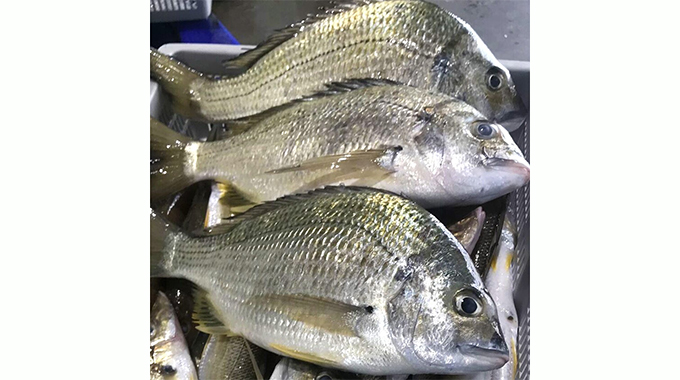
Precious Manomano
THE Government is pulling out all stops to ensure the fish farming industry grows to contribute effectively to the national agenda of boosting food and nutrition security and income generation in line with the Fisheries and Aquaculture Development Strategy.
The introduction of community gardens that accommodate two fish ponds and the various dam projects currently underway across the country has given birth to many fish hotspots that have the potential to turn commercial and generate incomes for the participating households.
This has seen the Government increasing the number of fish ponds by 29 percent from 5 634 fish ponds in 2022 to 7 247 this year.
According to the Crop, Livestock and Fisheries Assessment report for the 2020/23 summer season (pre-harvest) that was released by Ministry of Lands, Agriculture, Fisheries, Water and Rural Development, fish farming is dominated by Nile Tilapia at 98 percent followed by Rainbow Trout at 1, 1 percent while the other farmed species contribute a very small proportion of the production levels.
“There has been a decrease in production in the commonly farmed species in aquaculture. Nile Tilapia production dropped by 15 percent and this is mainly due to Lake Harvest, the main fish producer in the country, which reduced its production levels. Mashonaland West had the highest number (64 percent) of fish ponds constructed, followed by Matabeleland South at 49 percent. There is a steady increase in the number of fish ponds from 2020 to 2022,” said the Ministry.
The report further indicated that 69 percent of most small-scale fish farmers are in the communal sector and three percent in large-scale category.
A total of 16 million fingerlings were produced in 2022 and Nile Tilapia fingerlings have the highest production compared to other breeds.
This is because of all commercial hatcheries breeding Nile Tilapia.
It is also reported that most farmers source their fingerlings from local fish farmers leading to the recycling of genetics which can result in inbreeding, loss of hybrid vigour and stunted growths.
The Ministry also noted that small-scale farmers in most provinces still have difficulty acquiring fingerlings from reputable breeders, as these are in Kariba and Bindura.
Mozambique and Red breasted breams are mainly bred at ZimParks and research institutions for conservation purposes.
Fish farming is the fastest growing food producing sector and can be produced more efficiently and cost effectively.
The Presidential Fisheries Programme is set to be introduced in 1 200 dams across the country with 50 000 fingerlings set to be released into each dam by 2025.
Last year Zimbabwe produced 5049 tonnes of fish compared to 5901 produced in 2021, a decrease of 14 percent.
Fish species that are currently produced include Nile Tilapia, Red breasted bream, African catfish and Rainbow trout.
Statistics also indicate that Kapenta production increased from 5 333 tonnes in 2020 to 5 950 in 2021.
A total of 16 293 204 fingerlings were produced in 2022.
Breams are the most farmed fish species at 90 percent, followed by Trout at seven percent and Catfish three percent.
Nile Tilapia production decreased by 14 percent from 5 803 tonnes in 2021 to 4 948 tonnes in 2022.
Trout production decreased by 20 percent from 44 tonnes in 2021 to 35 tonnes in 2022 and Catfish production increased by 22percent from 46 tonnes in 2021 to 56 tonnes in 2022.
Recently, Deputy Minister of Lands, Agriculture, Fisheries, Water and Rural Development Davis Marapira said participation in fish production led to the development of the country through exports of produce to SADC regional markets and other countries thereby increasing incomes.
He said more fish ponds would be set up to support people’s livelihoods adding that Manicaland was doing well in fish production.
Aquaculture can be a turning point in Zimbabwe’s economic growth through creation of employment for youths. Government’s move is in line with vision 2030 working towards an upper-middle income economy by 2030, following the successful completion of the fast track Land Reform Programme.



 Online Reporter