admin
admin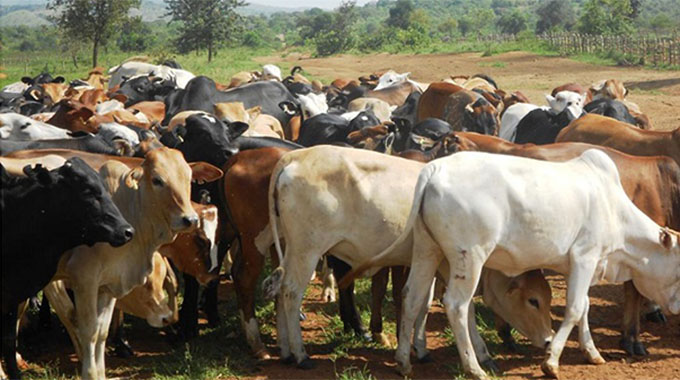
Precious Manomano
Herald Reporter
The Government has rolled out a livestock feeding programme that is accompanied by enhanced surveillance and provision of water to ensure the country’s 5 718 523 cattle herd survives the drought.
This also comes at a time when the private sector is importing 400 000 tonnes of grain that will go towards stock feed.
At the same time, Government is constructing over 1 600 water troughs in an equal number of rural wards to alleviate the effects of the El Nino-induced drought.
Already Government has secured 2,2 million hay bales with private players chipping in with 1,5 million.
About five million hay bales are expected to be produced this season to feed livestock, while water is also being distributed in areas where animals are vulnerable.
Across the country, over 1 000 dip tanks are being rehabilitated to ensure that diseases are kept at bay.
According to the Crop, Livestock and Fisheries Assessment Report 2 (CLAFA), 9 941 cattle have succumbed to drought countrywide.
The report also indicates that fair grazing and adequate drinking water will be available for up to nine months in good areas and three months in the worst hit areas.
According to the report, about 47 percent of the rural wards will face grazing shortages starting this month and 76 percent of the wards will face water challenges for livestock use, putting 2 million cattle at risk.
This means about 35 percent of the livestock face starvation, while the rest of the national herd is affected by poor nutrition.
Statistics from the Ministry of Lands, Agriculture, Fisheries Water and Rural Development indicate that Masvingo has the highest number of the national herd of 995 069 followed by Midlands with 971 244, Matabeleland North has 726 786, Mashonaland East has 679 586, Matabeleland South has 689 654, Manicaland has 643 954, Mashonaland West has 538 456 and Mashonaland Central has 473 774.
About 1 164 350 beef herds in Matabeleland North, Matabeleland South, Midlands and Masvingo provinces require 5,6 million hay bales from this month to November.
The animals will be given 15kg of hay each together with other sources of food such as grazing and survival meals.
A wide range of strategies will be used and some animals will be relocated to relief grazing areas.
As part of the drought mitigation measures, Government has suspended 15 percent VAT on abattoir slaughters to encourage formal selling and firming of prices.
Government has also decentralised livestock marketing to ward feedlots and 8 899 tonnes of maize unfit for human consumption at GMB was used as stock feed.
It has also embarked on a nationwide borehole drilling programme to save both livestock and people.
Drought conditions can cause a variety of problems such as poor nutrition, increased parasites hence vaccinations are also important in drought periods.
Recently, Deputy Minister of Lands, Agriculture, Fisheries, Water and Rural Development Vangelis Haritatos said there is a need to develop a drought mitigation strategy to prevent livestock losses adding that preparations to capacitate Village Business Units (VBU) to hold livestock sales are underway.
Zimbabwe is faced with the worst drought in 40 years.



 Online Reporter