Chronicle Editor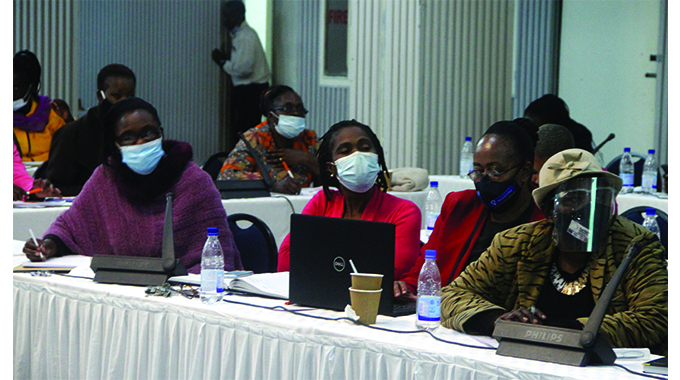
Yvonne Ncube, Chronicle Reporter
REPRESENTATIVES of various arms of the Government yesterday, met in Bulawayo to discuss ways to provide permanent penalties and remedies for sexual harassment.
Held at a local hotel, the meeting- which is part of countrywide consultations- was hosted by the Ministry of Women Affairs, Community, Small and Medium Enterprises Development.
The objective of the consultations is to gather the views of stakeholders on the Principles of the Sexual Harassment Bill and the Gender Equality Bill. The inputs from the consultative workshops will then inform the principles for the two bills.
Zimbabwe is a signatory to a number of regional and international instruments that seek to promote gender equality and eliminate all practices that discriminate against women and girls.
However, delegates noted that gaps still exist in realising gender equality such that de-facto equality still remains rhetoric hence the need for comprehensive legislation on gender equality.
Delegates noted with concern that legislation has failed to adequately address the issues of sexual harassment and gender equality hence the need for commitment to ending gender -based violence and all harmful practices that continue to impede the realisation of gender equality.
Issues of sexual harassment are enshrined in different pieces of legislation in particular the Labour Act, the Domestic Violence Act, the Criminal Law (Codification and Reform) Act and Statutory Instrument 1 of 2000.
However, these provisions have not comprehensively addressed issues of sexual harassment.
Therefore, a comprehensive sexual harassment legislation is required to cover all forms of sexual harassment in the workplace, tertiary institutions, public spaces and sexual in private/domestic settings.
In her opening remarks the ministry’s Director Legal Services Miss Fungai Chiware said after the repeal of the Sexual Offences Act and enactment of the Criminal Law (Codification and Reform) Act, sexual harassment has still remained a serious challenge as it is not clearly defined in the existing laws.
“Issues of sexual harassment are currently enshrined in different pieces of legislation in particular the Labour Act, the Domestic Violence Act, the Criminal Law [Codification and Reform] Act and Statutory Instrument 1 of 2000 Public Service Regulations.
“However, these provisions have not comprehensively addressed issues of sexual harassment. It might be prudent to strengthen the existing legislation or to enact a comprehensive piece of legislation which covers all forms of sexual harassment,” she said.
Miss Chiware said adequate laws need to be put in place to address gender inequalities to cover all gaps in the campaign for equality.
“Adequate laws need to be put in place in addressing gender -based inequalities. If these laws are adequate why are there more men in decision making than women?” she asked rhetorically.
Miss Chiware said the process of coming up with the two proposed bills is a commitment to end sexual and gender-based violence and eliminate all forms of discrimination against women as enshrined in the international and regional protocols on gender.
She said consultations are an integral part of the law-making process in Zimbabwe. To come up with sound principles that are acceptable to the generality of the population, it is imperative that wider consultations be made with various stakeholders to solicit their views on the subject matter.
“Public participation is the cornerstone of sound, democratic decision making, improved policy development, increased Government responsiveness, and strengthening of citizen trust in public institutions. It ensures Government’s commitment to the promotion of gender equality and removal of all barriers which impede this goal. As the Ministry of Women Affairs, Community Small and Medium Enterprises Development we will pay attention to your views which will inform us on the way forward which we need to take as a Ministry regarding sexual harassment and gender equality in our country,” she said.
Mr Steven Nyaruwata, the deputy director of gender in the ministry, said the high-level political compact seeks to renew Government’s commitment to ending GBV and all harmful practices that continue to impede the realisation of gender equality.
“The compact is expected to include an action plan that will be implemented by multiple stakeholders taking a whole Government approach. For the compact to be acceptable and implemented it requires ownership by all relevant stakeholders at all levels, hence the need for extensive consultations for its formulation,” he said.
One of the ministry’s vital functions, Mr Nyaruwata said, is to formulate, recommend, implement, coordinate and evaluate policies, strategies and programmes that promote women empowerment, gender equality, community, cooperative, and MSMEs development.
Other regional consultations will be held physically in Masvingo, Gwanda, Hwange and Mutare, targeting 50 stakeholders in each of the regional towns. -@SeehYvonne


 Online Reporter