admin
admin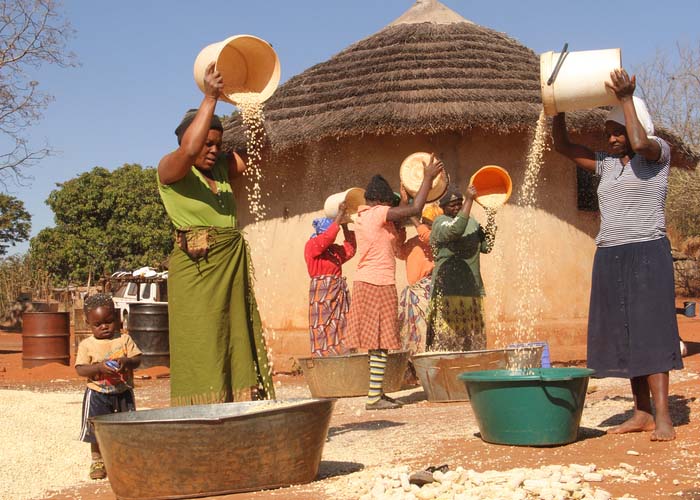
There are growing calls for Government to capacitate smallholder farmer with inputs and markets so as to increase yield per hectare in line with the 1990s production levels.
Smallholder farmers were producing between 70 percent and 80 percent of the country’s maize harvests at about one and half tonnes per hectare without inputs in the 90s.
Currently, most farmers are producing about 0,8 tonnes per hectare, torching calls for Government to support communal farmers with seed, fertilizers and markets for their produce.
Last week, SeedCo Zimbabwe’s head of agronomy services, Mr John Basera, said smallholder farmers are central to food self-sufficiency as they currently contribute about 80 percent to maize output.
“This sector is no doubt a critical agricultural hub and a major maize production driver. For the country to attain food security, first there has to self-sufficiency at the household level, then food surplus and the country will re-emerge as the breadbasket of Southern Africa.
“lt is imperative to address challenges faced by smallholder farmers who make up the majority of cereal farmers in the country.
“It is everyone’s challenge to roll out initiatives in the commercialisation of smallholder agriculture for it to increase its contribution to national maize production and to the GDP at large.
“We should always bear in mind that the second green revolution (1980-90s) was led by the smallholder sector. This has been done before and can, therefore, be repeated. With the right on-farm preparations and planning we can do it,” said Mr Basera. About 65 percent of the country’s population ekes out a living from agriculture, which also contributes almost 17 percent to GDP.
Mr Basera also said it is crucial for the country to move away from describing smallholder farmers as subsistence farmers when they are the major drivers of agricultural productivity.
Agriculture, Mechanisation and Irrigation Deputy Minister (Livestock), Cde Paddy Zhanda, also added his voice on the need to capacitate communal farmers and expose them to markets for them to increase output.
Deputy minister Zhanda said it is wrong to talk about subsistence farming when the farmers are applying fertilisers to their crops.
The switch from subsistence farming will improve output, according to experts. Mr Basera said with input support, small-holder farmers can ramp up production capacity from the current 0,8 tonnes per hectare to upwards of three tonnes, which is normally the break-even productivity point under good management levels.
“If the smallholder farmers can push us to this level, in addition to the noble command farming programme meant to target the A2s and large-scale commercial farmers, surely we can produce surplus and all this has some implications for a possible third green revolution,” said Mr Basera.
Deputy minister Zhanda conceded that in much as commercial farmers are struggling to access affordable financing to boost productivity, communal farmers used to produce several tonnes of maize without Government support in the 90s.
“The issue of productivity is central to agriculture. That is exactly where the problem is and that’s why people have gone into problems as far as farming is concerned.
“If you look at production of maize in 1995/1996 (cropping season), that is the first year Zimbabwe produced 2,6 million tonnes of maize and you get 2,6 million tonnes from communal farmers.
“In subsequent years, farmers were producing an average of 1,5 million tonnes per year, constituting about 70 to 80 percent of the maize which was produced by communal farmers.
“They were not mechanised at all, it was cheaper for them to produce and I don’t know why we want to re-invent the wheel and not revisit the template that caused them to produce,” said the deputy minister. In the mid 1990s, communal farmers were producing an average of two tonnes per hectare with the assistance of one Agriculture Extension (Agritex) officer in every ward.
However, according to last year’s Agritex Crop Assessment Reports, the yield has come down to 0,8 tonnes per hectare despite an increase the presence of five Agritex officers in every ward.
In neighouring Malawi and Zambia, communal farmers produce the bulk of the 2,7 million tonnes and 2,8 million tonnes of maize respectively realised in those countries without mechanisation.
In Zimbabwe, Government has deliberately sought to equip farmers with tractors and irrigation, especially after the land reform programme of 2000 so as to empower the new farmers but production levels are falling.
Government has had to import maize mainly from Zambia to augment the little produced.
“. . . Government has given tractors year in, year out but nothing is happening and surely, we are entitled to re-visit the template. I would suggest that we engage communal farmers, give them resources, give them the access to markets, get them paid as quickly as possible and I am sure they will produce,” he said.
Communal farmers have generally not benefitted for the subsidised $390 per tonne of maize offered by the Grain Marketing Board (GMB) largely because they are situated far away from the markets. Meanwhile, Mr Basera has urged farmers to start preparations for the 2016/17 summer cropping season so as to increase production.
Preliminary indications from the Meteorological Services Department show that the upcoming cropping season will have a normal to above-normal rainfall. Last year, yields were affected by the El Nino phenomenon which is set to be replaced with La Nina.
La Niña, sometimes called El Viejo, anti-El Niño or simply “a cold event”, is associated with below-average sea surface temperatures across the east-central Equatorial Pacific.
Its impact tends to be the opposite of those of El Niño.



 Online Reporter