

 admin
admin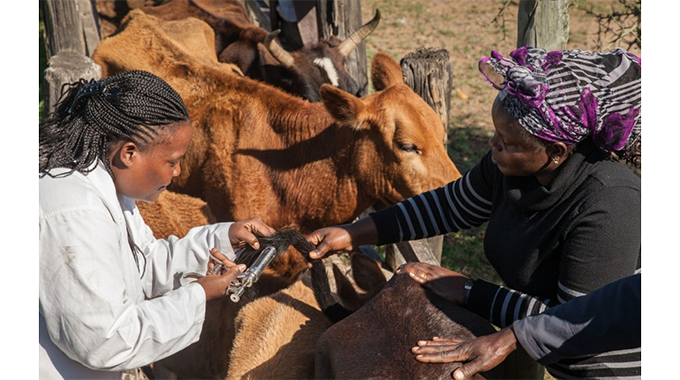
Precious Manomano-Herald Reporter
The Directorate of Veterinary Services (DVS) is targeting to produce more than 350 000 doses of the January Disease vaccine (BOLVAC), 100 000 doses each of the red Water and Gall Sickness vaccines before the rainy season to fight cattle diseases.
Currently, it has produced a total of 140 000 doses of Theileria to vaccinate animals against January disease.
It has also produced 70 000 doses each of the Redwater and Gall Sickness vaccines this year. The Government has also assured farmers that under the Presidential Blitz Tick Grease Programme they have adequate stocks of tick grease, for distribution to cattle farmers to complement dipping, targeting one million households in the upcoming summer season.
Department of Veterinary Technical Services Acting Deputy Director-Epidemiology and Informatics Dr Samuel Swiswa said farmers should be aware that the rainy season comes with an increased threat of tick-borne diseases hence, they need to be vigilant and implement measures to protect their animals.
“It is recommended that farmers consistently send all their cattle for weekly dipping during the entirety of the rainy season. Farmers should also apply tick grease on their animals to complement plunge dipping. Farmers should also deworm their animals to control worms and liver flukes. It is recommended that animals be dewormed just before the onset of the rainy season, in the middle of the rainy season (January/February 2025) and at the end of the rainy season (April 2025). Farmers should also ensure that their kraals have adequate drainage, to reduce mud, which predisposes animals to foot rot,” he said.
“Currently DVS is producing three tick-borne disease vaccines, namely BOLVAC (January Disease), Gall Sickness and Redwater. These vaccines are being used to vaccinate cattle under the Integrated Tick and Tick-Borne Disease Strategy. DVS plans to upscale the production of these three tick-borne disease vaccines to increase vaccination coverage,” he said.
Dr Makaya also said the directorate will continue carrying out Tsetse fly and Trypanosomiasis disease surveillance targeting 12 500km2 in the Tsetse-infected and high-risk areas this summer season.
About 7 800 tsetse targets and tsetse odour sachets will be deployed 445 km long from Kariba Lakeshore in Mola to Mututa Basin in Mbire District.
While 4 200km2 has been targeted for the progressive tsetse trypanosomiasis elimination this summer to reduce the burden to affected communities.
Vaccination is the primary method of prevention and control for several infectious viral and bacterial animal diseases of zoonotic origin across the globe.


 leeroy
 Online Reporter