daniel chigunwe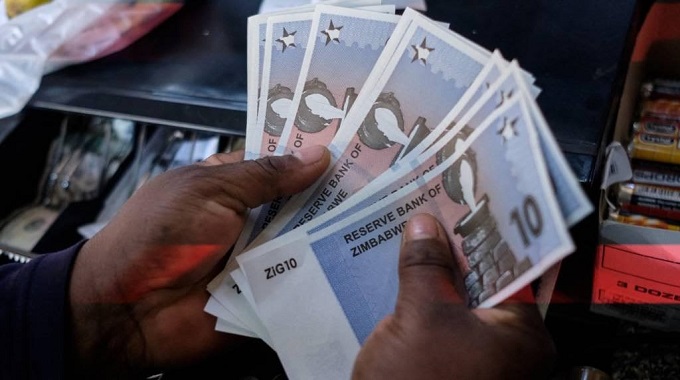
Nelson Gahadza
The Zimbabwean government’s de-dollarisation plan, launched with the introduction of the new Zimbabwe Gold (ZiG) currency, appears to be facing a rocky start. Many companies and businesses are adopting the US dollar (USD) as their functional currency.
De-dollarisation aims to reduce reliance on the US dollar and increase usage of the ZiG. However, the current economy, estimated to be 85 percent dollarised, shows no signs of significant change. Most products, services, and listed company reports are priced in USD.
Many Zimbabweans anticipated the ZIG would be accepted for various goods and services currently sold exclusively in USD, including fuel but Government has adopted a cautious approach on the widespread usage of ZiG.
“We need to revisit the path that led to the multi-currency system,” said George Guvamatanga, permanent secretary for Finance, Economic Development, and Investment Promotion, in April 2024.
“De-dollarisation is a gradual process. We are on a journey towards 2030, and there will be a point where fuel and duties will be transacted entirely in ZIG,” he said.
Reserve Bank of Zimbabwe (RBZ) Governor Dr John Mushayavanhu echoed this sentiment, emphasising a gradual de-dollarisation strategy relying on increased demand for ZiG, particularly during quarterly payment date (QPD) transactions due on the 25th of June 2024.The RBZ roadmap aims to boost ZiG transactions from the current 20 percent to 50 percent by 2026.
“By year-end, we hope to be at 70/30 USD/ZiG, then 60/40 in 2025, and 50/50 in 2026,” the Governor said.
“Afterwards, we won’t need to monitor it as de-dollarisation will likely happen on its own. However, businesses are increasingly using USD to generate working capital in foreign currency. Bank loans and advances are also over 85 percent USD-denominated.NMB Bank’s recent financials reveal a balance sheet of $1,7 trillion as of May 2024, with 92 percent in USD.
Their microfinance division, launched last year, exclusively lends in USD, with a current loan book of slightly over US$4 million.
Rainbow Tourism Group (RTG) switched to USD reporting for its financials effective January 1, 2024.
Zimre Holdings group chief finance officer Zvenyika Zvenyika stated at an analyst briefing that 84 percent of the group’s revenue and all business units generate positive cash flow in USD.
He explained that permission was sought from the Securities and Exchange Commission (SecZim) to present financials partly in USD to reflect true performance.
Several businesses have planned capital expenditure programs based on increased USD revenue, considering the average 85 percent USD sales.
Zimbabwe National Chamber of Commerce (ZNCC) chief executive Christopher Mugaga highlights that businesses generate an average of 85 percent of their sales in USD. “The message to banks is to design products relevant to a market already holding onto US dollars,” he said in an interview.
Zimbabwe used a multi-currency system from 2009 to 2019, followed by a combination of foreign and domestic currencies while exploring currency stabilisation options.
Tapiwa Mashakada, an expert in trade and investment facilitation and former minister during the Government of National Unity, emphasised the need to increase ZiG usage and reduce the current estimated 85 percent dollarised transactions.
“We need to encourage ZiG circulation to prevent a return to full dollarisation,” he said.
Since their introduction on April 30, 2024, banknotes and coins have been scarce, forcing continued reliance on USD.
The lack of smaller ZiG denominations further inconveniences consumers and disrupts exchange rates.
While the ZiG10 is the most circulated smaller denomination, but its availability remains limited, and many people haven’t used it yet.
Due to the change shortage, a product or service costing US$0,50 might now be priced at ZiG10. Some service providers have even created their own coupon systems as change, affecting exchange rates.
Governor Mushayavanhu acknowledged the issue, stating that cash, especially coins, is still in banks and not fully distributed.
He advised customers to withdraw coins directly from their banks.
“For instance, if your child uses public transport daily, withdraw enough ZiG coins for the month from your bank,” he said.
“Combi (public transport) operators benefit from the current situation.
“You are right that combi owners have no desire to get coins from the banks because the current situation where change is scarce is benefiting them.
“It is the commuting public who should push the circulation of ZiG by tendering the exact fare for a ride that is ZiG7,” he said.



 Online Reporter