admin
admin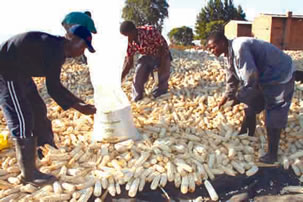
Equally critical and always problematic is the manner in which the farmers budget their grain so that it can take them to the next harvest.
In most seasons farmers have harvested enough grain to take them into the next harvest, sometimes with large surpluses to sell to grain dealers.
It has become a norm to see farmers running like headless chicken in search of grain to feed their families as early as the beginning of the rainy season.
In more severe cases some even have their granaries drying up as early as September.
Grain shortages are always an obstacle to most of their farming operations which are disrupted as they are forced to work in other people’s fields for the grain.
It is also during these times of shortages that some village heads are sometimes unjustifiably demonised by people attempting to sneak their names onto the lists of vulnerable people who get food from programmes initiated by Government and non-governmental organisations.
A number of farmers in Hurungwe are yearly entangled in this web, not because they harvest very little but because they overlook the small but critical issue of grain budgets.
Experts say farmers thus need to come up with a proper consumption pattern that will enable them to budget grain that will take them through the year.
It is wise to always leave a surplus that can be disposed off in the next harvest.
Although research by the Arex specialists shows that a person needs an average of 150kg (three bags) of grain per year, most communal farmers fail to realise that this figure does not as well account for consumption by pets such as dogs and cats.
As such they are usually found in grain deficit leading to them looking for food.
An officer with Arex working in the district advised farmers of the need to start taking grain budgeting seriously to avoid shortages during the year.
He said once a farmer is in arrears, chances are that he or she will fail to manage their time and affecting cropping and work time in the fields.
“My experience has shown that farmers tend to dispose the bulk of their produce to offset few luxuries and immediate needs at the expense of the family consumption pattern.
“The basic concept of communal farming is food sufficiency. Everything else comes as a plus for the farmer.
“We are encouraging our farmers to make sure they provide for their families before they can look at the market,” he said.
In other cases most homes budget strictly for members of the family without putting some grain aside for visitors and other miscellaneous programmes, hence their granaries usually dry up barely half way towards the next harvest.
As such, a family of five that also has two dogs needs to put aside more than 15 bags a year to accommodate Boki and Ginger.
Arex recommend that, families that keep free range chickens, dogs and others small pets should also factor them into the yearly grain budget clearly reflecting the quantities that are reserved for the domestic animals.
It is also imperative that communal farmers also budget for their visitors in coming up with a grain budget.
A village head from Kebvunde area under Chief Nematombo in Hurungwe, Dhobia Majinjiwa said that grain budget should also factor in the inevitable such as death in the family.
“There is nothing taboo about budgeting grain for a funeral as every person can be taken away by the almighty any day any time,” he said.
According to Mr Majinjiwa: “Unless one is swapping maize for rice, potatoes, wheat or other alternatives of the same value, it is irrational to exchange budgeted grain for meat or fish, as is the case among many people in my area.
“Some people act on impulse thereby selling their grain for goods of lesser value. Even during the time the maize is still green, people from Harare bring wares like buckets, second hand clothing, and soap to
exchange for grain.
“At harvest time these dealers reappear and collect their maize from the villagers. Some villagers end up crying as they would have taken too many items against their limited harvests.
“Fish vendors from Sanyati and fishing camps in Kariba also prey on ignorant farmers. Villagers only realise that they have no grain when it is too late,” he said.
Another villager said the advent of the US dollar had sent some villagers into a frenzy. They are selling everything only to regret later.
Mr Stephen Chamangwa of Kanyoka Village in the Kapiri area under Chief Kazangarare, said farmers were trying to put aside grain for consumption but impulse buying mostly by women resulted in massive deficits.
“Of late we have been invaded by a new brand of hairdressers who are operating mobile salons. They come with all forms of hairstyles whose prices they peg in buckets of maize.
“As payment the women invade their granaries for budgeted grain to pay these beauticians without the knowledge of their husbands,” he said.
Men in the area were also no exception as they sometimes took the budgeted grain and exchanged it for beer.
“Some men are stealing from the granaries and exchanging grain for beer or selling the grain to raise the cash to buy liquor.
“Some offer to go to the grinding mill only to exchange the grin for beer.
“They take more buckets than they declare to their wives for exchange to “makorokoza” for booze.
“Some, clandestinely take the grain from the granary and directly swap for liquor,” he said.
Ngoni Diza, a farmer from Chasara Village under Chief Nematombo in the Kemureza area, said such behaviour defeats the entire purpose of grain budgeting resulting in farmers failing to meet family needs.
“It is prudent and economically sensible to dispose of a bag of maize or millet when one has acquired an alternative, such as 20kg of rice, otherwise grain should be one of the most priced possessions.”
To ensure that one’s budgeted grain achieves its purpose, specialists recommend that the granary be secure against all forms of burglary, moisture and veld fires.
The grain should also be protected against weevils and rodents as these can unnecessarily reduce both the quality and quantity of the budgeted grain.



 Online Reporter