Sikhulekelani Moyo, Zimpapers Business Hub
The Grain Millers Association of Zimbabwe (GMAZ), Southern Region, has applauded the Government’s initiative to lift Statutory Instrument 87 of 2025, which players say will go a long way in addressing the shortage and maintaining product prices.
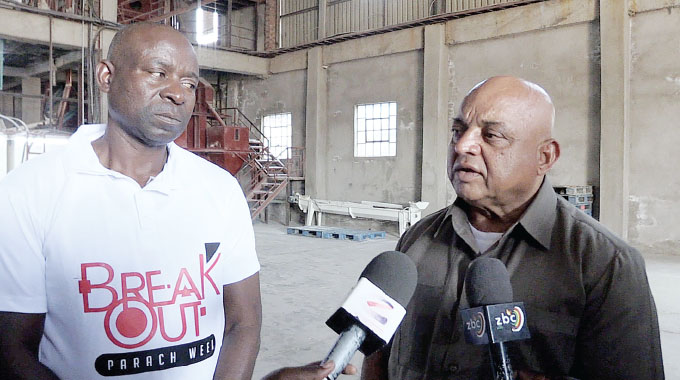
This was said during a tour held by the Industry and Commerce Deputy Minister, Raj Modi, at different milling companies in Bulawayo on Monday.
Updating the Deputy Minister during the tour of National Foods Limited, GMAZ Southern Region chairperson, Mr David Moyo, said the sector welcomes the Government’s initiative to lift the grain import ban.
He revealed that Southern Region players have been facing challenges, with many millers having halted production due to a shortage of raw material.

“We invited the Deputy Minister to come and assess the situation of millers in the Southern Region; milling plants don’t have the raw material, and even the available mealie meal is not enough to deliver to the shops,” said Mr Moyo.
“We have reached out to the Government, and we are so happy that the Government has heard our cry; the SI 87 of 2025 has been lifted, so that everyone can import maize.”
The recently gazetted Statutory Instrument 87 of 2025 amends the Agricultural Marketing Authority (Grain, Oilseed and Products) By-laws of 2013, outlawing the importation of grain, oilseeds, and related products, except under limited circumstances.
According to the SI, with effect from April 1, 2026, processors will be legally required to procure at least 40 percent of their annual raw material needs locally. By April 1, 2028, all such requirements must be sourced from local farmers.
Lands, Agriculture, Fisheries, Water, and Rural Development Minister, Dr Anxious Masuka, is on record as saying the policy cements efforts that began in 2020, when off-takers were persuaded to finance part of their raw material requirements through local contracting.
To safeguard farmers, the instrument introduces two pricing benchmarks: an import parity price (the landed cost of grain in Zimbabwe, including freight and insurance) and a production parity price, pegged to local production costs.
Where import prices fall below local parity levels, the difference will be paid into the Agricultural Revolving Fund, insulating domestic producers from external shocks.
However, to avoid price hikes and artificial shortages in the market, millers have been tasked to pay US$10 per tonne to the Agricultural Revolving Fund instead of the total difference, which the players say should be done officially so that they do not face challenges of breaking the law.
“The Lands, Agriculture, Fisheries, Water and Rural Development Minister has said any miller can import maize by paying US$10 per tonne, but our concern is that the SI remains the same, saying that where import prices fall below local parity levels, the difference should be paid into the Agricultural Revolving Fund,” said Mr Moyo.
“We appeal to the authorities that the SI should reflect that millers can pay US$10 per tonne because we are afraid that at any time the Minister or the Permanent Secretary can be changed, but the SI will remain in place. But we are hoping that they are solving it, as we know that our Government is a listening Government. As millers, we are there to complement the Government’s efforts in making sure that everyone is fed.”
He added that the region does not produce much grain and they rely on buying it from other regions, which results in increased costs, which are then passed on to consumers.
In his response, Deputy Minister Modi said that he visited the millers to show the Government’s commitment to making sure that all the grievances are solved as soon as possible.
“The Government will do its best to make sure that millers start importing as soon as possible. We cannot afford to have milling companies close because of the shortage of raw material. We will make sure that they can soon resume milling,” said Deputy Minister Modi.
“The Government has already started working on this; millers have been told to pay only US$10 per tonne, not the total difference.”
According to the update from different milling companies, which the Deputy Minister toured, some have been down for about two weeks, some for days, with the issue of access to raw material being a challenge.
Millers said they are a partner to the Government and where there is a change, they should be consulted.
Also, the other challenge raised by millers is the willing buyer, willing seller issue, where millers are supposed to source grain from willing sellers, who are farmers.
GMAZ Southern Region vice-chairperson, Mr Mthokozisi Sibanda, said the situation has revealed that there are few willing sellers, which he said has become a challenge. Therefore, Mr Sibanda said the flow of grain from the Northern Region, where most of it is produced, cannot move because the farmer is not willing.
“That is the reason why we are seeking the import to be opened so that we can restart the whole process of bringing sustainable provisions of food in the region,” said Mr Sibanda.
“Another issue, we would like to appeal to the Government to at least expedite the process of issuing these import permits so that we can quickly close up the gaps that are beginning to be seen in the market. But otherwise, we really appreciate the Government’s interventions through the SI 87, and we want to appreciate the listening gesture that the Government has given us that when we made our cries as the region that the SI has a threat to increase food prices in the region, the Government was there to listen and we are happy as millers to say that some of the bottlenecks have been amended.”