Online Reporter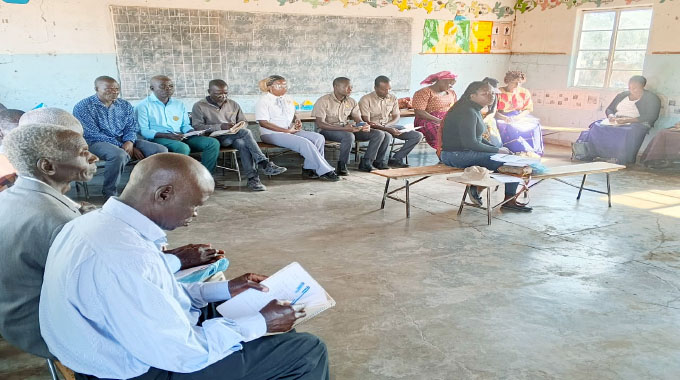
Fairness Moyana in Hwange
THE National Aids Council (NAC)-led “Not in My Village” campaign has reached another significant milestone in Hwange Central Constituency, with traditional leaders pledging to spearhead intensified community action against child marriages, teenage pregnancies, HIV infections and drug and substance abuse.
The campaign, which is being rolled out across communities through a partnership between NAC and the Chiefs Council, has continued to gain momentum as village heads and traditional leadership structures take ownership of efforts to tackle social challenges at grassroots level.
On Friday, traditional leaders, Government departments and community stakeholders gathered at Mashala Primary School under Chief Whange’s jurisdiction, marking another step in the campaign’s expansion across Matabeleland North Province.
The meeting was attended by Chief Whange, Headman Prosper Neshavi, representatives from the Zimbabwe Republic Police, Ministry of Health and Child Care, Ministry of Women Affairs, Community, Small and Medium Enterprises Development, Environmental Health Technicians and a Ward Development Officer.
Speaking after the workshop, Hwange District Aids Coordinator, Mr Nehemiah Ndlovu, said the campaign was a national initiative targeting traditional leaders as key drivers of behavioural change within communities.
“We came up with a programme together with the Chiefs Council called the ‘Not in My Village’ campaign. It is targeting child marriages, teenage pregnancies and drug and substance abuse.
“All chiefs in Matabeleland North Province were trained in Lupane and were tasked with cascading the programme to their village heads,” he said.
Mr Ndlovu said the programme had already been rolled out in areas under Chief Mvuthu and was now being extended to villages under Chief Whange, demonstrating the campaign’s growing reach and acceptance among traditional leadership structures.
“The campaign is also focusing on ending new HIV infections. We discussed the HIV situation in the district and encouraged traditional leaders to play a leading role in promoting HIV prevention and testing within their communities,” he said.
Mr Ndlovu said Hwange District’s HIV prevalence rate currently stands at 11.1 percent while the HIV incidence rate is 0.13, reflecting progress in reducing new infections.
“Our statistics continue to show a decline and we are happy with the progress. We will continue working tirelessly so that we eventually achieve single-digit figures in new HIV infections,” said Ndlovu.
While celebrating progress made in reducing new HIV infections, Mr Ndlovu said more work was needed to address the district’s high burden of sexually transmitted infections (STIs).
“As a district, we have high STI infections and that remains a major concern. STI infections are an indicator that communities remain at risk of HIV transmission. This is why we need everyone, especially traditional leaders, to take ownership of the campaign,” he said.
The workshop also broadened its focus to sanitation and public health, with Ministry of Health officials encouraging communities to eliminate open defecation and ensure every household has access to a toilet.
Chief Whange welcomed the initiative, saying it had equipped traditional leaders with critical knowledge and practical tools to safeguard communities.
“This workshop was very important because it sensitised traditional leadership structures and gave us more knowledge on how we can prevent early marriages, drug and substance abuse, HIV infections and other social problems affecting our communities,” he said.
Chief Whange said teenage pregnancies remained a major concern in his jurisdiction, with some school-going girls falling pregnant before reaching the age of 18.
“That is a serious concern for us as traditional leaders. We also have challenges related to drug and substance abuse among young people. This workshop has equipped us with information that we can now share with our communities,” he said.
He called on business operators to work closely with law enforcement agencies to prevent underage access to alcohol and other harmful substances.
“Shop owners should work hand in hand with the police. They should not be selling alcohol or any intoxicating substances to anyone under the age of 18,” said Chief Whange.
Female village heads who attended the workshop praised the programme, saying it had strengthened their capacity to address social challenges at community level.
Village Head Sophie Mpofu of Mashala Down said the training had empowered traditional leaders with practical knowledge to help protect children and vulnerable groups.
Simangani Village Head Shetani Moyo said traditional leaders had a responsibility to ensure that every child remained in school and was protected from exploitation.
Meanwhile, Mwemba Village Head Price Lusumbami said the campaign would help strengthen community awareness and accountability.
Headman Prosper Neshavi applauded the participation of village heads, saying their commitment demonstrated a shared determination to improve community wellbeing.
Officials from various Government departments encouraged traditional leaders to continue promoting health-seeking behaviour, sanitation, gender equality and child protection as part of broader efforts to build resilient communities.
Participants resolved to cascade the campaign messages to every village, reinforcing the growing momentum of the “Not in My Village” campaign and strengthening community efforts to ensure that child marriages, teenage pregnancies, HIV infections, drug abuse and open defecation become a thing of the past.