admin
admin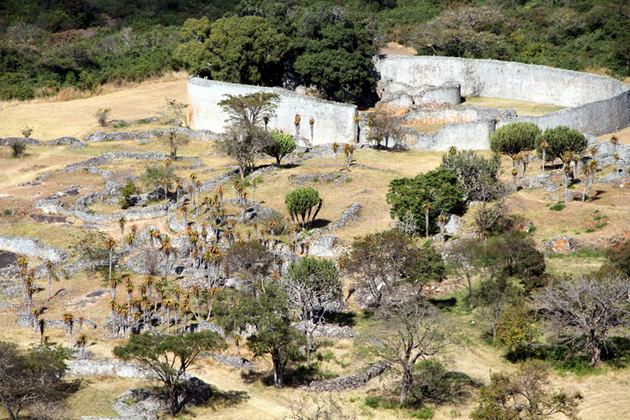
 Yoliswa Dube Features Reporter
STONE upon rock, upon boulder, upon pebble were ingeniously stacked one after the other with neither mortar nor cement to build a magnificent fortress.
Madzimbahwe — the house of stone, from which Zimbabwe got its name, remains a marvel historic site.
Now referred to as Great Zimbabwe, Madzimbahwe or Madzimbabwe which is located some 30km out of Masvingo — protective walls — is where king of the Rozvi, Nyatsimba Mutota is believed to have lived.
These residences are surrounded by a perimeter wall which was built to establish the power of the state; not having one meant you were a mere commoner.
Their significance is couched within the concept of order where people were discouraged from barging into the king’s residence but were forced to walk in a single file.
A recent tour of the Unesco World Heritage site revealed much about the engineering, architectural as well as cultural and traditional history of the Bantu people, particularly the Shona.
“Archaeologists compare the civilisations of the Romans with those of the Shona. The inhabitants of Great Zimbabwe practised subsistence farming. They grew millet and kept huge herds of cattle.
“They traded with the Arabs, primarily barter trade where they would send animal skin, gold and ivory and in return, got beads and brass among other things,” said history enthusiast Champion Ndigunei, a senior tour guide at the monument.
This house of stone was built from granite, a type of rock created deep below the surface of the earth after molten magma cooled. Solely bare, dry rock was used with neither mortar nor cement.
The ancient path, about a 350m long walk uphill to reach the peak of the hill complex is a walk that only the fit can endure. It is steep and requires a significant amount of leg work.
“Before you started walking up the hill to visit the king, you needed to first pass through the outspan, a reception area. You couldn’t see the king without passing through the reception area. It’s important to note that the inhabitants of Great Zimbabwe were related to those at the Khami Ruins and Mutapa Ruins in Mt Darwin.
“In building these, they worked with nature rather than dominating it,” said Ndigunei as he pointed to a boulder camouflaged by other stones along the ancient path.
At the peak of the hill complex, where the king is believed to have lived is a glorious view of Lake Mutirikwi. Nyatsimba Mutota did not enjoy the stunning lake view, however, as the dam, the biggest one after Lake Kariba, was built by prisoners of the war in 1960 and supplies Masvingo as well as the lowveld.
Exhausted and sweating while at the peak of the hill complex, Ndigunei explains: “The entrance into the king’s residence is a reconstruction of the one in 1920. In fact, 30 percent of the monument has been reconstructed while the rest has been preserved in its natural state.
“We have a conservation department comprising of curators and surveyors who constantly monitor the monument.”
In the king’s residence was a conical tower, a symbol of Shona granaries. Only the foundations of huts were still visible. A pit, identical to a traditional kitchen hut still stood firm with a bench, a fire place and pottery next to it.
“When a king died, all his houses were destroyed and new ones were built for the new king,” explained Ndigunei as he wiped beads of sweat from underneath his hat.
Also visiting this breathtaking monument were tourists from Germany who said they were fascinated by Great Zimbabwe and had visited the country specifically to see the monument.
“We heard about Great Zimbabwe through a history programme we run in our country and were keen to tour the site personally,” said one agile German tourist who had reached the peak of the hill complex as some members of his group trailed well behind.
At the hill complex were monoliths, types of stone resembling horns. These horns were said to represent the power of a king, much like the horns of a bull.
Carefully organised, the king’s residence had a guard’s port where a warrior stood watch to ensure the king was safe. If you thought security guards came with modernisation, think again!
Madzimbahwe was built strategically, to allow for trade with the Arabs as well as the Portuguese.
In the recess enclosure, within the king’s residence, lived a spirit medium.
“The spirit medium wielded more power than the king. If he or she became possessed, they would enter the sacred enclosure and try to interpret the fate of the government.
“The strength of a government was determined by the relationship between the king and the spirit medium,” explained the tour guide in a high-pitched voice.
Ndigunei said the monument was sacred and people were not allowed to conduct rituals at the site willy-nilly. “There are rituals done here before the sun is out at least twice a year otherwise people are not allowed to practise rituals here at will. During the liberation struggle, people are believed to have come into the sacred enclosure to conduct certain rituals,” he said.
A cave, like one would most likely see on Robinson Crusoe or Pirates of the Caribbean drew the attention of the news crew.
Ndigunei explained that the cave is believed to have been used as a storeroom.
“Deposits of iron ore were found in the cave. Some archaeologists also believe that due to its unusual acoustics, the cave could have been used for communication purposes. Others believe certain rituals were conducted in the cave,” he said.
Also at the site was a gold furnace enclosure where clay pots which are believed to have been used to smelt gold were found. More stones were used to build a gigantic Zimbabwean bird, with a swelling breast and a beak. Soapstone birds facing the east were found at the monument; something believed to have been a symbol of hope. The echoes of a butler eagle meant there was an enemy around.
“Kings were buried with gold and wood carvings of rhino covered with gold foil were also made. The death of a king was equated to the fall of a mountain,” said Ndigunei.
A fascinating concept, reconstruction of the Shona village, where locals sell their sculptures and pottery work as well as display the cultural music and dance of the Great Zimbabwe inhabitants made for spectacular viewing.
Locals benefit from the monuments’ influx, which has become the market for their wares.
Ivhu Inhaka, a local traditional music ensemble sang the afternoon away in a tune dubbed “Nhaka yamadzibaba”.
A mixture of men and women, old and young, dressed in traditional attire resembling the monuments heritage displayed a feisty performance.
“We provide entertainment to visitors of the monument. We do songs and dances that were done at the installation of a king, to thank the gods for the rains or to simply entertain,” said one member of the group.
A tour which takes approximately two hours, the Great Zimbabwe is a must visit for every Zimbabwean as it awards one the opportunity to learn much about part of the country’s heritage.
The site has been legally protected since 1893 and is protected under the National Museum and Monuments Act Chapter 25:11 (1976) which provides for the legal protection of the resources within the property.
The National Museums and Monuments of Zimbabwe (NMMZ), under the Ministry of Home Affairs, is directly responsible for the management of the property.
Funding for the management and conservation of the property comes mainly from the government with limited income generated by entrance fees, accommodation and sale of publications which are used to finance projects at national level at the discretion of the NMMZ board of trustees.
The most famous part of the monument, the great enclosure, which has been well documented and has been used on various motifs representing Great Zimbabwe, was the highlight of the tour.
Europeans who had visited the place earlier on thought it was the capital city of the Queen of Sheba but they were wrong.
It was the abode of the king’s first wife and has a double chevron pattern at the top – a pattern which was a symbol of fertility.
With a circumference of 255m, the gigantic conical tower at the great enclosure leaves no doubt that its builders were genius engineers and architects. It is at this enclosure that the queen is believed to have given young girls lessons about marriage and puberty.
The conical tower is a symbol of unity, abundance and marks the climax of masonry.
“Mukadzi aidiwa uyu (This woman must have really been loved),” said Ndigunei of the great enclosure.



 Online Reporter