Conrad Mupesa-Features Writer
AT sunrise, Lake Kariba often looks eternal as the water stretches endlessly into the horizon, broken only by half-submerged trees and fishing boats drifting quietly across the golden surface.
For generations, this vast lake has promised life, food, energy, employment and hope, not just for communities along its shores, but for millions across Zimbabwe and Zambia.
For residents in Harare, Gweru, Midlands Province and Kotwa, Mashonaland East, Kariba powers homes and industries.
And, so it does for Lusaka, Livingstone and Kitwe in Zambia, where it also provides an important source of fish and protein just like in Zimbabwe.
But for the people who live in Kariba town and Siavonga, the lake is more than infrastructure or statistics, it is survival itself.
Stretching over 380 kilometres, Lake Kariba is the heartbeat of an entire regional economy.
It feeds households with the famed white meat of Kariba; tilapia, sustains fishermen who rise before dawn to cast their nets, and supports boat operators, tour guides, hoteliers, crocodile farmers and their workers.
It also anchors critical institutions, the Zambezi River Authority, Zambia Electricity Supply Corporation (ZESCO) and the Zimbabwe Power Company (ZPC), whose operations keep lights on in cities hundreds of kilometres away.
Yet beneath this serene beauty, a quiet crisis is unfolding.
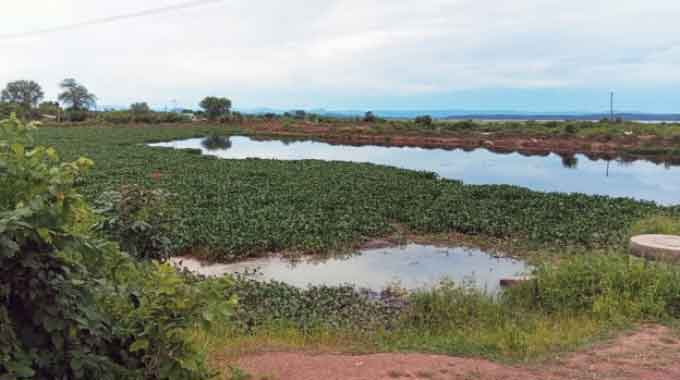
Along parts of Kariba’s shoreline, thick patches of water hyacinth have begun to appear, floating carpets of green that look harmless from a distance, even beautiful.
Water hyacinth is one of the world’s most destructive invasive aquatic plants.
Native to South America’s Amazon Basin, it was introduced across the globe more than a century ago as an ornamental plant.
In African waters, free of natural enemies and fuelled by pollution, it multiplies at a frightening pace.
Within weeks, it can blanket entire bays, blocking sunlight, sucking oxygen from the water and suffocating fish below.
Across the continent, water hyacinth has already left a trail of economic and ecological destruction.
On Lake Victoria and Lake Naivasha, fishing communities were pushed to the brink as nets clogged, boats stalled and fish stocks collapsed.
Closer to home, Lake Chivero stands as a stark warning and years of pollution turned it into a fertile breeding ground for hyacinth.
Despite repeated removal efforts, the weed has proved stubborn and relentless.
Environmentalists fear Kariba may be next, only this time, the consequences would be far greater.
For those who live off the lake, the danger is no longer theoretical.
“We have seen what this weed does,” said a fisherman in Kariba, Artwell Shoko, carefully mending a net scarred by vegetation.
“When hyacinth comes, the fish move away. Our nets get damaged, fuel costs rise, and some days you return home with nothing.”
Boat operators also echoed the anxiety, noting that their lives and businesses were under threat.
“Our engines are not made to push through thick weeds,” said a tour boat skipper, Luckmore Tigere.
“If hyacinth spreads, tourism will suffer. No one wants to cruise through rotting green mats. This lake feeds many families, not just fishermen.”
At the heart of Kariba’s vulnerability lies a familiar problem, untreated sewage and nutrient pollution.
Human waste disposal ponds lie dangerously close to the lake.
Elephants and hippos, moving between the ponds and the shoreline, inadvertently carry hyacinth into open waters, accelerating its spread.
In 2024, Kariba Municipality pledged to erect an electric perimeter fence to keep wildlife away from the sewer ponds, a move that could have slowed the invasion significantly, but the plan never materialised.
Kariba Municipality finance director, Mr Saratiere Chitenhe in 2024 confirmed to Mashonaland West Minister of State for Provincial Affairs and Devolution, Marian Chombo during her tour of the resort town that the council was working on setting the perimeter fence.
Instead, the project was downgraded and eventually dropped altogether.
Kariba spokesperson Mr Gabriel Mazivisa last week confirmed that the fence was not budgeted for in 2026 and was not prioritised in 2025.
This is despite the municipality having been fined by the Environmental Management Agency (EMA) for discharging raw sewage into the lake six years ago.
EMA Mashonaland West public relations officer, Mr Munyaradzi Nhariswa confirmed that enforcement tickets were issued and a court case over pollution of Lake Kariba is currently before the courts.
Apart from unprotected sewer ponds, EMA believes Kariba continues to dispose of partially treated sewage water into the lake.
“The Environmental Management Agency is gravely concerned with the Municipality of Kariba’s persistent discharge of partially treated sewage into streams leading to Kariba Dam, an ongoing violation that poses a severe and escalating threat to public health and the dam’s ecosystem.
“The sources of the pollution include unattended clogged manholes, and sewer bursts. Hot spot areas include Mahombekombe, Mpetauke, Nyamhunga and Batonga,” said Mr Nhariswa.
Laboratory results from EMA’s investigations have also shown that partially treated wastewater was highly laden with nutrients, primarily nitrogen and phosphorus, which trigger eutrophication.
The eutrophication process depletes dissolved oxygen as organic matter decomposes, creates toxic conditions, and allows pollution-tolerant species to dominate, undermining aquatic biodiversity, water quality and human health.
“Nutrient-laden waste waters have directly fuelled the explosive spread of water hyacinth, an invasive alien species. The municipal ponds and Kariba Dam shorelines are heavily infested with water hyacinth, forming dense, rapidly expanding mats,” noted Mr Nhariswa.
Mr Nhariswa added that hyacinth infestation creates cascading problems as it blocks sunlight, causing oxygen levels to crash and decimating native aquatic life, and the weed clogs waterways, increasing flood and evaporation risks.
“The presence of water hyacinth, coupled with unattended sewer bursts, disrupts fishing and water supply, while creating stagnant breeding grounds for disease vectors like mosquitoes,” he said.
To address the crisis, EMA adopted a two-pronged strategy, combining engagement with City Fathers and legal action and, following multiple meetings, the agency filed a case against the Municipality sometime back in August 2019, which resulted in a landmark court ruling that the local authority had violated section 57 of the Environmental Management Act.
The court mandated that the pollution issues be resolved by October of that year.
However, in the past year, continued reports from residents and documented instances of recurring sewer bursts and overflowing manholes compelled EMA to pursue further legal action against the council under case CR09/25.
“We firmly believe, the clear link between municipal sewage pollution, resultant proliferation of water hyacinth, and widespread ecological degradation demands urgent attention.
“Protecting our wetlands is not merely an environmental concern, but a fundamental imperative for safeguarding biological diversity, human health and promoting economic growth,” said Mr Nhariswa.
If left unchecked, water hyacinth could choke critical water intake systems, disrupt hydroelectric power generation and increase evaporation losses in an era of climate stress.
The plant also creates breeding grounds for mosquitoes and water-borne parasites, raising public health risks for lakeside communities.
While Kariba remains breath-taking as a lake that gives more than it takes, the green patches of multiplying hyacinth along its edges threaten the entire ecosystem.