Chronicle Editor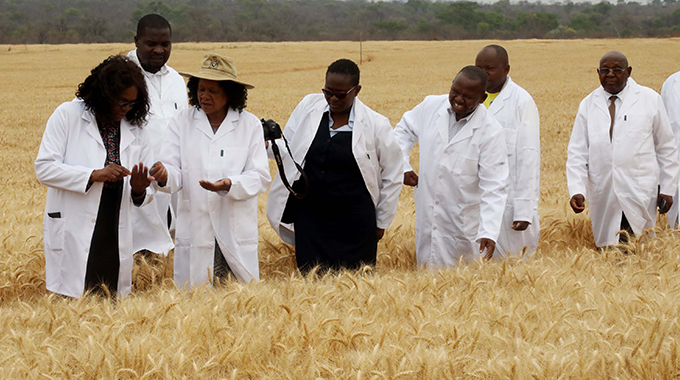
Raymond Jaravaza, [email protected]
A YEAR ago, a huge chunk of land owned by Gwanda State University (GSU) lay barren and unproductive. It took meticulous planning to turn it into productive land and this year it has a thriving winter crop that does not only enhance food security but will contribute to the rural industrialisation of Filabusi.
The university put 17,8 hectares under winter wheat at its Insingadale Farm and expects to harvest 88 tonnes which translates to more than four tonnes per hectare.
The harvesting of the crop is expected to start this week as the institution of higher learning has already been supplied with a combine harvester by the AFC Commercial Bank.
A relatively young university that was established in 2016 through an Act of Parliament and in fulfilment of the Government’s policy of having at least one State University in each of the country’s 10 provinces, GSU is taking strides in contributing to the skills base in the country in addition to food production.

The university tookover the former Epoch Mine premises in Insiza District, Matabeleland South, a province that is richly endowed with mineral resources. By venturing into commercial farming, GSU is leveraging on its skills base as some of its students are studying agro-based courses.
“We started clearing the land sometime in December and we did it manually because the university is yet to be mechanised. The process of clearing the land as a result took a long time,” GSU Vice Chancellor, Professor Doreen Zandile Moyo said yesterday.
The crop which is ready for harvesting is the university’s first winter wheat and Prof Moyo said they were thrilled with the quality of the crop.
“We expect a good harvest given the quality of the crop. There are two benefits to this project. The first being the academic side whereby our students come here for their practical lessons and the second benefit is that we will earn money from the crop as a university. Our hope is that the students will use the knowledge gained to venture into winter wheat farming,” said Prof Moyo.
Vice Chancellor Moyo said since this was their first crop, they encountered a few challenges.
“The first challenge was the issue of funding which forced us to knock on many doors seeking assistance.
The Honourable Minister (Dr Evelyn Ndlovu) was very helpful on that front, especially when it came to acquisition of this land. The land that we initially got from the Government was 40 hectares but now we have 100 hectares. Our goal is to produce and contribute to the national food basket,” said Prof Moyo.

She said the situation was worsened by the El Nino-induced drought that ravaged the country.
“The project would not have been a success without the permit from Zinwa (Zimbabwe National Water Authority) that allows us to draw water from the nearby Insiza River to augment supplies from our boreholes at the farm,” said Prof Moyo.
To get a buy-in from the local communities, the university consulted with the local leadership that assisted in identifying contract workers for the project.
“We also encountered challenges of theft and vandalism of infrastructure but we addressed the problem by engaging the community,”said Vice Chancellor Moyo.
She said by employing locals, the university had given ownership of the project to the local community who are now protecting the infrastructure against vandals.
Matabeleland South Minister for Provincial Affairs and Devolution, Dr Ndlovu, said despite falling short of the targeted hectarage for winter wheat cropping, GSU is leading the way in transforming the province through innovations that change lives.

“The province had a target of 5 000 hectares for winter wheat but due to the drought, we only managed to plant 4 000 hectares. The Gwanda State University crop is an addition to that target,” she said.
Minister Ndlovu said Government had confidence in the capabilities of the relatively young university hence it was availing more land for projects.
“Gwanda State University is a young institution but the speed at which they are implementing their programmes and growing as a university is very impressive.
“The university has a cattle and goat project and they are planning to add piggery, which shows how innovative they are when it comes to food production,” she said.
Matabeleland South Province is a predominantly mining and agricultural-based economy and the university is adding value not only by adding to the skills base of the province but by also producing in livestock and crop production.



 Online Reporter