admin
admin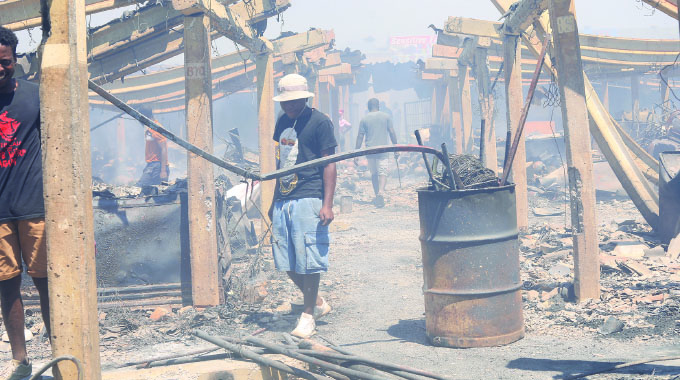
Elliot Ziwira, Senior Writer
The cacophony of Mbare, Zimbabwe’s oldest high-density suburb, has taken on a mournful tone.
Ear-piercing honking, animated shouting, shrills of dejection, and vigilant touting – the din from both humans and machines – which marks Mbare, now underscore the agony of a community ravaged by fire. Since Tuesday night, the buzzword around here is “fire” – a persistent metaphor of shattered dreams.
It is a word that has become synonymous with agony, frustration, and distress.
Yesterday morning, as this writer navigated Mbare Musika, the epicentre of the blaze, the usually vibrant energy was subdued.
Conversations, once filled with hope and hustle, are now hushed and tinged with despair.
The convergence of Mbare Road and Chaminuka, 16th, and 20th streets, once a hub of activity, starkly conjures memories of loss. Njere to the northeast and the newly-established Zebra Mall to the southwest stand witness to the devastation.
Established in 1907, Mbare is a bustling district that invokes different memories among Zimbabweans and foreigners alike—the nostalgic, grisly, regretful, hopeful, gleeful, and simply unsayable.
In this paradox, scores of traders either mill around, seek each other’s comfort in small groups, or rework their stalls in anticipation of new beginnings. Their tales reel out into one boundless story of survival, community, and the human spirit’s capacity to overcome adversity.

BACK IN BUSINESS. . . Some traders resumed business yesterday
As the acrid scent of char and devastation hangs heavy over Mbare, like a mournful shroud, humanity’s capacity to withstand shocks is soon put to the test.
Rising from humble beginnings: Isaac Madimbire’s story
As 54-year-old Isaac Madimbire, a tailor who grew up in rural Gutu, surveys the ruins of his livelihood, determination and despair meet in the ashes clogging his mind.
“I feel like I have lost a part of myself,” he says, eyes scanning the blackened stalls, once bustling with resilience and lively chit-chatter. “Nonetheless, we will rebuild, stronger and more united than ever.”
If determination were a person, then it must be Isaac. His never-say-die spirit was forged in the fires of entrepreneurship spanning three decades.
“I came to Harare in 1990 after writing my O-Levels in 1989,” he says.
From humble beginnings as a tailor in 1990, he built a thriving business with his wife in 1995.
“We started working at Mbare Musika in 1995 where my mother-in-law operated from. I had just married,” he narrates. “Since my wife was well-vested in the nitty-gritties of hustling having learnt from her mother, she handled the retailing side, while I concentrated on production.”
They started by supplying hats to Malawi and Mozambique. Around 2000, the couple diversified to audio cassettes, clothing, and electrical gadgets sourced from China.
“Mbare sharpened us,” Isaac reminisces, a hint of pride in his voice.
“We were unstoppable. Our hats sold like hotcakes. We would supply at least 500 pieces a day, which prompted us to employ more people and increase our sewing machines to five.

Isaac Madimbire
Later, Isaac joined his wife full time at the market, after acquiring another stall, adding a new product to their list of merchandise—school uniforms. Their school uniform business boomed.
“As demand grew, we engaged other tailors, supplying uniforms to schools and traders nationwide,” he says.
A life’s work reduced to ashes
With the heavens on his side, supported by his wife, Isaac bought a house for his family in Dzivaresekwa, Harare. Counting his blessings by the stars, he invested heavily in preparation for Christmas and the first school term of 2025.
Then disaster struck, reducing his dreams to ashes.
“I lost US$5 000 worth of uniforms, my wife lost US$10 000 in products, in addition to US$200 and R4 000 in cash meant for restocking,” Isaac recounts, his voice a ball of emotion.
“We’re now in debt since some of the uniforms were paid for in advance. It’s like starting from scratch.”
A new beginning
Despite the fall, Isaac refuses to remain on his knees.
“Giving up is not an option. I have two wives and six children to care for, four of whom are still in school, while the other is doing mechanics at college. My second wife lives at our rural home in Gutu where she also sells uniforms to local schools,” he says.

Roderick Maposah
As co-chairperson of the market committee, Isaac represents half of the almost 5 000 traders who lost their goods and livelihoods in the inferno. “We’re multifaceted—elderly, young traders whose families rely on this market. It’s not just a place to trade; it’s our lifeblood, he stresses.
“Imagine waking up one morning, and your entire livelihood is gone,” weighs in Miriam Mashanda (45) from Nenyere Flats, Mbare, a fellow trader and mother of four school going girls.
Appealing for support, she adds: “It’s like a nightmare, but we’re determined to rebuild.”
Traders have pooled resources to repair damaged infrastructure, including the perimeter wall and toilets, vowing to restart operations within days.
“We’ll operate in the open, but the sun won’t deter us,” Isaac declares.
“We need a starting point. This market is key to other provinces of the country; traders come from afar for stock.”
His eyes glued to his ruined dreams, yet burning with determination, Isaac says, “We have been assured by the authorities that no one will be moved from here. We will rise from the ashes, stronger and more united than ever. Mbare will thrive again.”
A father’s legacy: Roderick Maposah’s ordeal
As a new dawn is reflected in Isaac Madimbire’s nightmare, sixty-five-year-old Roderick Maposah’s ordeal begins.
The co-chairman of the Mbare retail market committee scans the smouldering ruins of his dreams, the devastation reflecting in his eyes.
“I felt like my heart had been ripped out,” Roderick says, overwhelmed by emotion.
He recalls the Tuesday night phone call that shattered his world: “His voice laced with panic, around 9pm, the youth chairman told me the market was ablaze.”
Unable to find transport from his home in Ruwa, he endured the nightmare until 4am on Wednesday.
As a father and grandfather, Roderick has always been the rock of his family. A widower since 2018, his daughter, son, and three grandchildren rely on him for support and guidance.
For 23 years, he nurtured his market stall into a thriving enterprise following the closure of the clothing company he worked for in 1996. Diversifying from cabbages to dried vegetables, sugar beans, groundnuts, Bambara nuts, cowpeas, and brown rice. Innovative and resourceful, he installed 12 solar panels and chargers, providing essential services to traders.
All that collapsed on Tuesday night as the raging fire swept across Mbare Musika, leaving Roderick with nothing.
“I had stocked up for the upcoming rainy season, anticipating my customers’ needs,” Roderick teary recounts. “40 buckets of brown rice at US$80 each, 1,5 tonnes of Bambara nuts, 40 buckets of shelled groundnuts, 20 buckets of pearl millet, 12 large solar panels, chargers and batteries. All gone – reduced to ashes.”
His daughter’s stall, equipped with 20 solar panels, also perished in the blaze. Roderick estimates his total loss at approximately US$10 000.
Contemplating his next move, Roderick’s thoughts turn to his family’s well-being. “How will I provide for them now, and where will I even start from?” the future worries him. “Everything depends on this market – my life – their livelihoods.”
However, like Isaac and Miriam, he believes that he will rise again.
“For my family, for my grandchildren’s future, I will rise again,” his determination shines through the rubble.
Towards the future
In the aftermath of the nightmare that befell traders at Mbare Musika, Knowledge Transfer Africa chief executive officer, Charles Dhewa’s voice rings out laced with collective hope.
“Life goes on,” he says, surveying the bustling market.
“Today, over 100 commodities are on sale, prices unchanged. The show must go on.”
Dhewa appreciates the support pledged by authorities, and hopes for a better, more resilient market.
“Perhaps this is an opportunity to rebuild with a bigger shed,” he suggests. “We pray things will be better than before.”
He emphasises that Mbare Market is more than just a trading hub; it is a lifeline for Zimbabwe’s food systems. As an agro-based economy, he emphasises the importance of strong markets for the country.
“Mbare supplies seed, mainly indigenous ones, and traditional grains, like cowpeas and groundnuts,” he explains. “We need good infrastructure to withstand drought and climate change.”
Dhewa calls for collective action, urging big corporations and pension funds, like National Social Security Authority (NSSA), to invest in markets, and food systems. “We can fix our challenges without outside assistance,” he asserts. “Let us work together to build strong, resilient markets. We don’t have to wait for disasters.”
Indeed, the inferno may have ravaged Mbare Musika, but it couldn’t extinguish the hope and determination, which has always defined its inhabitants. The Government’s support, and collective efforts will surely deliver a brighter future, for the market symbolises shared dreams.



 Online Reporter