Chronicle Editor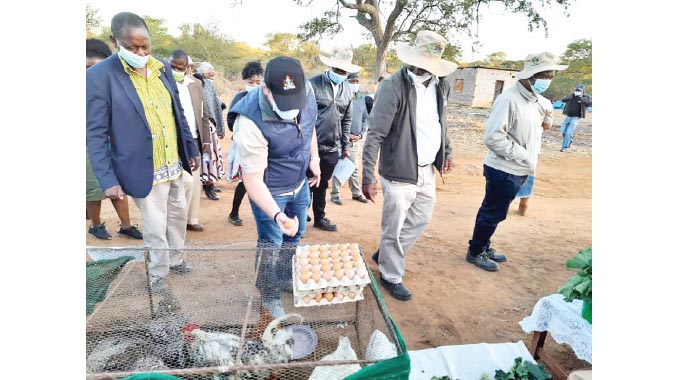
Yoliswa Dube-Moyo, Matabeleland South Bureau Chief
Farmers at the newly revitalised Guyu-Chelesa Irrigation Scheme in Gwanda District are set to venture into milk production which is expected to contribute to meeting the national demand.
The irrigation scheme now has a dairy component with 20 hectares set aside for fodder production.
About US$660 000 has been invested in the rehabilitation of the irrigation scheme which is in Ward 14.
The main works at Guyu-Chelesa Irrigation Scheme included the rehabilitation of storage tank, boreholes and installation of sprinkler and field equipment.
Guyu-Chelesa irrigation scheme has 160 beneficiaries who are also being trained to treat farming as a business.
Speaking during the commissioning of the revilatised irrigation scheme last week, Deputy Minister of Lands, Agriculture, Fisheries, Water and Rural Development Vangelis Haritatos said the irrigation scheme rehabilitation project places great value on the environment in line with the doing no harm principle.
“While the scheme has not been operational for a number of years, now that the Smallholder Irrigation Revitilisation Programme (SIRP) has rehabilitated it, we hope to see an increase in the production of milk.
I encourage you to fully utilise the land allocated for dairy to grow the dairy herd in this project as well as contributing to meeting the national demand for milk consumption,” said Deputy Minister Haritatos.
He said the country is producing 89 million litres of milk per year against a national requirement of 120 million litres.
“In addition to milk production, we hope farmers here at Guyu will utilise the irrigation scheme to grow fodder to supply to other farmers in the area.
Matabeleland South is a cattle hub which is, however, dry and cattle often need supplementary feeding during the dry months.
If livelihoods are to be developed in the province, the development of the livestock is key,” said Deputy Minister Haritatos.
Guyu-Chelesa Irrigation Scheme chairman Mr Gifford Moyo said the new block system whereby they collectively cultivate on one big piece of land using shared inputs and resources that is being implemented at the irrigation scheme was a learning curve for farmers.
“We’re excited about the project and happy to learn more about the newly adopted block system.
We will eventually get to the level Government wants us to reach as it makes sure that no one is left behind,” said Mr Moyo.
Through SIRP, Government and its partners wants to establish 350 000 hectares under irrigation across the country.
SIRP is a US$52 million programme established in 2016 to reduce the vulnerability of smallholder farmers to food and nutrition insecurity, climate change effects and economic shocks as well as contribute to the resilience of smallholder farming communities.
The programme is expected to revitalise 60 irrigation schemes covering 6 100 hectares in Manicaland, Masvingo, Matabeleland South and Midlands provinces.
It targets over 27 500 rural households where 15 000 households are irrigators and 12 500 households are in the adjacent rain-fed areas.
In Matabeleland South province, nine schemes in Gwanda, Mangwe, Beitbridge and Insiza will be rehabilitated under the SIRP programme.
– @Yolisswa



 Online Reporter