Online Reporter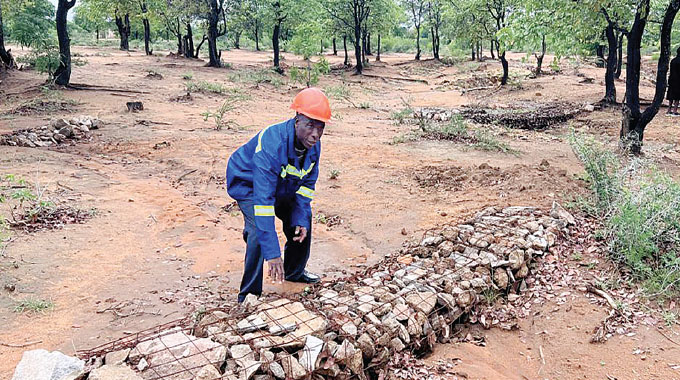
Sukulwenkosi Dube-Matutu, [email protected]
THE community of Ntanye area in Gwanda District has embarked on an ambitious land restoration project to rehabilitate degraded land, safeguard water sources and protect their horticulture projects.
Villagers have constructed various conservation structures, including gabions and stone bunds, to trap run-off and stabilise the land.
Project chairperson, Mr Zacheous Sibindi, said land degradation in the area had spiralled over the years, resulting in the loss of trees and the formation of deep gullies that endangered both humans and livestock.
He said the environmental damage had also lowered the water table, affecting boreholes and threatening the community’s garden projects.
The restoration efforts are being supported by Government in partnership with Welt Hunger Hilfe (WHH) under the Humanitarian Drought Response project.
So far, 3,8 hectares of land in Wards 4 and 15 have been reclaimed through the construction of gabions and stone bunds.
“There was severe damage to our land because of the cutting down of trees and loss of vegetation, which created gullies.
“When this programme came, we were educated on how this damage was affecting our water table,” said Mr Sibindi.
“Indeed, we had seen that our boreholes were now running out of water. Our garden had also been affected. Since we started the programme, we have begun to notice a difference.”
He said vegetation is beginning to regenerate, and the water table has improved.
“The gabions and stone bunds are now trapping water that used to be washed away. We have also extended our gully reclamation works to other damaged areas in the village,” he said.
Mr Sibindi added that the gullies had become a major concern as they posed a danger to livestock and community members.
A villager, Ms Bridget Ncube, said the community received training on soil conservation and environmental protection. She said residents are now applying the restoration techniques at their homesteads and in their fields to reduce soil loss.
She recalled that before the degradation, the area was rich in vegetation and served as grazing land.
“We were taught that the state of the land has an impact on our livelihoods as it drives many economic and social activities. That is why we need to retain the nutritive value of our land,” she said.
The humanitarian drought response project, which began in March and is coming to an end this month, is also being implemented in Mount Darwin District.
Its key objective is to provide emergency access to safe water, sanitation and hygiene services, supported by local water committees and community health volunteers, in order to reduce the risk of water-borne diseases and strengthen community health.
The project is funded by the Germany-based Bauer Foundation, with WHH as the implementing partner, while various Government departments provide advisory support.
WHH head of drought recovery, Mr Vincent Chiunya, said 73 households have benefitted from the gully reclamation programme, which forms part of efforts to help communities recover from the effects of the El Niño-induced drought.
“Under our gully reclamation project, we have assisted farmers to reduce soil erosion and retain the nutritional value of their land. In Ward 14, a total of four hectares of land was reclaimed,” he said.
Mr Chiunya added that 21 gabions and nine stone bunds were constructed in Ntanye Village.
“This was implemented under the sustainable environment pillar as part of efforts to restore the environment. The state of the environment has a direct effect on the livelihoods of communities,” he said.–@DubeMatutu