admin
admin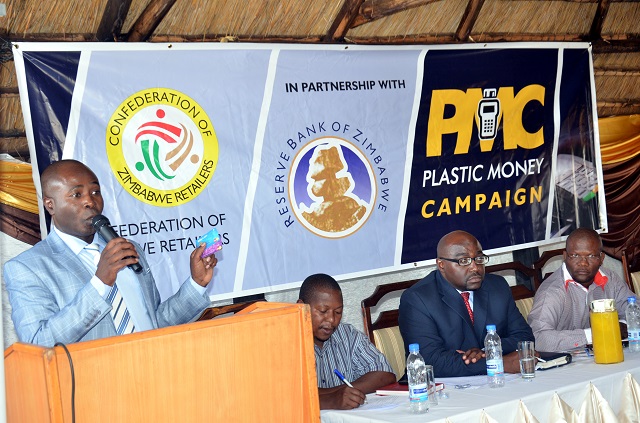

Robin Muchetu, Senior Reporter
THE Reserve Bank of Zimbabwe together with the Confederation of Zimbabwe Retailers have encouraged businesspeople in Gwanda and other towns surrounded by rural areas to embrace the use of plastic money to aid ease of doing business.
CZR president Mr Danford Mutashu told businesspeople at a sensitisation conference in Gwanda on Friday that adopting plastic money will ease on the demand on hard cash.
“We want people in Gwanda to use plastic money more because there is demand for the United States dollar. We went around and saw that Gwanda is a great place and there is potential for development. There should be manufacturers that set up here and small businesses being assisted to do business so that they serve retailers in these areas,” he said.
RBZ deputy director Bulawayo region Mr Kasanda Sibanda said young people were key in pushing for a cashless transaction society. He said with a large number of young people in Zimbabwe there is going to be a high uptake of the use of plastic money as young people are more technologically conscious.
Some delegates said they were being short changed in cashless transactions as goods were now double priced, one for cash and another for swiping with a bank card.
“It is illegal for retailers to be charging double for cashless transactions, prices of goods have to remain the same even if you are using a Point of Sale (POS). Such companies should be reported to the RBZ,” said Mr Sibanda.
Delegates said some businesspeople were not accepting credit and debit cards and this was discouraging them from using the method of transaction. Farmers who attended the conference said they were bound to face challenges with plastic money as the services are not readily available in rural areas.
A local farmer Mr Lehlohonolo Mokoena said: “We understand the concept but the challenge is that in some parts there is no electricity or network so it does not make sense for us to embrace it. Even our workers cannot be paid via this means,” he said.
Mr Mokoena said it will be time consuming for workers to be travelling into towns looking for places that offer plastic money services when they are coming from rural areas. In response Mr Mutashu said mobile money companies must extend their services to rural areas.
“Over 70 percent of the population in Zimbabwe is in the rural areas and yet service providers are concentrated in the cities where there is a fraction of the population. Whose interests are they serving?” he questioned.
During the conference it was also highlighted that inter-bank connectivity was vital as some POS machines were not accepting cards from certain banks which has seen shops being forced to acquire many POS.
Gwanda Municipality Economic and Development officer Mr Mandlenkosi Moyo said the country was more than five years behind in term of use of plastic money and said more and more people need to be educated about its importance.


 Online Reporter