Online Reporter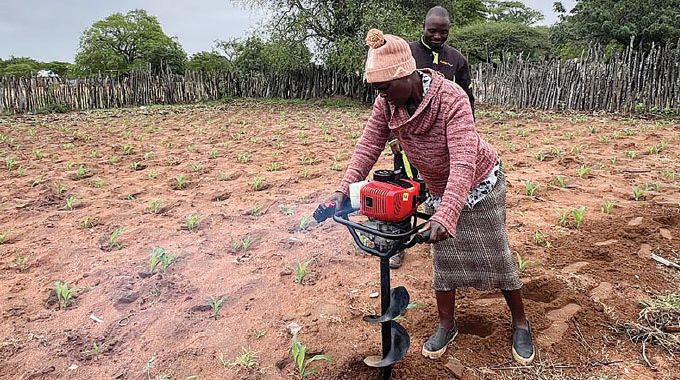
Sukulwenkosi Dube-Matutu, [email protected]
GONE are the days when Gwanda villagers shunned the Pfumvudza/Intwasa farming model for being a labour-intensive exercise when digging holes after Ntanye Women’s Farming Group members received soil auger machines that will greatly reduce the time they spend preparing their plots.
A total of 172 farmers from 15 groups in Gwanda District are beneficiaries of the Humanitarian Drought Response Programme being implemented by Government in partnership with Welt Hunger Hilfe (WHH).
Each group has 10 members and they can rent out the machine to other farmers to generate income.
A soil auger machine is a drilling device used to drill holes and is a convenient piece of equipment for farmers implementing the climate-proof farming model that has been adopted by farmers across the country as the Government targets 14 million Intwasa/Pfumvudza plots by smallholder farmers in the 2025/26 summer cropping season.
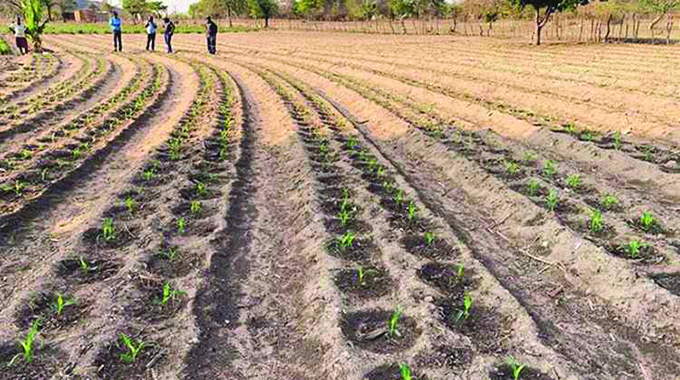
Intwasa/Pfumvudza model — centred on conservation farming, efficient water use and improved soil management — continues to be the cornerstone of Zimbabwe’s agricultural transformation and food security strategy amid the growing threat of climate change.
A soil auger holes out a standard Pfumvudza/Intwasa plot in less than an hour yet manual holing of the same size of land would take several days, a factor that is appreciated by Ntanye Women’s Farming Group member and beneficiary Ms Silibaziso Nyoni (66).
“We purchased the soil auger machine with the help of WHH last month. We have now started using the machine to dig holes in our plots and for some the process has already been completed,” she said.
“Having this machine is a huge relief to us as digging holes manually was taxing for us.
“For a person of my age it was difficult for me to complete my plots yet we had to embrace Intwasa to record good harvest. Farming has become easier and we can prepare our plots within a short space of time and concentrate on other chores,” said Ms Nyoni.
Some of the villagers, especially the elderly and those of poor health, have in the past expressed concern that the Intwasa/Pfumvudza model is labour-intensive and that they cannot stand spending days in their plots just to complete the holing process.
The Government has responded to the concerns by mechanising the Intwasa/Pfumvudza programme, where farmers can use machines like soil augers and tractors.
Ms Duduzile Ndlovu (50) said they were taking turns to prepare plots in their field to ensure that the work is done timeously for all members of the group to plant on time.
She said instead of spending almost a week working on one plot in her field, the work was complete within an hour. Ms Ndlovu said as women they are also able to handle the machinery.
“As we progress, we hope to rent out the soil auger machine to other farmers so that we can get income from the machine. We will also be able to able to assist fellow farmers in the process to reduce labour involved in holing,” she said.
The humanitarian drought response project, which started in March, is coming to an end this month. It is also being implemented in Mount Darwin District.
The project is being funded by German-based organisation Bauer Foundation with WHH as the implementing partner. Various Government departments will play an advisory role.
Matabeleland South Provincial Agricultural and Rural Development Advisory Services (Aards) director, Mrs Shupikai Sibanda, urged farmers to embrace mechanisation, saying that where farmers cannot afford to buy the machinery, they can come together and mobilise resources to buy the equipment, which they can share.
“This is a worthy investment for every farmer who is enrolled under the Pfumvudza/Intwasa programme, not just the elderly or the not-so-physically-strong,” said Mrs Sibanda.
“The cost is competitive if we consider the work that the machine does. A soil auger holes out a standard Pfumvudza/Intwasa plot in less than an hour yet manual holing of the same size of land would take three days or even five.
“Wider adoption of the soil auger will ease the physical burden on farmers. It enhances their efficiency and saves time,” she said.
Mrs Sibanda said communities have to embrace various Government support programmes to cushion farmers against the effects of climate change.
She said the prevailing weather conditions require farmers to depart from the traditional way of farming.
A number of companies have started producing and selling earth augers, which are hand-operated, petrol-powered machines with a cost of between US$135 and US$250 each, depending on their size.–@DubeMatutu