admin
admin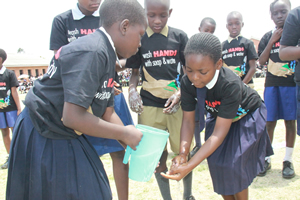
Child Welfare Minister Henry Madzorera said yesterday.
Over 10 000 people were infected with cholera in 2008 and 15 000 suffered from the disease in 2009.
Speaking at the launch of Global Hand Washing Day in Budiriro, Minister Madzorera said washing hands with soap had proved to reduce the incidence of diarrhoea diseases by 50 percent and respiratory infections by 25 percent.
“Hand washing with soap, particularly at critical moments including after using the toilet and before handling food, is among the most effective and inexpensive ways to prevent diarrhoea diseases and pneumonia,” he said.
DISCUSS THIS STORY ON FACEBOOK
He discouraged the washing of hands with water only as it removed only visible dirt.
“The belief that washing hands with water alone to remove visible dirt is sufficient to clean hands is common in most countries including ours.
“Using soap adds to the time spent washing, breaks down the grease and dirt that carry germs by facilitating the rubbing and friction that dislodge them and leaves hands smelling pleasant,” he said.
The minister also noted that not only the use of expensive soaps removed dirt.
He said researchers in several developing countries illustrated that lack of soap was usually not the barrier as a majority of poor households had access to soap.
Minister Madzorera said hand-washing day was commemorated to commit policymakers and stakeholders to provide a supportive and enabling environment that promoted appropriate hand washing.
“The main objective of the commemoration is to nurture and promote a culture of appropriate hand-washing at home, in institutions, at school, at work places and at any social gathering,” he said.
Unicef representative, Dr Peter Salama, said his organisation was working to improve the safety of Zimbabweans through supplies of hand washing facilities, particularly in schools and other public places.
“Unicef remains committed to working together with the Government of Zimbabwe, development partners, United Nations sister agencies, civil society organisations and communities to ensure that Zimbabwe’s women and children have access to clean and adequate water,” he said.
World Health Organisation country representative, Dr Custodia Mondlate, said hand washing was effective in preventing water borne diseases.
“The fact that we are gathered here today to commemorate this day and not to respond to any cholera outbreak, as was the case in 2008 and 2009, is a true testimony of how the simple practice of hand-washing with soap and water can contribute to saving millions of lives from water borne diseases,” he said.
In Zimbabwe, there are so many cases where people greet each other with open palms and these include funerals, church gatherings, workplaces and weddings.



 Online Reporter