admin
admin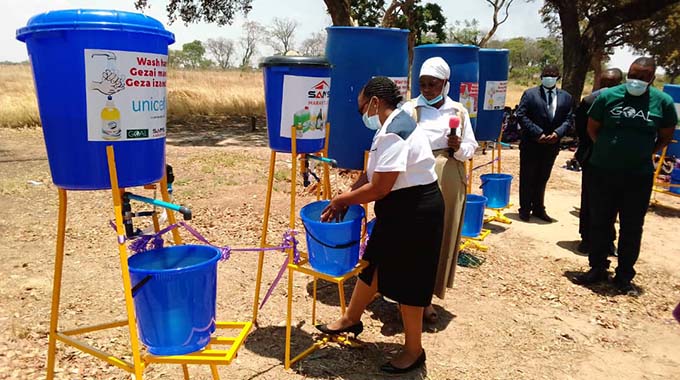
Ivan Zhakata-Features correspondent
Handwashing has become the most common method to prevent the spread of the deadly Covid-19 virus in many communities.
The virus has wreaked havoc across the world bringing the economy to a standstill. Schools have not been spared with the education system world over affected as kids either have limited face to face time with teachers
or learn remotely. Either way, children have been affected and there is need to find solutions so that normalcy returns to the classrooms and playgrounds.
As a solution to this challenge, a local firm, SANS Marketing has introduced handwashing facilities which cater for more people in reducing the spread of Covid-19.
The units are designed in such a way that a person can press a pedal using his or her foot and the drum releases water while he or she washes hands to avoid close contamination as per World Health Organisation recommendations.
This invention is similar to the tip tanks (chigubhu gear) used in rural areas, but more modern and containers bigger.
SAMS managing director Mr James Samhembere said when the Covid-19 pandemic started they thought of a strategy whereby people can clean their hands through handwashing facilities.
The idea was mainly targeted at school and public places which are frequented by large numbers of people.
Mr Samhembere added the technology will help a lot in schools as they will be
using hand soaps, which are cheaper than sanitisers.
He said in order to reduce the spread of Covid-19 in public places, they recommend washing of hands with clean running water and soap.
“A lot of schools will also benefit from these facilities. We have had a partnership with GOAL Zimbabwe where we have been supplying them with the units and they distributed them to schools and other public places,” Mr Samhembere said.
“In Harare, we have worked with GOAL where we have supplied four districts namely Mbare, Highfield, Waterfalls and Kuwadzana. All schools in these districts have got an average of four units at each school and the response has been very good.
“We have also supplied all Salvation Army owned schools. They have an average of about 648 schools across the country in all provinces. The schools have these units in different sizes. We also have schools in Murehwa where there is an organisation which bought the units for four schools.”
He added: “We have got AfriCare which covers Hurungwe and Zvimba districts and have bought 400 units and they are only distributed in schools but growth points as well. We also have ActionAid which covers parts of Manicaland and we have supplied more than 100 to them so all these units we have had good response.”
Mr Shamhembere said they have also produced a handwashing soap that goes with the handwashing facilities. He said the soap is developed in such a way that one and half litres dilute a 200 litre drum of water that can serve an estimate of 700 people.
“It is economic because if you use soap which is cheaper than sanitisers in a school which has around 1 000 pupils, it means that one litre a day can wash almost the entire school and handwashing facilities can be put at different strategic points at schools. If students are coming from the toilet and changing subjects, they can wash their hands and the school staff as well can do the same.
“We have seen some schools and institutions where you only wash your hands at the entrance, but these people are going to spend the whole day at the school. You need to have these handwashing facilities at
different strategic points so people can have access to them even when inside the premises,” he said.
Mr Samhembere said the Government through the Ministry of Health and Child Care and education ministries, churches and NGOs needed to come together in making sure that all schools, public places, clinics, hospitals and funerals have the handwashing facilities as they come in handy in combating Covid-19.
“In an exercise that we did in Mbare for three months, statistics showed that 3. 2 million people washed their hands in that community through our hand washing facilities. That helped in reducing not only Covid-19 but also other communicable diseases like diarrhoea and typhoid.”



 Online Reporter