Chronicle Editor
TODAY the country makes history with the holding of the 42nd Independence Day main celebrations in Bulawayo, the first time they are being held outside Harare since 1980.
The day was preceded by a children’s party at State House in Bulawayo yesterday where the First Family hosted a select number of children drawn from all of the country’s districts.
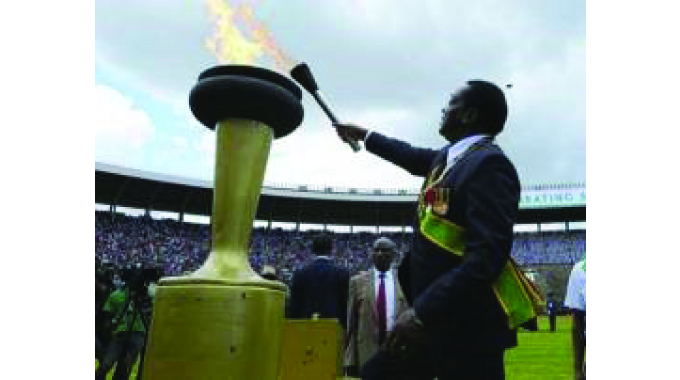
The Uhuru torch and Independence Cup also toured Bulawayo suburbs in the build-up to the celebrations today.
The country’s two football giants Highlanders and Dynamos will clash after official proceedings after which a music gala will be held.
This is the day for all Zimbabweans to celebrate the sacrifices made by the sons and daughters of the soil in liberating the country and the gains made thus far.
The people of Bulawayo and surrounding areas are therefore, encouraged to come to Barbourfields Stadium in their numbers to celebrate this important day.
The President is on record as having said that the decision to devolve the country’s national celebrations is a profound statement on collective ownership of the days.
“For the first time in the history of our 42 years of Independence, we mark this sacred day away from Harare, our capital city. The commemorative festivities will be held in Bulawayo, our second largest capital.
“This is much more than a mere change of venue and geography. It is a profound statement on collective ownership of the day.
We all share it as Zimbabweans, regardless of village, town, city, district or province. Indeed, that day unites us all as one people, whatever our colour, creed, tribe, sub-culture, language, age or gender.
For that reason, no one place or city monopolises its commemoration,” said President Mnangagwa in his Sunday weekly column at the beginning of the month.
He said from this year going into the future, all regions will take turns to host this very important day so that the whole nation identifies with it in equal measure.
“Again, this is more than a mere hosting responsibility; it is an opportunity for the national leadership to concentrate its focus on specific and peculiar needs of each region when it hosts this national event.
“In future, the host region must arrange for a week-long conference preceding the anniversary, and during which the focus will be on it exclusively.
This neatly dovetails with our broader, constitutionally mandated policy of devolution by which powers of, and decisions on, governance and development cascades down to regions,” he said.
He said the day is supposed to present an opportunity for the country’s leadership to take stock of how each of the 10 regions has fared, or is faring, in carving a distinct economy based on its unique factor endowments.
“Any one region hosting our Nation for this happy commemoration, must give us a picture of its total situation, warts and all.
We want to know about the state of infrastructure, the basic social amenities, the state of education, contribution to our national agriculture, the natural resources available to it, and how, in meticulous combination, all these are interacting to yield provincial GDPs and rural industrialisation which contribute to the overall national GDP,” he added.
The President says while it is good that the concept of devolution has brought with it the development of growth points that will burgeon into towns and cities, it was critical to ensure that the transformation to urbanity is underpinned and driven by gainful economic activity as opposed to concentrated human settlement.
“A key question to ask, therefore, is what economic activity agglomerates and supports those settlements? How are residents of those sprouting urban settlements eking out a living; what is their livelihoods,” he said.
“Such a key question allows us to plan for rural transformation through gainful economic activity, as opposed to rural pauperisation through thoughtless densification of settlements. Towns and cities are nodes of industrial activity; they are not just demographic propositions.”



 Online Reporter