Chronicle Editor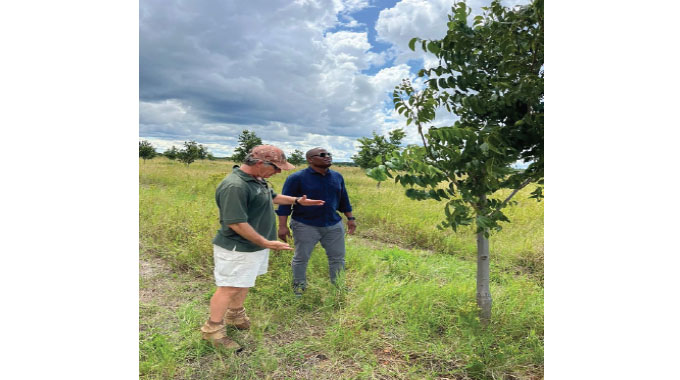
Sikhulekelani Moyo, Business Reporter
MATABELELAND region is set to start reaping commercial pecan nut export benefits in the next two years with trade development agency, ZimTrade, saying farmers in the region are showing positive progress in growing pecan trees.
Farmers in both Matabeleland South and North provinces have recently embraced growing of pecan nut trees while the Agricultural Rural Development Agency (Arda) has also joined the campaign.
In a recent interview, ZimTrade southern region manager, Mrs Jacqueline Nyathi, said the pecan nut tree project was progressing in the region.

Once commercial harvest starts, she said the project has the potential to benefit communities through employment creation, which contributes to economic development.
Mrs Nyathi, whose team visited one of the projects in Matabeleland North, urged farmers to increase hectarage under pecan tree growing in order to derive more export benefits in the long term.
“The pecan nuts project is progressing well with the trees starting to bear fruit and indications are that this project might be used to expand production of pecan in the region,” she said.
“Commercial harvest from the current project is expected to commence in the next two years.”
Pecan nut trees take five years to grow before bearing fruits and can survive for more than 50 years, experts say.
“Although the initial capital outlay is huge such as setting up irrigation systems and fertiliser application, once bearing fruit starts, the tree can offer returns for more than 50 years if cared for well,” said Mrs Nyathi.
“Thus, pecan nut farming is a long-term investment with huge financial rewards.”
Prominent Umguza farmer and Zimbabwe Commercial Farmers Union (ZCFU) member, Mr Winston Babbage, said although there is no complete database of farmers engaged in pecan nut production in Mat North, he was aware of the drive to boost the project, which also involves the Arda Balu Estate in Umguza District. He also said he has visited the estate on a familiarisation tour.

“As ZCFU we are mobilising interested farmers to take on this lucrative project. There are 133 trees per hectare with each plant taking between seven to eight years to reach maximum production of 50kg per tree, giving us a total yield of 6 650kgs at an out-grower price of 7USD per kg, giving us a total of 46 550USD per annum,” said Mr Babbage.
“The trees can last for well over 100 years. In conclusion we are spreading the gospel on pecan production as the way forward to complement our export of tobacco and others.”
The pecan tree is originally from South America and was discovered to thrive in the Zimbabwean climate because of the good soils and weather patterns.
Due to changes in customer need, ZimTrade said the demand for pecan nut is expected to grow, which will give Zimbabwean farmers export opportunities.
“Taste for the pecan is growing in major markets of the world, indicating export opportunity for local producers,” said Mrs Nyathi.
“Over the next years, the global demand for pecan nuts is expected to grow significantly, driven by changes in consumption patterns including rising demand for alternative sources of protein that replace meat.”
Citing findings from Trade Map, ZimTrade said in 2020 the global market for pecan nuts was set at US$2,17 billion, with the United States of America being the largest consumer taking 40 percent.
To support growth of pecan nut production, ZimTrade said the Government has put in place a number of incentives to promote agriculture production and exports.
As a trade development and promotion organisation, ZimTrade has been engaging local and international partners to come up with interventions that will boost production of crops and trees with export potential.
– @sikhulekelaniM1
Normal
0
false
false
false
EN-GB
X-NONE
AR-SA
/* Style Definitions */
table.MsoNormalTable
{mso-style-name:”Table Normal”;
mso-tstyle-rowband-size:0;
mso-tstyle-colband-size:0;
mso-style-noshow:yes;
mso-style-priority:99;
mso-style-parent:””;
mso-padding-alt:0in 5.4pt 0in 5.4pt;
mso-para-margin-top:0in;
mso-para-margin-right:0in;
mso-para-margin-bottom:8.0pt;
mso-para-margin-left:0in;
line-height:107%;
mso-pagination:widow-orphan;
font-size:11.0pt;
font-family:”Calibri”,sans-serif;
mso-ascii-font-family:Calibri;
mso-ascii-theme-font:minor-latin;
mso-hansi-font-family:Calibri;
mso-hansi-theme-font:minor-latin;
mso-fareast-language:EN-US;}
Normal
0
false
false
false
EN-GB
X-NONE
AR-SA
/* Style Definitions */
table.MsoNormalTable
{mso-style-name:”Table Normal”;
mso-tstyle-rowband-size:0;
mso-tstyle-colband-size:0;
mso-style-noshow:yes;
mso-style-priority:99;
mso-style-parent:””;
mso-padding-alt:0in 5.4pt 0in 5.4pt;
mso-para-margin-top:0in;
mso-para-margin-right:0in;
mso-para-margin-bottom:8.0pt;
mso-para-margin-left:0in;
line-height:107%;
mso-pagination:widow-orphan;
font-size:11.0pt;
font-family:”Calibri”,sans-serif;
mso-ascii-font-family:Calibri;
mso-ascii-theme-font:minor-latin;
mso-hansi-font-family:Calibri;
mso-hansi-theme-font:minor-latin;
mso-fareast-language:EN-US;}



 Online Reporter