admin
admin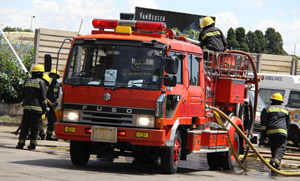
Council’s fleet of fire tenders is grounded.
The only vehicle still running is from Greendale fire station but had a breakdown yesterday on its way to Kuwadzana to extinguish an inferno. It had to be towed to the scene.
However, the mission had to be abandoned after fire officials were told residents had put out the fire.
The city’s fire brigade department has 43 fire tenders listed on its asset sheet, some of which are as old as 58 years.
Of the 25 ambulances the city’s fire section has, only three are operational although they regularly breakdown.
Of the 43 fire tenders, 27 are reported to be non-runners, while the other 16 are said to be “on and off,” and always grounded due to faults such as faulty batteries, malfunctioning breaks and water pumps.
This means the city has no single vehicle functional at its fire sections.
Sources revealed yesterday that the department used to depend on a Japanese donated fire tender that has since broken down.
This has paralysed the department and now finds it difficult to attend to cases of fire outbreaks.
The only vehicle still in good condition is the one used to attend to fuel fires. This vehicle uses foam to extinguish fire and its tank cannot carry water.
The department yesterday failed to attend to two reported fire cases in Kuwadzana and Belvedere because the Greendale truck the department depends on, broke down twice on its way to the two scenes.
Kuwadzana and Belvedere have fire stations that do not have any functional truck.
“It’s very sad . . . We were actually towing the fire tender to the scene, but abandoned it after we received calls that the fire had been put out by the residents,” said a source.
A second incident occurred in Belvedere near the Harare Exhibition Park and the scene had to be attended using the same Greendale vehicle, which again failed to make it as it broke down just after a kilometre.
Sources within the department disclosed that the major problem within the city council was prioritisation of matters.
“It seems some authorities do not understand the importance of the fire brigade and they have handicapped us. The vehicles are very old and are always breaking down.
“We are afraid this situation could lead to disaster in the event of a severe fire outbreak,” the official said.
It is understood that the department last had new vehicles in 1991. The department has smaller vehicles that have the capacity to carry about 400 litres – which is not enough to put out strong fires.
“We can only spend a minute with the 400 litres of water. We need water carriers with a capacity of 9 000 litres,” the official said.
The department said it could efficiently discharge its duties if given two vehicles at the Greendale station, two for Kuwadzana station and four stationed at the Belvedere station.
Every year council complains about lack of fire fighting equipment with 95 percent of its equipment having outlived its life span.
This means the manufacturers could have phased out some of the fire tenders making it difficult for the department to get spare parts.
Yesterday, chief fire officer, Mr Saviour Mugava, said he had recently briefed Local Government, Rural and Urban Development Minister Ignatius Chombo about the challenges facing the department.
He could, however, not give more details on the matter.
But city spokesman, Mr Leslie Gwindi yesterday painted a different picture of the situation, arguing all was well with the city’s fire department.
He said the department was not facing challenges without elaborating.
“Recently, we gave your paper a conclusive story and there is nothing new.
“I have been informed about today’s (yesterday) incidents and it is not true that the fire fighters failed to attend because there was no operational fire tender. There is nothing like that and please do not argue with me,” Mr Gwindi said.
Harare is a fairly busy city with fires of different magnitudes being reported daily in addition to road traffic emergencies, some of which require the attendance of fire fighters with proper equipment.
There are also fears that most tall buildings in the city are at risk in case of fire outbreaks because of low water pressure.



 Online Reporter