admin
admin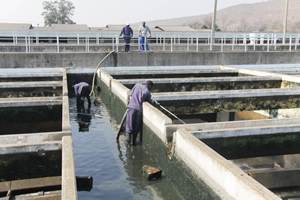
close to Harare’s raw water abstraction point.
The freezing temperatures are also “solidifying sewer effluent,” affecting works.
Town clerk, Dr Tendai Mahachi, yesterday confirmed the increased pollution of Lake Manyame by Norton Town Council was part of the problem.
He showed the news crew clarifier ponds that were being cleaned to remove the blockages during a tour of water works yesterday.
He said Harare was buying pumps to ensure the Norton sewer was pumped into a nearby plantation instead of Lake Manyame.
“I am going to seek the mandate of council,” he said.
At least US$400 000 is needed to resuscitate the Norton sewer plant.
The water situation is worse in the satellite towns of Chitungwiza, Ruwa and Epworth with Chitungwiza reporting three cases of typhoid.
Residents were seen scrounging for water in Warren Park, Westlea, Chitungwiza, Ruwa and Norton yesterday.
In Highlands, Borrowdale, The Grange, Chisipite and Glen Lorne areas, companies that sell water in bowsers are recording brisk business.
Residents are paying US$50 for a 5 000-litre tank, while a 2 500 litre tank costs US$40 to fill up.
The water delivery companies do not serve high-density suburbs, a situation that forces residents to resort to shallow wells and boreholes.
Women are the hardest hit as they walk long distances to fetch water.
Mrs Henrietta Muyambo of Greendale suggested the city should deploy water bowsers each time there were water “challenges”.
Mr George Rashirai said the water shortages had affected his daily operations as he had to wake up early to look for water for his children.
Mrs Netsai Chinyuku of Belvedere said the suburb had not experienced any water shortages despite the city’s depressed supplies.
The Herald news crew yesterday visited the Morton Jaffray Water Treatment Plant to verify reports that the water clarifiers were blocked.
Harare Metropolitan requires 1 200 million litres a day.
Whittling supplies to around 311 million litres means only a few residents have access to water.
About 45 percent of the treated water is lost either through leaks or thefts.
This implies that very little of the 311 million litres reaches the people.
“Our raw water quality is bad.
“Normally we get 70 percent of our raw water from Lake Manyame.
“But because Norton is discharging its raw sewer into the lake we have had to cut back on the amount of raw water we abstract,” said Harare Water director Eng Christopher Zvobgo.
He said the city had been forced to revert to the heavily polluted Lake Chivero, which is upstream of Lake Manyame.
The effect of the heavy pollution is that the city has increased its chemical dosage into the water, attracting a huge monthly bill in excess of US$3 million.
Norton chief executive officer, Mr Winslow Muyambi, confirmed his council was discharging raw sewer into the lake and that the sewer had affected Harare’s raw water abstraction.
“It is true we have a problem. Our plant collapsed,” he said.
He said the council has drafted a work plan which cannot be implemented because of cash-flow problems.
Norton owes Harare over US$1,2 million in unpaid water bills while its own residents owe it US$1,7 million.
Failure to pay by both Norton and its residents has serious repercussions on reinvestment in the water sector.
Mr Muyambi said besides council, industry was also directly off-loading its untreated wastewater into the lake.
He said such activities were not only affecting potable water availability but other water-related activities like farming, fishing and rowing.



 Online Reporter