
Theseus Shambare
FROM afar, the rugged escarpments punctuating certain Harare suburbs might be mistaken for natural geological formations, remnants of the city’s ancient landscape.
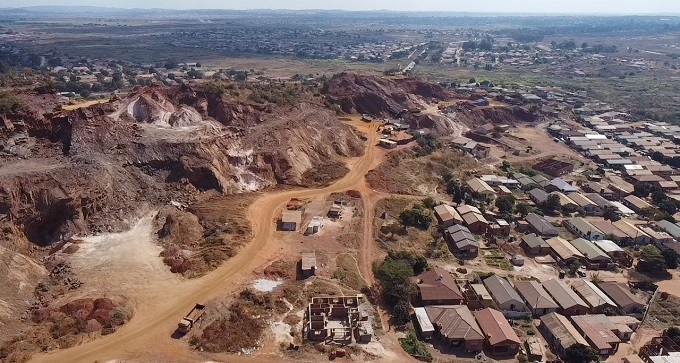
However, a closer examination reveals something else: residential properties now lie perilously on once-stable hillsides, the consequence of sustained gravel extraction.
Areas such as Warren Park, Kambuzuma, Aspindale and Mabvuku exemplify this precarious situation, where dwellings are now below eroding slopes, susceptible to structural failure triggered by heavy rainfall or other anthropogenic activities.
The inhabitants of these areas endure a constant state of apprehension, fearing displacement due to the instability of their living environments. This situation underscores the urgent need for effective urban planning and environmental regulation to mitigate the risks associated with unsustainable resource extraction and protect vulnerable populations.
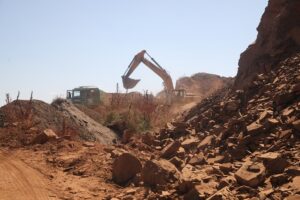
Every day, heavy trucks traverse the roads of these suburbs, making their way uphill to transport gravel.
“You hear the trucks, the ground shakes and all you can do is hope it holds for one more night,” said Chiedza Mavheneka, a resident of Kambuzuma, whose house is one of those located at the foot of such disappearing hills.
“Each rumble sounds like disaster creeping closer.”
The silent menace is environmental degradation, driven by unchecked gravel and sand extraction. Across suburbs, miners and dump trucks have transformed once-serene landforms into scenes of destruction.
A shift manager for trucks and front-end loaders operating in one of the areas, who requested anonymity, offered his perspective.
“This whole hill carries various people’s stands. Most of them cannot afford to construct their houses in the hills like what we see in other leafy suburbs,” he said.
“Conversely, we are a construction company and need this gravel for our various projects. Most of this gravel, we sell it to people whose stands are in wetlands. We also supply for slab backfilling, as well as road patching.”
The shift manager explained that a cooperative comprising local residents engaged them to level the hill for easier construction.
But this comes at a steep cost — trading future environmental stability for immediate housing needs.
Concern
Harare Residents Trust director Precious Shumba has been sounding the alarm for years. He directly addressed the situation at Warren Hills in Warren Park.
“The environmental degradation at Warren Hills has been of concern to the residents of Harare for a long time,” he said.
“What is most disturbing is that the people involved in gravel mining are not remitting any of their revenues to the Warren Park community as corporate social responsibility. The roads are being damaged and the environment has been desecrated. In a few years, Warren Hills will be history.”
Shumba said illegal operations, particularly in Mabvuku’s wetlands, are reportedly enabled by corruption.
“Residents have voiced concerns about sand mining,” he said. “There have been allegations of bribes being offered by sand miners, including organised trucking companies operating in plain sight.”
Beyond the visible destruction, communities face long-term risks: land instability, erosion, contaminated water and garbage dumping in degraded wetlands.
“These sites can still be restored. But it requires commitment from all stakeholders. Residents must be included in monitoring and holding the authorities accountable,” Shumba said.
Harare City Council’s silence
Despite the destruction of the hills and the devastating environmental damage being inflicted in the process, the Harare City Council has remained quiet on the case.
For weeks, the council officials have been sitting on questions from The Sunday Mail Society seeking answers on what they were doing to avert the unfolding environmental disaster. The inquiry sought to find out what the city council was doing to ensure the gravel extraction, if it is being done legally, has a minimal impact on the environment.
The city was also asked about its plans to prevent future environmental degradation, particularly on landforms and in open spaces.
The Harare (Protection of Marginalised Land) By-laws, 2014, prohibit certain activities on marginalised land. The by-laws say no person shall, without a valid licence issued by the Environmental Management Agency (EMA) in terms of section 21 of the Environmental Management (Environmental Impact Assessment and Ecosystem Protection) Regulations, 2007, the proof whereof shall lie upon him or her, remove, dredge, fills, build upon, cultivate, excavate, degrade or otherwise alter in any way the soil or surface of
(a) wetlands; or
(a) sloppy areas; or
(b) hills; or
(c) land within thirty (30) metres of the naturally defined banks of a public stream; or
(d) land within thirty (30) metres of the high flood level of any body of water conserved in artificially constructed water storage on a public stream; or
(e) bed, banks or course of any river or stream; or
(f) any other area which the council may from time to time designate as such.
Prevalence/Legality
EMA said the extraction of gravel and sand was rampant in Harare.
The agency’s environmental education and publicity manager, Ms Amkela Sidange, said the extraction of gravel in some areas of Harare was being done by the City of Harare under an approved environmental management plan (EMP). But the activities were being done illegally in many other parts of the city.
“We monitor the activities based on the plan produced by the council,” she said.
“But activities in open spaces near Kambuzuma and Mufakose are illegal.”
She said environmental protection orders and fines were being issued in areas where gravel and sand were being extracted illegally.
“We are working with other enforcement agents to ensure compliance. Rehabilitation is part of the environmental management plan and we are monitoring that,” said Ms Sidange.
However, residents remain sceptical about the consistency of enforcement.
“From our perspective, there is selective enforcement,” Shumba said. “People with political connections continue mining without consequence, while ordinary citizens are punished.”
But EMA insists a “whole-of-government” approach is being taken.
“Local authorities are the gatekeepers of these natural resources,” Ms Sidange said. “They must craft and enforce by-laws to protect the areas.”
EMA reckons wetlands are crucial ecosystems. “Once disturbed, they take hundreds of years to regenerate,” she said.
Government perspective
In an interview with The Sunday Mail Society, Local Government and Public Works Minister Daniel Garwe said his office was prioritising environmental issues.
“We have mandated local authorities to work closely with EMA and other institutions to address illegal land use and protect the environment,” he said.
“Even registered companies must be monitored closely. Any divergence from agreed terms must be punished.
“We understand that Harare has launched an environmental and climate policy to encourage resident participation in environmental management.”
He acknowledged widespread illegal land use and destructive mining, pointing to ongoing reforms.
“Cabinet recently approved the Urban State Land Management Policy. It will improve transparency, accountability and operational efficiency in managing urban State land,” said Minister Garwe.
The policy aims to clarify the roles of stakeholders, standardise procedures for land acquisition and sale, and strengthen oversight mechanisms to curb corruption and unregulated developments.
Minister Garwe said a legal review was underway.
“Harare has over 500 by-laws, many outdated. We are working with the Attorney-General’s Office and the city to update them,” he said.
He emphasised the need for cross-sectoral collaboration.
Risk
Back in Kambuzuma, the daily presence of heavy trucks and earthmovers has left residents emotionally and physically shaken.
Homes on the slopes suffer the brunt of land tremors as the hill is stripped away.
Mavheneka points to a visible crack snaking across her veranda.
“It started after the rains last year. And now, with each truck that passes, it appears to be widening,” she said.
She added that if she had somewhere to go, she would have relocated, but her only option is to wait and hope.
“Rain will be the end of us if this continues,” notes Anesu Dzingai, another resident. “The water will find its way through these cuts and finish what the machines started.”
While the hills are disappearing, the gravel removed from them is often dumped into wetlands to prepare a strong ground for housing construction, creating another potential environmental crisis.
The gravel truck manager confirmed: “We get orders from cooperatives developing wetlands. That is where a lot of this gravel ends up.”
According to experts, the extraction of gravel and sand compromises Harare’s water table, destroys natural drainage systems and increases the city’s vulnerability to flooding.
A 2022 report by the Zimbabwe Environmental Law Association (ZELA), titled “Environmental Crime and Urban Land Degradation in Zimbabwe” and authored by Shingirai Vambe and Tafadzwa Chikumbu, sheds light on the growing complicity behind such destruction.
“Land barons and mining cooperatives are operating in Harare’s wetlands, hills and open spaces,” they wrote.
The authors caution that such activities are not only illegal but are also “worsening urban poverty by displacing vulnerable residents, destroying public infrastructure and polluting community water sources.”
According to EMA’s 2020 State of the Environment Report, illegal sand mining and waste dumping in Harare’s wetlands and hills pose serious risks of erosion, land instability and water pollution in surrounding residential areas.
What lies ahead
Harare’s environmental crisis reflects a larger local authority governance failure and lack of political will to enforce by-laws.
Yet all is not lost.
“We are saying the days of land ‘baronism’ are over. Developers will now carry genuine, securitised papers from the ministry,” Minister Garwe declared.
But action needs to be taken fast because, on the ground, time is running out.
“The hills will not wait for bureaucracy. What we need is urgent, inclusive action to protect lives and restore our natural heritage,” said Shumba.
Without swift and coordinated efforts, Harare’s once-proud hills may soon be gone, along with the safety and dignity of the people who live beneath them.