

 admin
admin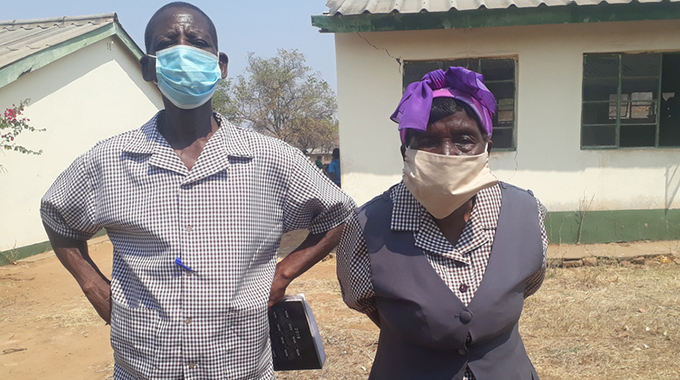
Roselyne Sachiti Features, Health & Society Editor
A seventy-six-year-old woman clad in a brown and white dress, and a grey waistcoat walks into a classroom at Mudzengerere Secondary School in Mount Darwin district.
Holding a small handbag, Letty Chindundundu of Kamiremire village in the Dotito, is covering her nose and mouth with a mask, as her eyes scan the room.
She checks if a group of boys and girls seated on desks are practicing social distancing and also if they all have masks on.
Moments later, Gogo Chindundundu goes outside to see if children waiting for their turn to have deworming medicines — praziquantel and albendazole — being freely distributed through the Ministry of Health and Child Care (MoHCC)-led National Treatment of bilharzia and worms also known as Mass Drug Administration (MDAs), are also covering their mouth and nose.
For Gogo Chindundundu, a village health worker (VHW) since 1982, this is just like any other day in the office.
The manner in which she does her work and the energy she exhibits when doing so tells of her years of experience, dedication and commitment.
She tells The Herald Saturday that she has never stopped doing her job of providing primary health care and keeping her community healthy since then.
She wants to leave a legacy.
“Since I was young, I always had a passion to serve my community,” said Gogo Chindundundu. “I was born like that and will continue doing so till I die. I want the younger generation to learn from me.”
In 1982, Gogo Chindundundu, then a mother of two, was one of the people who trained to become a VHW at Karanda Mission Hospital.
“I was trained in communicable and non-communicable diseases,” she said with pride. “I started field work in 1983 and have never stopped. Even with this bigger task (Covid-19), I still have enough time to take care of my family’s needs.”
For a non-paying job, her role has become demanding lately, as many people in rural areas are complacent when following Covid-19 prevention measures like social distancing, wearing of masks, and hand washing, among others.
When she first heard of Covid-19, Gogo Chindundundu knew she had to do more to protect herself first, given her age which is high risk, and also her community.
She was hungry to learn more about the novel disease.
“I listen to the news and hear what is being said about Covid-19,” she said. “I also learn about Covid-19 from health officials at Mount Darwin Hospital and other development partners who come here.”
Armed with knowledge, Gogo Chindundundu does not tire and goes around her community educating people on the dangers of Covid-19.
“When I hear new local statistics, I quickly educate the people to prevent misinformation,” she said. “I tell them the number of people who have died, those who have recovered and the number of positive cases. A lot of people in rural areas think that Covid-19 is for those in urban settlements and other countries, so they do not wear masks.”
Gogo Chindundundu goes a step further in her work.
“At funerals, I make sure that I wear a mask,” she said. “People laugh at me when they see me wearing the mask. They say God will protect them. I always remind them that when one comes face to face with a lion, they do not just stand and pray just because God will protect them.
“They should run for dear life and the same applies with Covid-19. When I see such people sitting close to each other I tell them to observe social distancing. I also show them how social distancing should be done.”
As she walks around her community doing door-to-door visits, Gogo Chindundundu ensures people have water and soap containers for washing their hands. At her homestead and at most entrances in this area, soapy water containers known as “chighubhu gear” (a manually operated tip tap) are visible, and this makes Gogo Chindundundu happy.
Even if the visibility of “chighubhu gear” excites her, she ensures that people use them.
Before the emergence of Covid-19, she never stopped working and recalls some of the work she has done.
“Whenever there are mass drug administrations, I ensure that I go around the community to alert and educate them of the programme, when it will start and who is being targeted,” she said.
“For this mass administration programme, I rounded up 300 children who came to Mudzengerere Primary School. They all received their medicines and I am happy. I am now at Mudzengerere Secondary School to help other VHWs, whose areas have villagers coming here for the service.”
Gogo Chindundundu has answered many knocks on her door, sometimes in the dead of the night, clarifying information to those who would have shied to do so in public.
Her role as a VHW has seen a reduction of preventable and communicable diseases like bilharzia in her community, though cases keep resurfacing as a result of attitudes.
“There is need for social behaviour change,” she said. “People, especially men still go back to contaminated water sources. Sometimes I become unpopular when I ask them not to go back. They say they do not want to be bothered.”
With increased knowledge on health and the prevention of disease, Gogo Chindundundu has managed to maintain a healthy lifestyle.
“I make sure I eat a balanced diet to prevent non-communicable diseases like cancer, high blood sugar and diabetes,” she said. “I also ensure that my surroundings are clean to prevent diseases like cholera.”
In that part of country, malaria cases are high and Gogo Chindundundu has on countless occasions done rapid diagnostic tests (RDT) on people with symptoms and administered chloroquine to those found positive.
Educating people on proper use of mosquito nets and the importance of spraying programmes is part of her duties she does flawlessly.
She has also referred severe cases of malaria to clinics.
Gogo Chindundundu takes part in water and sanitation programmes like the rural WASH information management system (RWIMMS) in her community and provides real time updates of functional and non-functional boreholes in wards under her.
She was also there when HIV and Aids was at its worst in Zimbabwe.
“That time was difficult, especially before antiretroviral drugs came,” she said. “I did a lot of work educating communities on prevention measures.
“I also took time to educate traditional and faith healers of the need to refer people for HIV testing instead of telling them that their illness was a result of witchcraft. This helped increase numbers of people who went for HIV tests.”
Mr Danny Mapika (62), another VHW who has worked with Gogo Chindundundu since 1982, said she is a role model to him and many others in their community.
He believes that if more people have such commitment to their jobs, then communities will live healthier lives as information will be on their doorsteps.



 Online Reporter