admin
admin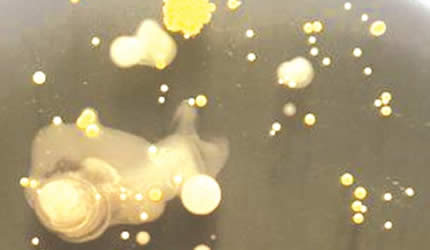
their mobile phones on to Petri dishes to see what they might carry.
Although the results after just three days looked pretty grim, thankfully most of the bacteria were harmless — nevertheless, it just shows the invisible life that can lurk on your phones.
Some disease-carrying bacteria were occasionally found, such as Staphylococcus aureus — a common cause of Staph infections including food poisoning, impetigo and even septicaemia.
It is thought that 20 percent of people are long-term carriers of the bug, which often lurks inside the nasal passages.
The colonies of bacteria that form after the phone has been imprinted are from the body’s invisible bacterial flora.
Now that the messages have been electronically received or delivered, they represent a tangible and biological residue of our manifold hellos and goodbyes.
Bacteria can utilise many different things as vectors in order to promote their transmission.
Insects, water, food, coughs and sneezes, sexual contact, and rain are just a few examples.
The mobile phone appears to be no exception this rule.
Dr Park said: “It seems that the mobile phone doesn’t just remember telephone numbers, but also harbours a history of our personal and physical contacts such as other people, soil and other matter.”
Dr Park said: “It seems that the mobile phone doesn’t just remember telephone numbers, but also harbours a history of our personal and physical contacts such as other people, soil and other matter.”
Dr Simon Park, senior lecturer in molecular biology, said: “As part of a course called Practical and Biomedical Bacteriology, an undergraduate module that I run, I get the students to imprint their mobile phones on to bacteriological growth Petri dishes so that we might determine what they might carry.
“It’s unusual but a very effective way of engaging our students with the often overlooked microbiology of everyday life.
“The ecological niche on the body for Staphylococcus aureus is the nostrils, so a furtive pick of the nose, and quick text after, and you end up with this pathogen on your smartphone.
“You can clearly see the outline of the phone on this, but the whole plate is covered by the spreading growth of a bacterium called Bacillus mycoides.
“This pattern of growth is unique to this bacterium and because soil is its natural habitat, we know that this phone or its user had recently been in contact with soil.
“Each phone tells a story.
“From these results, it seems that the mobile phone doesn’t just remember telephone numbers, but also harbours a history of our personal and physical contacts such as other people, soil and other matter.” — Daily Mail.


 Online Reporter