Online Reporter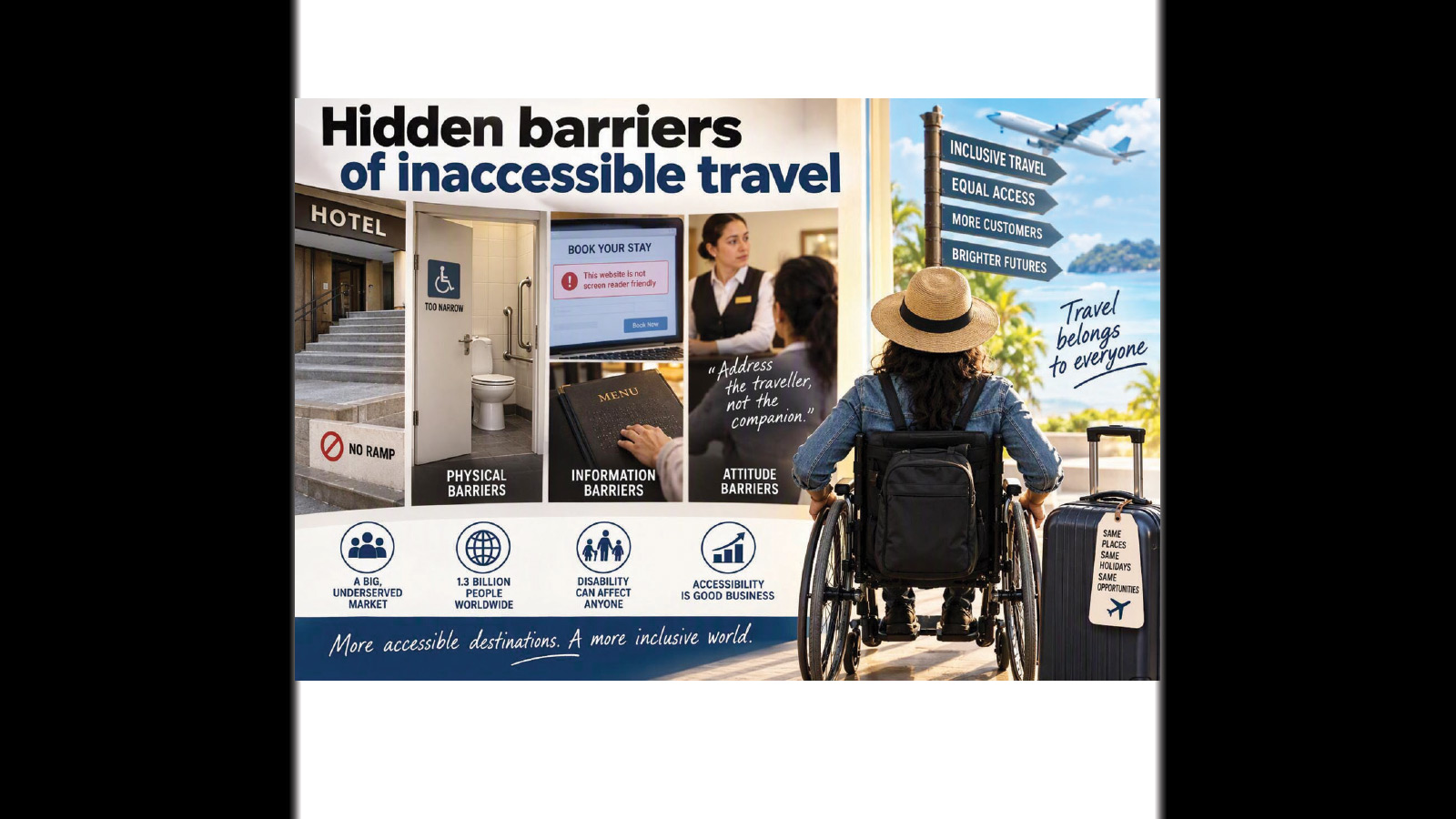
Disability Issues
Dr Christine Peta
MOST of us think a holiday is simple: choose a place, book a flight, go, stay and enjoy your holiday.
But for persons with disabilities, it may be a struggle.
The first barrier is physical.
A wheelchair user may arrive at a hotel to find that the “accessible room” is reached only by a service lift at the back.
There may be steps with no ramp.
A toilet may carry a wheelchair symbol, but the door may be too narrow to pass or it opens inward, so there is no room for the wheelchair to turn.
Grab rails may be behind the seat instead of beside it; the sink and soap may also be out of reach from the seated position of the wheelchair user.
In some instances, the accessible toilet door may be locked and the key held at reception, so every visit becomes a request and a wait and often the room has quietly become a broom and mop cupboard.
The second barrier is information.
A hotel may call itself “accessible” but never explain what that means.
A booking website may not be read by a screen reader, the software a blind traveller relies on to turn text, buttons and links into speech. What is supposed to be a four-minute booking may become an hour on the phone.
A restaurant may keep its menu on one laminated sheet that a blind customer cannot read. Yes, a waiter can read the menu aloud, but it costs dignity and independence.
Every visit begins with asking for a favour, as the customer with disabilities is not enabled to browse or change their mind privately and at their own pace, just like everyone else in the restaurant.
The menu is rarely the only inaccessible document: the wine list and the bill may also be inaccessible.
Large print or braille may not cost much, but the barrier survives because nobody in the business wants to notice it.
The third barrier is attitude, featuring staff who address the companion rather than the traveller with disabilities, alongside the quiet assumption that disability and adventure do not belong in the same sentence.
The toilet blocks the body, the website blocks the task, the menu blocks the social act and attitude blocks the welcome.
In some cases, a traveller with a chronic illness must plan around medicine, tiredness and a fridge for drugs, which are logistics that no brochure mentions.
For children with congenital disabilities, it starts early: school trips may be quietly cancelled and family holidays may be chosen for the parents’ convenience rather than that of children with disabilities.
Accessible travel is a large, under-served market.
Persons with disabilities rarely travel alone; they come with partners, children, friends and carers.
An inaccessible destination turns away all of them, leaving guests with no choice but to go elsewhere.
New digital laws may help by requiring websites and apps for shopping, banking and transport to be accessible from the start, not only on request.
Good design that plans for the widest range of bodies and minds from the beginning may be cheaper and kinder compared to fixing things later.
A dropped curb built for wheelchair users also helps parents with prams, delivery workers with trolleys and travellers dragging suitcases. Subtitles help in a noisy airport and clear signs help anyone who is lost.
The United Nations estimates that 16 percent of the world population consists of persons with disabilities, totalling about 1,3 billion people.
Most of us will experience disability at some point through injury, illness or simply getting older.
A tourism industry built only for the young and non-disabled is, therefore, built for a shrinking share of its future customers.
Inclusive tourism is not charity; it is good infrastructure, clear information and a little imagination.
Until “accessible” means what it is supposed to mean, the doors of tourism will remain closed to many persons with disabilities.
Dr Christine Peta is a disability, public health, policy, international development and research expert. She can be contacted on: [email protected]