Online Reporter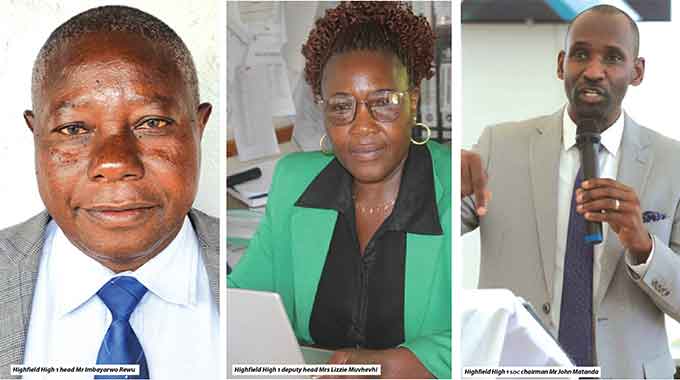
Takunda Gambiza
HIGHFIELD HIGH 1 School in Harare recorded notable improvements in its 2025 examination results after strengthening skills-based learning and targeted academic support under the Heritage-based curriculum (HBC), deputy head Mrs Lizzie Muvhevhi has said.
The approach, she explained, is anchored in the Heritage-based curriculum, which the school has fully implemented from Form One up to Upper Six, ensuring that learners are not only academically sound but also equipped with skills they can use beyond the classroom.
“As a school, we are being guided by the Heritage-based curriculum. We are looking at skills. We want our learners to have something in life, so we have a lot of projects that the school is carrying out to teach them so that they can be masters of their own and useful in their communities,” said Mrs Muvhevhi.
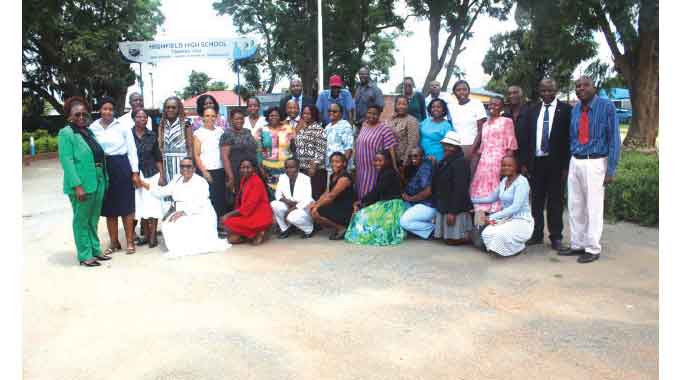
Founded in 1961 in Harare’s Highfield suburb, the school is a Government institution offering education from Form One up to Advanced Level, as well as non-formal classes for members of the surrounding community.
With an enrolment of about 1 500 learners and a strong establishment of qualified teachers, the school has positioned itself as one of the key educational institutions in the area.
Central to the school’s teaching philosophy are practical, income-generating projects that allow learners to apply classroom knowledge in real-life settings.
Mrs Muvhevhi said the school has expanded its agricultural programme, with livestock and crop production playing a major role.
“Recently, we started goat keeping, and we have about 39 goats.
“We also have roadrunners, about 600 of them, and a hatchery where we incubate and hatch eggs ourselves,” she said.
Learners, she said, are also actively involved in gardening projects focusing on cucumbers, onions, vegetables and maize. This is particularly the case with those pursuing Agriculture as a learning area, she added.
“We have learners doing agriculture, and we also want to introduce piggery so that the projects continue to grow.”
Beyond agriculture, the school places strong emphasis on balancing academic work with physical development and extracurricular activities.
According to Mrs Muvhevhi, timetables are carefully structured to allow learners adequate time for both studies and sport.
“We create timetables in a manner that gives learners time to focus on their academic work and also time to focus on their physical health,” she said.
Highfield High 1 offers a wide range of sporting activities, including soccer, netball, cricket, basketball, athletics and tennis. It has produced learners who have gone on to represent the school and the country at higher levels.
“We have a learner who went to Eswatini as part of the Zimbabwe basketball team. In athletics, we also had learners who qualified for national competitions,” Mrs Muvhevhi added. This holistic approach has also reflected positively on the school’s academic performance.
Examination results, she also said, have shown marked improvement, particularly at Ordinary Level.
“At O-Level, we improved to 89 percent last year from 79 percent in 2024,” she said.
At Advanced Level, the school maintained a high pass rate despite a slight drop.
“At A-Level, we had a 97 percent pass rate. It dropped by 1 percent compared to the previous year, and unfortunately two learners failed, but we had quality results.”
She said 19 A-Level candidates attained 15 points, which she said demonstrated the strength and quality of the results.
Mrs Muvhevhi highlighted that targeted academic interventions have played a key role in boosting pass rates, particularly for examination classes.
“We introduced Saturday studies for both O-Level and A-Level learners as a way of supporting them and strengthening their understanding of their subjects,” she said.
The school, she added, has also embraced technology-enhanced teaching and learning to improve outcomes.
“We are using interactive boards in classrooms, and the whole school is connected to the internet,” said Mrs Muvhevhi.
“Every teacher received a tablet from the school as a teaching tool, which has really helped in lesson delivery and learner engagement.”
Dedication and commitment
She attributed the school’s progress to the dedication and commitment of the teaching staff, whom she described as highly motivated despite limited material incentives.
“Our staff is self-motivated. They teach not because they expect incentives. We do not pay incentives, but through some of the projects, we offer lunch as a way of appreciation,” she said.
Mrs Muvhevhi also emphasised the importance of strong parent-school relations and the involvement of former learners, who continue to support the institution.
“We have former learners who are doing well in life and they come back to conduct workshops, to inspire the current learners and show them that success is possible,” she said.
Some of these former learners and partners have donated books, sports equipment and other resources, complementing support from the school development committee (SDC) and private companies that assist during school events such as speech and prize-giving ceremonies.
In addition to academic and practical training, the school places strong emphasis on learner welfare and mental health.
Guidance and counselling, she added, is fully integrated into the school timetable.
“We have a department of guidance and counselling, and nearly every teacher teaches guidance and counselling.”
The school also regularly engages external stakeholders to address social challenges affecting learners.
“Sometimes we call the police to address learners on life issues such as drug abuse, and we also invite officials from Government ministries to talk to our learners,” Mrs Muvhevhi added.
With its combination of improved examination results, practical projects, Saturday studies, digital learning tools, sporting excellence and strong community support, Highfield High 1 continues to position itself as a school that prepares learners for both academic success and life beyond the classroom.
“We want our learners to leave here empowered, skilled and confident, able to represent themselves well wherever they go and to contribute meaningfully to their communities.”