

 admin
admin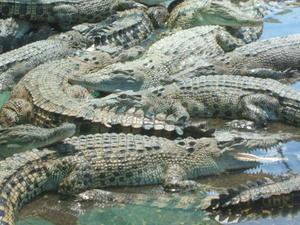
napping.
Their long visages show perpetual toothy grimaces punctuated by occasional yawns.
These grins are much a result of their anatomy and contentment as malevolence, painting quite a grotesque picture.
These crocodiles at the Mazvikadei Crocodile Farm in Banket, Mashonaland West, form the magnificent aquaculture that has been practiced here for the last two decades.
Entering the farm, one is informed by various signs of the one attribute that crocodiles are extremely dangerous being at mature ages from 15 years up to 120 can grow an average of five metres and weighing around 900 kilogrammes.
And this particular group of crocodiles, about 400 of them, has every reason to be content being there to eat, sleep and procreate.
“These are breeders and they are here for nothing else except to eat and mate and give offspring,” Mr John Banda, a breeder at the farm told The Herald when the paper visited the farm recently.
Banda has been imbued in aquaculture for the last six years when he came here in response to the demanding economic times.
Things have progressively changed and the amazing interaction of man and beast.
He revealed the secrets of his trade.
“Breeders are aged 15 years and above. They are not for any other purpose.
“The skin is scratched and useless and we do not sell their eggs,” he said.
On the other hand, the life of a breeding crocodile is predicated on passing seasons.
As they lay down languidly absorbing the June sunshine the crocodiles are reading for the mating season that begins in August.
Said Banda: “They mate from the beginning of August to the end of September.
“As the mating season begins we prepare the land around the ponds where the female crocodiles will lay eggs in sand nests.
“We collect the eggs from the nests and put them into the incubator where the eggs will hatch within 90 days.”
He revealed that the number of eggs each female lays depends on its age with the average nest having between 45 and 60 eggs.
As such the mating season, coming as it does in the hot days following winter, is necessarily a hedonistic time of the year.
The crocodiles are mainly fed from dead chicken from a company in Harare, condemned meat as well as other food from surrounding farms.
“We need about six tonnes of food during summer months and we feed the crocodiles twice a week while in winter we need to feed them once after two to three weeks,” said Banda.
He revealed that the crocodiles would during winter take as scant food as possible to fuel the body.
The voracity of the coming months could go down to the exertions of mating.
“There is a lot of fighting during the mating season and often some male crocodiles get injured.
“If a crocodile gets injured and the cut is too deep it might die,” said Banda.
Out of such industry and danger springs new life.
Mr Waison Phiri, manager here, is responsible for rearing the crocodiles into life, and profitability.
He says the quality of crocodiles depends on how they are reared.
It starts with the handling of eggs.
“During the laying process we look in the nests for the eggs. We put them in kaylite boxes in which there is vermiculite stuff.
“We look at bands that develop on the eggs after 48 hours indicating they are fertile.
“We pick the eggs and place them in boxes according to how they have been laid, they can lie horizontally or vertically, as seen by the bands and we have to place them in the boxes accordingly,” said Phiri.
He added that care was paramount in handling eggs.
Shaking the eggs would result in death of foetuses or deformities. The incubator is a big room equipped with a geyser, fans and thermometers.
For the eggs to hatch conditions must just be right to meet the 90-day period.
This chiefly includes the regulation of temperature to maintain an optimum 30-32 degrees Celsius.
“Above that you get more males and premature births,” explained Phiri.
Hatchlings, measuring 15 centimetres at birth, are then kept in special nursery pens where they are fed mainly on red meat and mince.
Fresh food is ideal for the well-being of the crocodiles, said Phiri.
Crocodiles are vaccinated against such diseases as pox which damages the skin.
Temperatures are maintained at an optimum 37 degrees Celsius.
From the outside pens where water is deeper and growth is faster, the crocodiles are moved into the inner blocks.
The rearing section comprises of seven blocks of six pens each and nine outside pens.
This is where Phiri and company are rearing between 20 000 and 25 000 crocodiles.
At the age of between three and four years the crocodiles will be ready for culling.
Phiri said: “The crocodiles will be between 90 centimetres and one metre long and their stomach size 23 centimetres.
“The quality of skin must be good with no brown spots or marks. We put the skins in coarse salt for seven days and thereafter in a coldroom.”
Culling is done once a month over a period of eight to nine days during which between 450 and 500 crocodiles are slaughtered.
They will be ready for export, and currently there is only one buyer who is based outside the country.
But far from being a mere occupation for the father of three Phiri and 41 others, including villagers from surrounding areas, it is more of a culture of living with crocodiles.
Prisca Mabemba came here in 2008.
She told The Herald that she came here to earn a living for her family.
At first she was afraid of the crocodiles.
But now she has discovered the inner soul of what Mr Quinton De Jager built in 1986 and lived to see and leave flourish when he died in 2005.
“I am no longer afraid,” she said.
And her demeanour as she feeds the crocodiles from a wheelbarrow tells of a person completely in harmony with crocodiles.
It’s all in a day’s work!
Members of the public can also visit the farm to see the crocodiles and do fishing for a fee.
They also have a chance to sample the delicacy of crocodile tail, which is sold here.



 Peter Tanyanyiwa
 Online Reporter