Online Reporter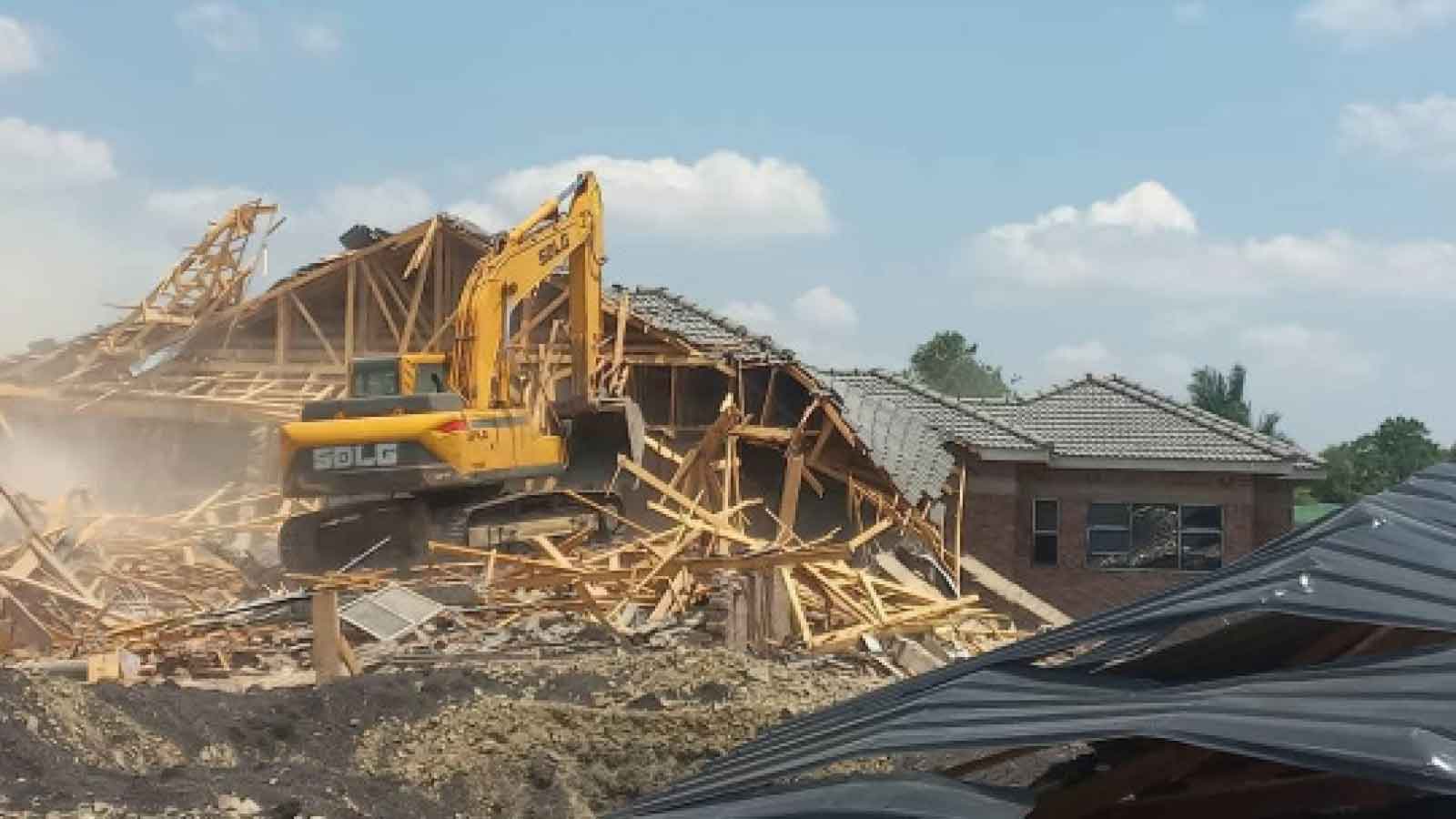
Check Point Desk
A WAVE of demolitions sweeping through Budiriro 4, Epworth, Mbare and parts of Harare South has exposed an entrenched “eviction economy”.
In this system, land barons, canny developers and corrupt officials profit while low-income families are left homeless.
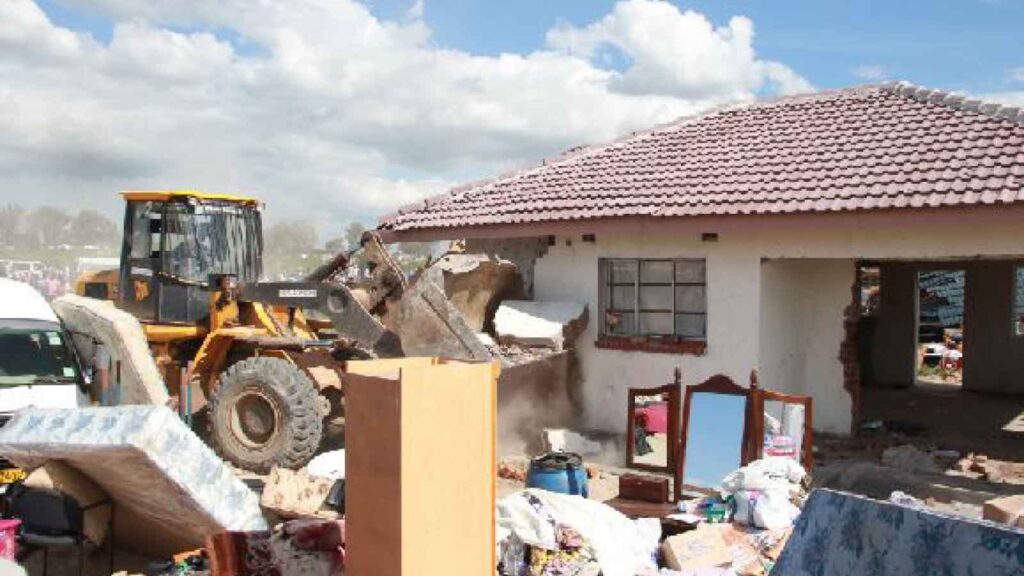
Over the past few months, scores of houses and informal structures have been razed ostensibly to enforce urban planning laws, clearing illegal settlements and reclaiming land for public use.
However, investigations reveal that many affected residents purchased their stands through intermediaries linked to local authorities or influential political figures, raising serious questions about accountability and motives.
In Budiriro 4, where demolitions frequently occur despite pending court challenges, residents are caught in a long-running land dispute involving the City of Harare, private developers and alleged land barons.
“We were sold these stands; we built in full view of the council and even paid rates,” said one resident, whose house was recently demolished.
“Now they say the land is illegal, but no one is arresting the people who sold it to us.”
Marian (last name withheld), a mother of four in Budiriro 4, is in the same predicament.
“I bought this stand in 2018 through the Tembwe Housing Cooperative. They assured us they were working with the council, and I paid everything I had. When the bulldozers came, they did not ask who sold us the land. They only told us to remove our property and leave.”
In Epworth, Tawanda Moyo said he was allocated his piece of land through Tongogara Housing Trust.
Like many others, he expressed fear that naming those behind the allocations could lead to intimidation or victimisation, given the alleged political connections of land dealers operating in these areas.
Legal concerns
Legal practitioners argue that these demolitions frequently proceed in defiance of constitutional protections.
Section 74 of the Constitution prohibits arbitrary eviction without a court order.
However, residents in several suburbs told The Sunday Mail Society that they were served with notices only days — and sometimes hours — before bulldozers arrived.
“Demolitions have become a convenient tool to ‘sanitise’ corruption,” notes Gamuchirai Mhetu, a Harare-based lawyer.
“Officials look the other way while illegal settlements mushroom, then move in with bulldozers once the land has changed hands or new interests emerge.”
However, Gabriel Masvora, the director of communications and advocacy in the Ministry of Local Government and Public Works, clarified the legal processes surrounding property demolitions.
“It is important to clarify that the Government does not demolish houses, nor is it responsible for issuing demolition notices,” Masvora said.
“In most instances, demolitions are executed only after the rightful landowners have sought and been granted a formal court order.”
He explained that once a court order is obtained, it is the responsibility of the specific companies, councils or individuals involved to notify the affected parties before proceeding with the demolition.
“The Government does not condone the activities of land barons and consistently urges home seekers to verify all information before purchasing land,” he added.
“To address these issues, the ministry launched the Urban State Land Management Policy last year, which is now fully operational.”
According to Masvora, the policy is designed to manage rapid urbanisation by tackling dysfunctional settlements, speculative activities and land baronism, thereby protecting citizens from fraudulent deals.
It further outlines stakeholder roles and provides strict operational guidelines for efficient land management.
“For areas where people have already settled, the Cabinet approved the ‘User Pays Principle’ in October last year,” Masvora noted.
“Under this programme, beneficiaries — many of whom were victims of land barons — are required to pay the rightful owner for total development costs.
“This includes the value of the land, the cost of servicing and any other associated expenses.”
The Government, he added, is currently facilitating negotiations between landowners and residents to allow for direct land purchases over an agreed time frame.
This pilot programme is underway at Whitecliff Farm in Harare and is expected to be replicated nationwide.
Addmore Nhekairo, the City of Harare’s director of Housing and Community Services, could not be reached for comment as he did not answer his mobile phone.
However, Harare City Council acting Town Clerk Engineer Phakamile Moyo urged residents to always verify the authenticity of any land offered by private developers at council offices before committing to a purchase.
“Verification helps establish whether the seller has legal right of ownership, if there is an approved layout and if the area is actually zoned for residential use,” Eng Moyo said.
“The council views the demolition of houses as a strictly last-resort measure.”
He further explained that the City of Harare is presently working to regularise certain illegally built houses, provided they are not situated on institutional stands (land reserved for schools or clinics) or protected wetlands.
“Illegal settlers are being organised into pay schemes to pool their resources, which will then be used to properly service the stands with necessary infrastructure,” he added.
He also revealed that the council intends to service future stands using its own resources, in addition to forming strategic partnerships with the Government and private sector players.
Selective enforcement
In Epworth, one of Harare’s fastest-growing dormitory towns, thousands of families face eviction.
The authorities claim their homes were built on land reserved for schools, clinics and industrial use.
While officials insist the exercise is necessary to restore order and implement a master plan, residents’ associations accuse the Epworth Local Board of presiding over years of chaotic land allocations.
“People did not invade land on their own,” said Henry Mwanjira, a representative of an Epworth residents’ association.
“Land was allocated by those in authority or by those claiming to act on their behalf. When the demolitions come, it is the poor who pay the price.”
Tawanda Moyo, whose two-room house was reduced to rubble, said the demolitions have seriously affected his family.
“We were never told this land was for a school until after we had built,” he said.
“Now my children are sleeping at relatives’ houses while the people who sold us the stands are nowhere to be found.”
Conversely, Dennis Muranduri, the housing manager for the Epworth Local Board, dismissed allegations of the board’s involvement in the recent activities.
“We are not part of the ongoing demolitions currently being discussed; we do not have such an operation in place,” Muranduri said.
“The only structures destroyed were those unfortunately affected by floods. To date, not a single person has approached our offices to raise concerns regarding any demolition issues.”
Dr Wilton Mhanda, secretary for the Epworth Local Board, also said:
“We are not demolishing any houses at the moment.
“However, I understand we have had some regularisation exercise in the past but without demolitions.”
Profiteering from chaos
Urban development experts argue that Harare’s housing crisis has created fertile ground for profiteering.
With the city failing to provide affordable, serviced stands, informal land markets have flourished — controlled largely by land barons who sell unserviced or disputed land to desperate home-seekers.
“Demolitions do not happen in a vacuum.
“There is money to be made at every stage: selling land illegally, reselling it after demolitions and eventually regularising the land once the poor have been pushed out,” noted one urban planning specialist.
In Harare South, where industrial land, peri-urban farms and informal settlements intersect, residents report similar dynamics.
Several families interviewed said they purchased land from intermediaries claiming to represent councils or Government departments, only to be declared illegal occupants later. Florence Chikomba, a resident of Harare South, observed that enforcement is often selective.
“Some houses are demolished while others are spared.
“It leads us to believe this is not about urban planning; it is about who has protection and who does not.”
The Government maintains that demolitions are necessary to restore order, enforce planning laws and protect land reserved for public infrastructure.
However, critics argue that without prosecuting those who illegally allocate or sell the land, these actions merely recycle poverty and injustice.
“Bulldozers are being used to treat the symptoms, not the cause.
“As long as land barons and corrupt officials operate with impunity, this cycle will continue,” said a civil society activist.