happiness Chikwanha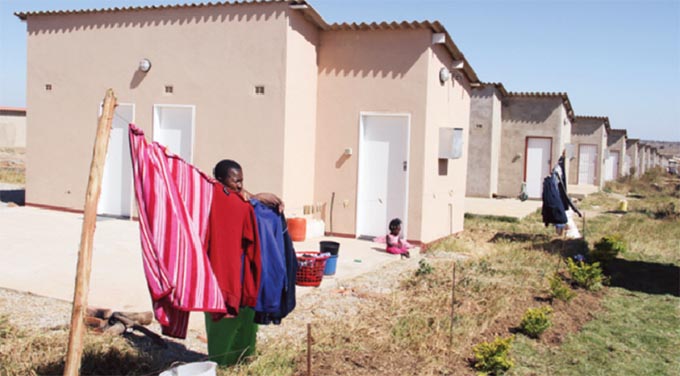
The old adage says, “Every journey begins with a single step”.Our first step of the journey was Part 1 of this edition, now we are in Part 4 which will be the final destination of this particular journey.
Part 4 covers the period from 2000 to 2015.
We have transcended from the pre-colonial through colonial to post independence Zimbabwe, flagging the major housing policy issues and relevant housing programmes over the years.
Thus, this particular edition marks the end of this journey, but there are many more to come in future related to this trajectory once the time is ripe. The purpose of this writing is not to evaluate the performance or lack of those policies, but just to highlight them.
I will leave the evaluation aspect to research enthusiasts or scholars.
From 2000 onwards, Government pursued the Pay for Your House Schemes that were initiated in 1995 as one of the strategies of augmenting housing finance by tapping resources from the would be beneficiaries.
The understanding was that Government would match beneficiary contributions on a dollar-for-dollar basis in order to make the programme sustainable.
The contributions were to be recovered in 25 years and beneficiaries would make monthly pre-construction payments to Government and the matched funds were used to service stands and construct houses and flats.
This was the period which saw the reintroduction of vertical space utilisation, where walk-up flats were built in areas such as Budiriro 2, Willowvale, Mufakose, Marimba, Seke B, Odzi, Zambezi, Dzivarasekwa Extension, Tynwald and Tafara (Harare), Khumalo (Bulawayo), Dombotombo (Marondera), Florida (Mutare) and Third Street (Gweru).
Around 2002/3, Government withdrew its matching contribution after indications from Treasury that they were unable to continue matching the beneficiary contributions.
The Pay for Your House Scheme was renamed to Access to Home-ownership Scheme.
The beneficiaries were no longer paying to Government, rather they were paying through building societies such as Founders Building Society and Beverly Building Society.
From this period on, Government was no longer building houses/flats, but merely servicing stands and beneficiaries built on their own houses.
The year 2000, witnessed the first written document entitled the National Housing Policy prepared after a wider stakeholder engagement.
Before then, all the policies were either pronouncements by policy makers or circular minutes or position papers prepared from an office.
The housing sector is guided by conventions on human settlement.
Informed by the Habitat Agenda II from the United Nations Human Settlement Programme (UN-Habitat), the Government of Zimbabwe convened the inaugural National Housing Convention in October 1997 in Victoria Falls, where various stakeholders were invited to deliberate on housing matters.
The resolutions from the 1997 Convention informed the 2000 National Housing Policy, of which drafting began in 1999. The major policy thrust of this policy was to do with pluralism in the housing delivery models.
Housing financing was beginning to dwindle at the time, where Government and building societies were failing to meet the housing demand.
Therefore, the convention recommended a multidimensional approach deviating from the conventional model of government as the sole provider of housing. Government’s role was reduced to that of a facilitator, creating a conducive environment for other players to come in.
Consequently, the private land developers were roped in with community-based organisations such as housing cooperatives. These models were aimed at leveraging housing finance to augment allocations from the fiscus. The base was, therefore, broadened.
In order to operationalise the policy, Government introduced a five-year strategy called National Housing Delivery Programme 2004-2008.
The rationale was informed by the acknowledgement that Zimbabwe was facing a critical housing crisis, and therefore, sought “to ensure that all key components in development planning that go to make up a “house” are catered for simultaneously and adhered to rigidly” (National
Housing Delivery Programme 2004-2008).
The programme was anchored on five pillars, that is, Land Acquisition, Land Use Planning, Servicing (off-site and on-site), Stand Allocation, and Building Plan and Construction of Dwellings.
In May 2005, prompted by the mushrooming and spread of illegal activities, Government introduced a Clean-Up Operation known as Operation Murambatsvina where all structures that were built off-plan were razed down.
All informal settlements countrywide were demolished, including illegal house extensions and backyard or front-yard cottages in conventional settlements. In order to accommodate those directly affected by the operation, Government introduced a successor operation called Operation Garikai/Hlalani Kuhle that same year.
This programme involved construction of core houses (under Phase 1) using multi-sectorial building brigades, that included members of the unformed forces and the civilians.
However, due to the increased demand Government introduced Phase 2 of the operation, where they allocated virgin land to organised groups such as cooperatives under the Aided-Self Help Schemes.
The beneficiaries would mobilise their own resources to service the stands and build their own houses.
In 2009, Government convened yet another National Housing Convention with all the diverse stakeholders in the housing fraternity.
The resolutions there-from informed the 2012 National Housing Policy, which the country is currently utilising.
The policy is also anchored on seven pillars as well, that is, housing finance; infrastructure, superstructure and technology; land acquisition, land use planning, surveying and registration; housing policy and legislative framework; the role of community-based organisations; private sector participation in housing and finally urban renewal.
The policy magnified the role of community-based organisations, especially housing cooperatives, hence their flourishment and such policies as incremental and parallel development were adopted.
However, incremental development and parallel development were later abolished in 2016. This marks the end of the housing policies journey.
Feedback: [email protected]



 Online Reporter