Sunday Mail Reporter
THE 2027 National Budget, which was presented in Parliament on Thursday, marks a decisive pivot from austerity-driven stabilisation to broad-based household and industrial empowerment.
Framed against a ZiG358,3 billion (US$12,8 billion) expenditure ceiling and projected revenues of ZiG349,5 billion (US$12,5 billion), the fiscal blueprint capitalises on hard-won macroeconomic stability — evidenced by an average ZiG inflation rate of 4 percent in 2026, a 33,7 percent surge in foreign currency receipts to US$15,9 billion and Zimbabwe’s milestone removal from the World Bank Group’s fragility list in July 2026.
Rather than resting on macroeconomic laurels, Treasury has engineered a distinctly people-centred fiscal package that places disposable income back into citizens’ pockets, democratises digital access, accelerates the green energy transition and fortifies the nation against impending climate shocks.
“The implementation of prudent fiscal policy by Treasury, complemented by monetary policy by the Reserve Bank of Zimbabwe, has broadly anchored the economy towards durable macroeconomic stability, characterised by low and stable inflation, as well as currency and exchange rate stability,” said Finance Minister Mthuli Ncube on Thursday.
“The hard-won gains, particularly macroeconomic stability, must be protected and further entrenched. The business community should capitalise on a stable environment and invest in new equipment, modernisation, digital technology, including automation and artificial intelligence.”
Direct pocket relief: Boosting disposable income and cutting transaction costs
At the heart of the 2027 Budget’s people-centred ethos is an immediate, tangible effort to ease the tax burden on ordinary workers and consumers.
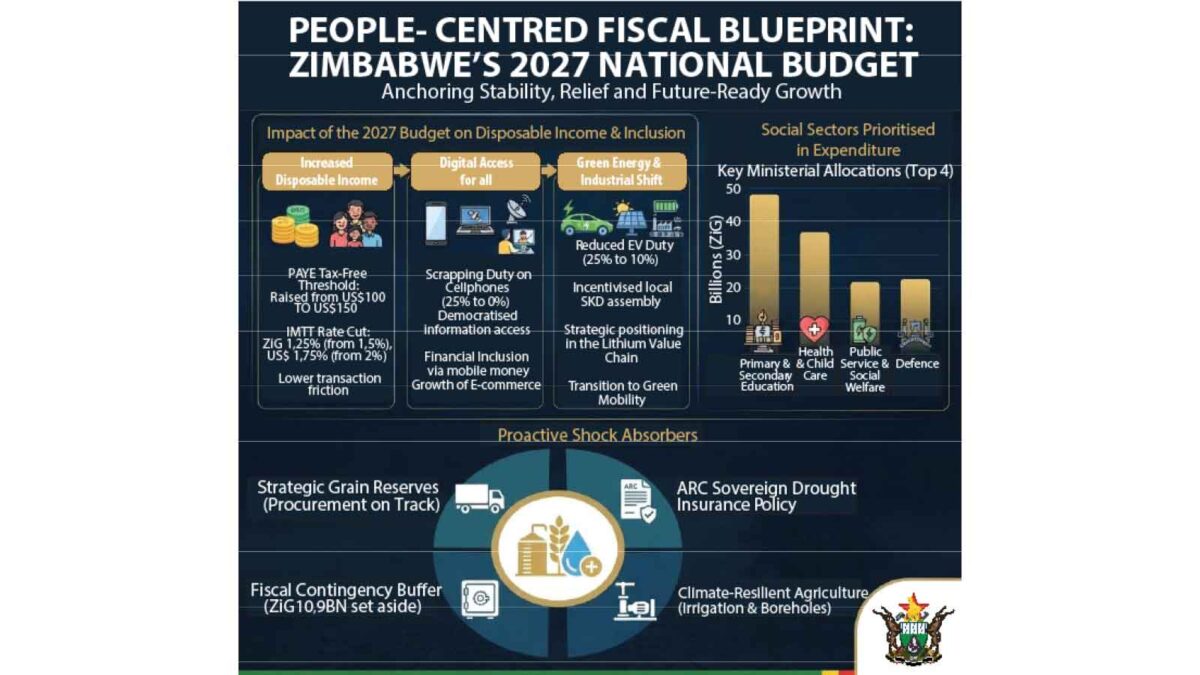
Following extensive pre-Budget consultations with civil society, labour and special interest groups, Treasury proposed raising the monthly personal income tax (PAYE) tax-free threshold by 50 percent, moving it from US$100 to US$150 (or its ZiG equivalent), alongside a commensurate adjustment of upper tax bands.
For low- and middle-income earners, this measure translates directly into higher take-home pay at a time when households are navigating global inflationary headwinds.
By expanding the tax-free bracket, the Government effectively injects liquidity directly into domestic consumption, stimulating aggregate demand across retail, services and local manufacturing without fuelling inflation.
Complementing income tax relief is a welcome reduction in the Intermediated Money Transfer Tax (IMTT) — long a point of friction for both everyday shoppers and formal businesses. In 2027, IMTT on ZiG-denominated electronic transactions drops from 1,5 percent to 1,25 percent, while the rate on foreign currency transactions decreases from 2 percent to 1,75 percent.
Beyond lowering the everyday cost of buying groceries, paying school fees and settling utility bills, this dual-track adjustment carries a sophisticated monetary policy objective: preserving a 50-basis-point spread in favour of ZiG reinforces the attractiveness of local currency usage, deepens financial intermediation and discourages informal cash hoarding.
Lower transaction friction encourages formal banking adoption, which already saw foreign currency deposits climb from US$700 million in 2018 to US$5,5 billion in 2026.
Expected multiplier effect of duty-free cellphones
Perhaps the most transformative microeconomic intervention in the 2027 fiscal statement is the complete scrapping of customs duty on cellular phones, slashing the tariff from 25 percent to 0 percent. In modern Zimbabwe, a mobile handset is an indispensable economic utility that underpins financial inclusion, education, commerce and civic participation.
By eliminating the 25 percent import duty, Treasury is dismantling a major price barrier that previously pushed consumers towards informal, grey-market smugglers while pricing millions of rural and low-income citizens out of the digital economy.
The ripple effects of affordable mobile devices will be felt across multiple sectors.
Lower smartphone prices expand access to mobile money platforms, digital banking and the newly launched Zimbabwe Entrepreneurship Exchange (ZEEX), enabling micro-entrepreneurs, smallholder farmers and informal traders to transact, access micro-credit and participate in formal value chains.
In addition, Zimbabwe’s burgeoning creative sector — encompassing musicians, content creators, filmmakers, graphic designers and digital marketers — relies heavily on mobile technology for both production and distribution.
Coupled with the ZiG1,3 billion allocation to the Ministry of Sport, Recreation, Arts and Culture and ZiG1,9 billion for Youth Empowerment, duty-free access to modern smartphones lowers capital entry barriers for young creatives, allowing them to monetise content globally and participate in artificial intelligence and digital innovation ecosystems.
Similarly, wider smartphone ownership ensures citizens in remote districts can access e-Government portals, real-time agricultural weather alerts and digital learning materials. Formal information and communication technology (ICT) retailers also stand to regain market share from briefcase traders, broadening the domestic value-added tax (VAT) base even as border tariffs fall.
Green energy strategy: Electric vehicles and the lithium value chain
In a forward-looking move that marries environmental stewardship with industrial geopolitics, Treasury reduced customs duty on electric vehicles (EVs) from 25 percent to 10 percent, while wholly suspending customs duty on semi-knocked-down (SKD) kits for approved local assemblers of electric commercial vehicles, motorcycles, tricycles and trucks effective December 2026.
For an economy that has endured external price shocks driven by Middle East conflicts and volatile global crude oil markets, accelerating EV adoption provides a structural hedge against imported fuel inflation. Every EV on Zimbabwean roads reduces national demand for imported fossil fuels, conserving scarce foreign currency reserves and insulating commuters and logistics operators from geopolitical supply disruptions.
Crucially, this policy positions Zimbabwe to capture downstream value from its status as a premier global producer of lithium.
The Government has maintained strict restrictions on the export of unprocessed raw minerals to compel domestic beneficiation and processing. By simultaneously incentivising domestic EV adoption and zero-rating SKD assembly kits, the 2027 Budget lays the groundwork for an integrated green-mobility ecosystem — linking local lithium extraction and battery-grade mineral processing to regional vehicle assembly aimed at the African Continental Free Trade Area (AfCFTA).
Supported by over 300 consecutive days without load shedding and a ZiG1,2 billion allocation to diversify the energy mix beyond hydro-dependency, Zimbabwe is steadily building the grid reliability required to power an electrified transport sector.
Protecting social pillars: Education, healthcare and climate resilience
A genuinely people-centred budget must also be judged by how it allocates public expenditure to human capital and social safety nets. Despite receiving ministerial expenditure bids totalling ZiG974 billion — nearly triple the available envelope — Treasury prioritised social sectors at the very top of its spending allocations.
Primary and Secondary Education received the single largest ministerial vote at ZiG47,7 billion, supplemented by ZiG15 billion for Higher and Tertiary Education, Innovation, Science and Technology Development. This guarantees funding for teacher salaries, examination fee subsidies, classroom infrastructure, and university innovation hubs — ensuring no learner is left behind.
Health and Child Care secured the second-largest allocation, at ZiG35,5 billion, to fund medical personnel, essential medicines, hospital rehabilitation and new healthcare infrastructure, safeguarding universal access to quality care.
Treasury also made provision for ZiG21,5 billion for the Ministry of Public Service, Labour and Social Welfare to shield vulnerable households through cash transfers, disability support and food security programmes. Simultaneously, ZiG17, 5 billion in constitutional devolution transfers empowers local authorities to deliver clean water, clinics and roads tailored for community needs.
Shields against climate and supply shocks
Recognising that economic growth is projected to moderate from 5 percent in 2026 to 3,5 percent in 2027 due to an anticipated super El Niño-induced drought, the Budget embeds robust shock absorbers before a crisis strikes.
Treasury has ring-fenced a dedicated ZiG10,9 billion (US$400 million) contingency reserve — funded from 2026 fiscal buffers — specifically to cushion the economy against severe climate disruptions.
In agriculture, backed by a ZiG27,6 billion vote, the Government is implementing a Six-Pillar Drought Mitigation Strategy, having already procured 365 000 tonnes of grain towards a 600 000-tonne strategic reserve while subscribing to a US$3,4 million African Risk Capacity sovereign drought insurance policy.
Furthermore, to shield farmers from global fertiliser supply chain disruptions caused by geopolitical conflicts, Treasury introduced a duty rebate on raw materials and capital equipment for local fertiliser manufacturers.
Combined with a new mandatory requirement for the Government, mining houses and large corporations to procure at least 15 percent of their inputs locally starting in 2027, these policies anchor domestic food security and industrial jobs.
Fiscal discipline as the ultimate guarantor
What elevates the 2027 National Budget from a list of populist promises to a credible social contract is its adherence to fiscal discipline.
Treasury resisted the temptation to print money or indulge in unfunded spending, strictly enforcing the Public Finance Management Act and requiring Treasury sign-off on all State contracts exceeding US$2 million.
By combining targeted tax cuts on incomes, electronic transfers, mobile phones and electric vehicles, with massive investments in education, health and drought resilience, the 2027 Budget proves that macroeconomic stability and human-centred development are mutually reinforcing pillars of Zimbabwe’s journey towards Vision 2030.