Online Reporter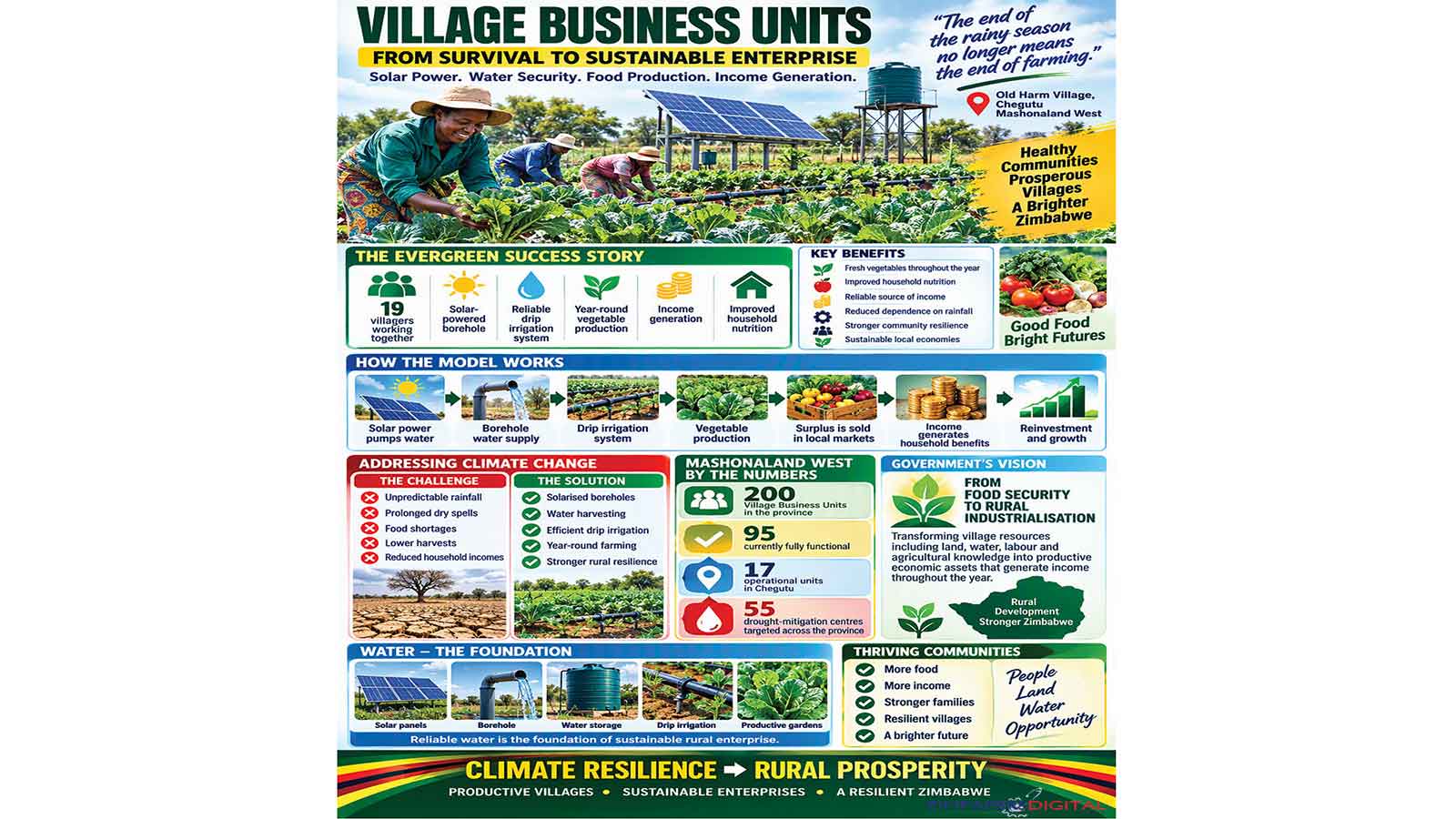
Conrad Mupesa-Mashonaland West Bureau
ON a piece of land in Old Harm village, Chegutu, Mashonaland West province, the rains no longer decide when 19 villagers can farm.
When the skies open, they plant.
When the rains disappear, they keep planting.
A solar-powered borehole pumps water into a drip-irrigation system, allowing the members of Evergreen Village Business Unit (VBU) to grow vegetables throughout the year.
The harvest puts more than food on their tables.
The vegetables are sold, generating income that goes towards household needs and is also reinvested into the project.
For people accustomed to an agricultural cycle dictated by increasingly unpredictable rainfall, the borehole has changed their farming methods.
It has changed the way they make a living.
“The establishment of this garden has really helped us meet our financial needs as a community,” said Evergreen VBU chairperson Mr Jerifas Kudzerema.
“We are able to generate income from the sale of our produce, while at the same time improving household nutrition because we now have access to fresh vegetables throughout the year. This has also helped us reduce our dependence on other sources of income.”
This is the simplicity of the idea behind VBUs, which the Government is rolling out as part of a broader strategy to transform rural communities into year-round agricultural producers and small businesses.
A VBU is more than a community garden where villagers grow vegetables for their own consumption.
It combines water, agricultural production, business management, markets and income generation in one village-level enterprise.
The model seeks to turn resources that already exist in rural communities — land, water, labour and agricultural knowledge — into productive economic assets.
Year-round production
For Ms Silana Marange, a member of Evergreen VBU, the biggest change has been the ability to continue producing when rainfall becomes unreliable.
“The solarised borehole has ensured that we have a constant supply of water for irrigation.
“We are using drip irrigation, which helps us to use the available water efficiently,” she said.
“As a result, we can produce throughout the year instead of relying only on the rainy season, and this has improved both our productivity and income.”
This is increasingly important in rural communities where prolonged dry spells can wipe out crops, reduce household food supplies and leave families with little surplus to sell.
The VBU model intends to break that cycle.
Instead of waiting for the rainy season to produce one major crop, beneficiaries can use irrigation to produce vegetables and other crops throughout the year.
That creates a potentially more regular stream of income.
And the economic cycle is relatively simple.
Water enables production.
Production creates surplus.
Surplus is sold.
Sales generate income.
Income meets household needs and can be reinvested into production.
That is what turns the project from a garden into a business.
Chegutu district agricultural extension officer Ms Jessie Katanda said the Government was, therefore, encouraging beneficiaries to think beyond production.
“Our extension officers and business advisers are working closely with the beneficiaries to develop viable business ideas that can help them expand and grow,” she said.
“We are also shifting our focus beyond production to include value addition, proper business management and marketing so that these village business units can become sustainable enterprises that generate meaningful income for the beneficiaries.”
That shift could determine whether VBUs remain small community projects or develop into durable rural enterprises.
Spreading the model
The experience at Evergreen is being replicated across Mashonaland West.
The province has about 200 VBUs, of which 95 are currently fully functional, according to provincial authorities.
Chegutu alone has 17 operational units, with others at various stages of development and awaiting commissioning.
In Hurungwe, the model is also being used to strengthen the economic position of rural women.
For Ms Violet Muburimi, the need is immediate.
“Communities are facing serious food shortages, and this is due to poor rainfall patterns,” she said.
“The coming in of the Pfumvudza/Intwasa farming concept from the Government has seen us realise more grain annually.”
Her comments highlight an important feature of the rural development challenge.
For smallholder farmers, climate change is not an abstract environmental issue.
It can mean less reliable rainfall, lower harvests, food shortages and reduced household incomes.
A VBU provides another layer of protection by allowing communities to produce food and generate income from irrigated land even when rain-fed agriculture is under pressure.
Foundation
The common thread running through the different VBU projects is water.
Without reliable water, a community garden remains vulnerable to the same rainfall patterns that undermine ordinary farming.
With a borehole, solar pumping system and efficient irrigation, the same piece of land can become a productive asset throughout the year.
This is why the Government’s VBU programme is being implemented alongside broader investments in water development and drought mitigation.
Provincial director for the Ministry of Agriculture, Mechanisation and Water Resources Development Mr Caristo Masiwa said the objective was to ensure that VBUs became productive and sustainable.
The Government is also targeting the establishment of 55 drought-mitigation centres across Mashonaland West.
The infrastructure is expected to improve water availability for communities and livestock in areas vulnerable to prolonged dry conditions.
Mr Masiwa said wells were being developed in dry areas, while VBUs were being established around water-harvesting infrastructure so that communities could retain and use water for livestock and other livelihood activities during dry periods.
The VBU concept connects with the Government’s broader rural development and industrialisation agenda.
The ambition is to move rural communities beyond simply producing enough food to survive.
A productive VBU can create a local economic chain.
Resilience
Hurungwe district Agritex officer Mr Andrew Mafuzhe said the Government was using a combination of interventions to strengthen rural resilience.
“As Government, we are working on ensuring that we beat the adverse effects of climate change through scientifically proven ways,” he said.
“We have introduced Pfumvudza/Intwasa farming, which has become a game-changer for our farmers, and village business units are being rolled out countrywide.”
The challenge now is to take that resilience one step further.
For the villagers at Evergreen, however, that transformation has already begun.
Their solar-powered borehole means the end of the rainy season no longer has to mean the end of their farming season.
This means rural development can increasingly be built not around waiting for the next harvest but around creating enterprises that work throughout the year.