Nqobile Bhebhe, Features Writer
A SIMMERING gold versus water war is unfolding in Bulawayo’s supply catchment areas in Umzingwane District, as surging global gold prices fuels a rush that is now intersecting dangerously with the city’s already fragile water security.
What should be protected lifelines for a drought-prone city, the second largest in the country are fast turning into contested zones, where the glitter of a precious metal is increasingly outweighing the value of the clear, life-sustaining liquid stored behind dam walls.
Zimbabwe’s gold sector is riding a powerful wave. International prices have been escalating on the market, pushing the metal’s appeal to new heights and reinforcing its position as a strategic pillar of the national economy.
To bring this into perspective, on Monday, globally, gold hit the US$5 000 mark and rose during the week.
For many citizens, gold means survival but for Bulawayo, a city perennially walking a water-tightrope, it signals risk.
Across several supply dams and their feeder rivers, scenes of environmental disturbance are multiplying.
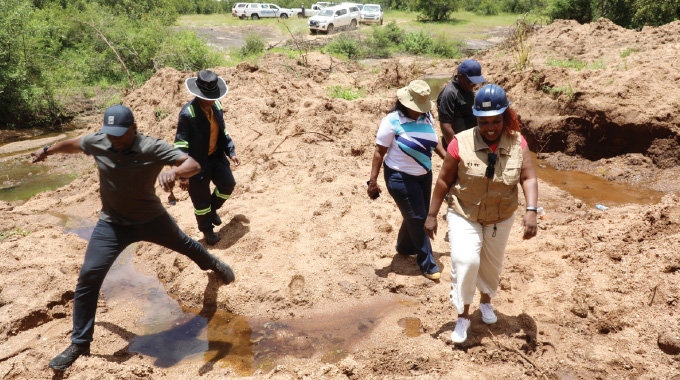
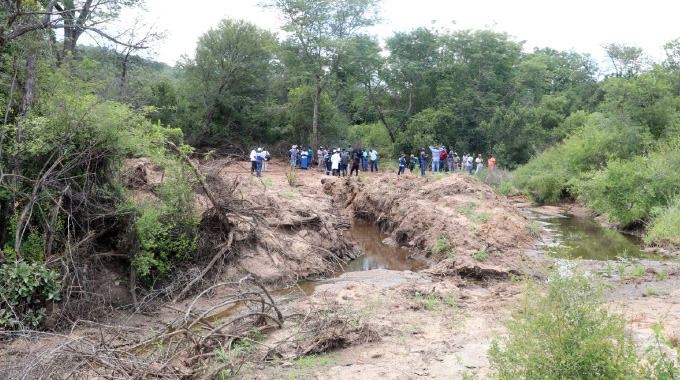
On Friday, during a fact-finding mission by city councillors and the media, riverbanks were seen gouged open, vegetation stripped away and deep pits punctured into once-stable soils.
During rainfall, the loosened earth is swept downstream, turning waterways into brown torrents that carry silt straight into reservoirs meant to store precious water.
The conflict is no longer abstract. It is visible in murky water, scarred landscapes and growing anxiety among city officials tasked with safeguarding supplies for residents and industry.
“At times I do ask myself why geographically, Bulawayo was placed in a gold area because at the end of it all we are now suffering consequences of gold,” council chairperson for Future Water Committee Councillor Khalazani Ndlovu said.
“We have the mantra ilizwe lakhiwa ngabanikazi balo, maybe together we can assist each other on mining activities, on how to curb them so that we all have access to water. Everyone needs water.”
The tour came as the Zimbabwe National Water Authority (Zinwa) this week reported that Umzingwane Dam is 35,4 percent full while Inyakuni stands at just 19,8 percent capacity, underlining the fragile state of the city’s water security despite recent rains.
In contrast, Mtshabezi Dam is 100 percent full and spilling for the first time in nine years, having last overflowed in 2017.
The development has been widely celebrated as a sign of improved rainfall patterns in the catchment — a rare and welcome shift after years of drought and climate stress.
Mtshabezi Dam, with a capacity of 11,4 million cubic metres, is one of six supply dams serving Bulawayo, alongside Umzingwane, Inyankuni, Upper Ncema, Lower Ncema and Insiza.
However, attention during the tour was fixed on environmental damage within the Umzingwane Catchment Area, where illegal alluvial gold mining has become a destructive force severely compromising Bulawayo’s water supply.
Unregulated activities along riverbanks are frequently blamed for blocking the natural flow of water into the dams, undermining the benefits of increased rainfall.
This week, Mayor, Councillor David Coltart sounded an alarm over rampant illegal gold mining in the Umzingwane river catchment area, warning of devastating consequences for the city’s water supply.
Every litre lost, every cubic metre of storage reduced matters, officials said.
For a city already battling financial constraints, the burden grows heavier. Yet the other side of the conflict cannot be ignored, they admitted.
Gold is not just another commodity, it is one of Zimbabwe’s top foreign currency earners. The Government has repeatedly underscored its strategic importance, and small-scale miners contribute significantly to output.
In communities around the dams, gold panning is woven into survival. It pays school fees, buys groceries and offers income where few formal opportunities exist.
Rising global prices have intensified this pull, drawing more people into the activity and pushing operations closer to sensitive areas.
The result is a classic development dilemma of national economic priorities and grassroots survival on one side, long-term environmental sustainability and urban water security on the other.
During the tour, council officials had a startling encounter with illegal gold panners at Upper Ncema Dam after the miners openly admitted operating freely in the protected catchment area, citing weak security.
Upper Ncema Dam is one of Bulawayo’s key supply dams, and any disruption to water flows poses a direct threat to the city’s already strained water situation.
Illegal gold panning often involves digging, siltation and diversion of streams, which can significantly reduce inflows into reservoirs while also causing long-term environmental damage.
A group of five illegal panners armed with their tools of trade stumbled on the municipal officials and media crew at the dam.
Three illegal panners fled while two remained. They appeared unfazed and even granted interviews to the media, calmly interacting with councillors in a bold show of defiance.
“To be honest, there is no security here, therefore we operate freely,” said one illegal miner who identified himself as Lungile Moyo.
“Even if you deploy more security and remove us, that would not scare us, and we will continue operating,” he said with a smile.
When asked if they attend workshops on land degradation, the illegal miner said it would be difficult to round up illegal miners for such an engagement.
Council officials admit that there is limited staff to man the vast catchment area, a loophole immensely exploited by illegal gold panners.
They argue that without firm protection of catchment zones, Bulawayo faces a deepening water crisis.
The geography of the dams compounds the challenge. Catchment areas are vast and often remote, making constant surveillance difficult.
Even where illegal operations are halted, panners frequently return, driven by economic necessity and the knowledge that enforcement resources are stretched thin.
Principal security officer Ndumiso Ndlovu said council should explore use of drones.
“It is time for the council to start thinking of using technology, the usage of drones to monitor the area.
By so doing, we will be able to monitor this vast area in real time. At the moment, we are just speculating where the gold panners could be,” he said.
Senior ranger, Mr Phineas Ndlovu, noted that the shortage of vehicles was also hindering their efforts to effectively monitor the catchment area.
He said it is difficult to patrol the vast catchment area on foot.
Although current persistent rains have helped raise dam levels, the environmental degradation and disregard for regulations pose a serious threat to livelihoods, agricultural productivity and industrial operations dependent on stable water supplies.
Bulawayo has long grappled with chronic water shortages driven by poor rainfall, climate change and heavy reliance on surface water sources.
During prolonged dry spells, the situation worsens, forcing the local authority to implement stringent water-shedding schedules that leave some suburbs without water for days.
In 2023 and 2024, dam levels fell to critical levels, with some reservoirs dropping below 30 percent, pushing residents and industry to rely on boreholes and water trucking.
The crisis has also strained council finances as ageing infrastructure struggles with fluctuating supply. Ageing pipelines, frequent bursts, vandalism and limited resources continue to hamper water delivery.
Medium-term interventions such as the proposed Glassblock Dam under a Public-Private Partnership model are being considered to ease pressure, alongside emergency options including drawing water from Khami Dam and expanding groundwater exploration, subject to sustainability assessments.