daniel chigunwe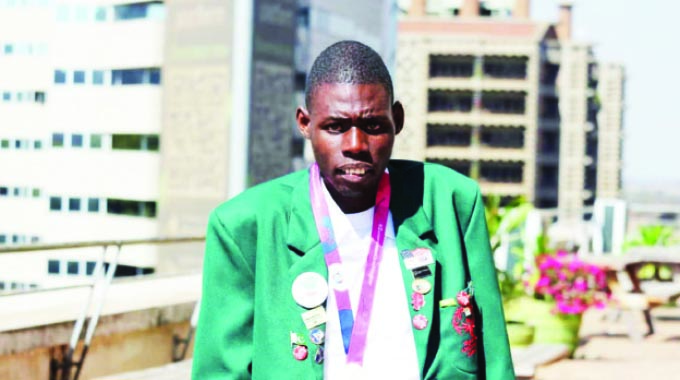
Tadious Manyepo
Sports Reporter
VIRGINIA MUVIRIMI vividly remembers how her autistic son, Tariro Mutosvori, always told her that one day he would complete their house in Stoneridge, Harare.
The 24-year-old has an autism spectrum disorder (ASD), a neurological and developmental condition that affects how people interact with others, communicate, learn and behave.
That is why Muvirimi never took her son seriously whenever he said the same things repeatedly.
She was right, in a way.
“I would ask myself how he would do so since I was the one who was always providing for him,” said Muvirimi.
“He has a disability, a unique one for that matter, and I wondered why he always talked about things like that. I would even cry silently but he is my son and at times I would just say that’s fine my son . . . ”
Widowed when Tariro, her only child, was just four and his condition still in its initial stages, Muvirimi decided not to remarry.
Instead, she decided to move across the Limpopo to look for opportunities in South Africa. The going hasn’t been as easy, as she survives on vending and piece jobs in the neighbouring country.
That’s how she managed to acquire the residential stand in Stoneridge, which she says belongs to Tariro.
Using the little earnings from her toil in Port Elizabeth, Virginia managed to partially build the house before things got even tougher.
But Tariro would chip in in the most incredible of ways to, as promised before, finish it off.
Tariro won a gold medal in Berlin, Germany, last year during the quadrennial Special Olympics as he stood tall in the relatively new game of bocce.
He earned just enough, including the US$5 000 cash received from the Government of Zimbabwe, to complete the seven-roomed house, where he now stays with a maid, who is paid by earnings realised from rentals of the three tenants accommodated there.
“Before we talk of what he brought back home from Germany, I should first acknowledge my utter disbelief when I first heard that he had qualified for the Special Olympics,” said Muvirimi.
“The development made me cry. I never thought one day he would be called up to represent the country, because I just believed he couldn’t do anything. After all, he is intellectually disabled.
“He is the reason why I decided not to remarry because I just thought no man would genuinely accept my son. So when he won, I was ecstatic and we just decided to use the money he earned from the games to finish the house.
“It is his house. I bought the stand for him so he could find somewhere comfortable to stay.”
Yet Muvirimi and her relatives never entertained the idea of seeing Tariro being taken to do sport by his coach, Maita Nyarota, in Kambuzuma.
Having been left in the custody of her maternal grandparents, Gogo Anna and Sekuru Muvirimi in Musana, Bindura, when his mother migrated to South Africa, Tariro simply couldn’t cope, especially in school.
That’s when he moved to Kambuzuma, Harare, where he stayed with his aunt while attending school, first at Wadzanai Primary and then at Kambuzuma High 1, where there are dedicated special classes.
While Tariro was home, having finished school in 2018, Nyarota was developing his Real Kambuzuma Sports Centre, where he accommodates everyone, thanks to Sports Minister Kirsty Coventry, who always supported the initiative. That’s how he started grooming Tariro as a soccer goalkeeper, before he eventually moved him to bocce.
“I couldn’t understand why the coach was taking my son to those games. So I instructed my sister, Epifania Chanyau, who always takes care of him when I am not in the country, to intervene.
“So it was always cat and mouse between my family and the coach as we didn’t want my son to engage in those sporting activities,” said Muvirimi.
Nyarota said Tariro’s family was always on his throat.
“It was very hard to convince them that we were only trying to change the course of their son’s life,” he said.
“But with the skills that I have acquired in my sporting journey, I eventually managed to show them the light.
“It’s very sad because his first international assignment was supposed to be in Kenya two years ago but the family refused. I am happy they then started to support him.
“I face a lot of challenges dealing with sports-persons like Tariro. I currently work with the Special Olympics Zimbabwe and so many potential athletes are denied the opportunity by their families.
“It’s a unique field and coaches have to be very passionate because athletes like Tariro can have mood inconsistencies and you need to be very attentive. I am happy he won the gold medal that changed his life. I foresee him winning many accolades in the future because we have now built a strong relationship and he listens to my instructions.”
Special Olympics Zimbabwe national director Lillian Chikara said there is potential in her organisation and families ought to make their children available for the sport.
“The biggest challenge that we encounter is that most families don’t want to see their children with ID doing sport,” said Chikara.
“So we are putting in concerted efforts to convince them to make their children available. We have experts in training sports-persons with IDs and they will surely win accolades for the country.
“We also lack sponsorship and we mainly survive due to the warm-heartedness of volunteers. But we have proved that we can do well internationally, like what Tariro and others have done. We bring medals from every tournament that we take part in”.
Tariro’s cousin, Admire Chanyau (25), who mostly takes care of his personal needs in Stoneridge, said positive vibes are running in their community due to his success story.
“I tell you, Tariro is inspiring parents with children who have ID. We always receive visitors and phone calls, with people asking how they will make their children join sports and be like Tariro,” said Chanyau.
“He has become an inspirational figure and a role model. We are always referring people to coach Nyarota.”


 Online Reporter