Online Reporter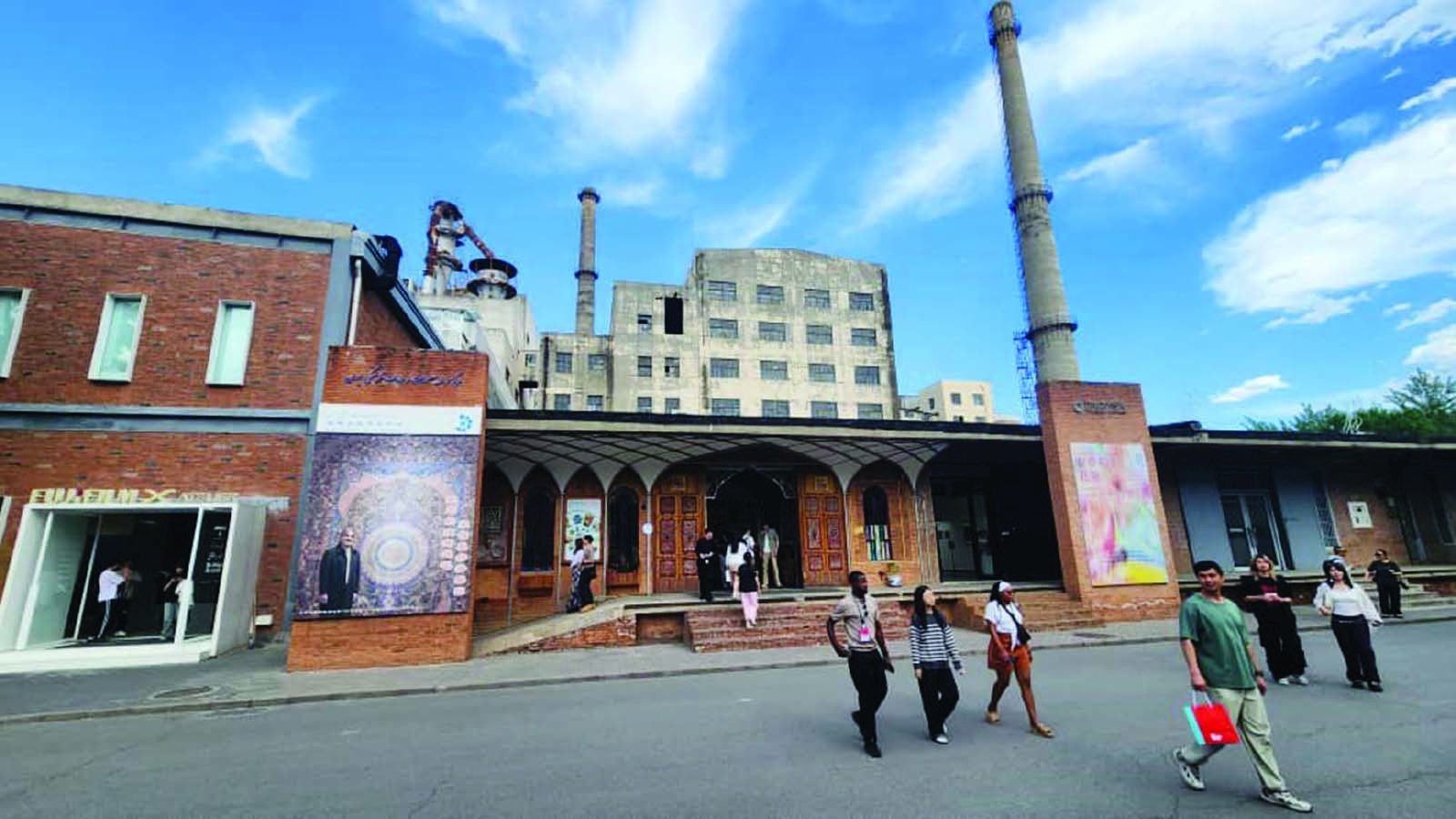
Roselyne Sachiti recently in Beijing, China
ON May 10, 2026, a 30-member delegation of Zimbabwean media professionals walked through the sprawling grounds of Beijing’s 798-751 Art District.
We wandered through galleries housed in former munitions factories, sipped coffee and enjoyed ice cream under exposed steel beams, and watched tourists frame shots against murals painted on brick walls scarred by the cultural revolution.
Leading the delegation was Information, Publicity and Broadcasting Services Minister Dr Zhemu Soda.
For the minister, the visit — part of a broader seminar on media modernisation hosted by the Academy of International Business Officials (AIBO) — was not just a cultural outing.
It was a glimpse into a possible future for incorporating art into Zimbabwe’s idle industrial heartlands.
China has turned industrial obsolescence into a competitive advantage, not by erasing the past, but by relicensing it for the future. Zimbabwe can turn underutilised properties in Bulawayo and Harare into engines of urban renewal.
The “accidental” miracle of Dashanzi
To understand the lessons we brought back home, having an appreciation of 798 Art District is important.
Located in the Dashanzi region of Beijing, the complex was originally the 798 Joint Factory, a massive military-industrial electronics complex built with Soviet and East German assistance in the 1950s.
It was the height of Cold War technology.
By the 1990s, the strategic industries had moved on.
The factories were largely empty.
The original plan, according to the publication Lianhe Zaobao, was simple — flatten it.
The land was worth a fortune, and the old buildings were viewed as obstacles to modern Beijing.
The rescue of 798 did not begin with a ministry directive.
In 1995, sculptors from the Central Academy of Fine Arts seeking cheap, high-ceilinged workspace discovered 798’s Bauhaus architecture, soon attracting international galleries that transformed the dead factories into a global art hub.
By 2005, the “Beijing 798 Art Festival” drew hundreds of thousands of visitors.
The Chinese government changed its mind.
Instead of sending wrecking balls, they dispatched urban planners.
In 2006, 798 Art District was officially designated a cultural and creative industry park.
Unlike the organic, artist-led “accidental miracle” of 798, 751’s transformation was more intentional and focused.
In 2006, it was redeveloped into a fashion and design hub, officially becoming 751D-Park Beijing Fashion Design Plaza.
In 2024, it merged with the adjacent 798 Art District to create the single, unified 798-751.
Lessons for Harare and Bulawayo
As we walked through 798-751, we saw potential for Zimbabwe.
Its story offered us three distinct pillars of wisdom, particularly relevant as the Government pushes the National Development Strategy 2 (NDS2) and Mutapa Investment Fund injects capital into parastatals.
Value of low-hanging fruit
Zimbabwe has some silent factories.
They are not ruins.
They are resources waiting for a new industrial grammar.
What 798-751 Art District demonstrated is simple, but easily overlooked: Repurposing is cheaper, faster and more culturally intelligent.
In Bulawayo, officials are working towards reclaiming the city’s status as the nation’s industrial hub.
While heavy manufacturing such as the new bus assembly deal with Ashok Leyland is the long-term goal, the 798-751 Art District model we witnessed suggests that creative industries offer a faster economic multiplier effect.
We learnt that an old textile factory does not just have to be revived to weave cloth; it could become a tech incubator or a fashion hub. Our visit opened us to new ideas.
Textile meets technology
Back home, the Government could designate underutilised factories as special economic zones (SEZs) with a specific mandate of industrial heritage plus innovation.
Zimbabwe has already established about 15 SEZs, though very few are yet to reach their maximum potential.
For example, an old model factory floor filled with 100 identical sewing machines making cheap T-shirts could be converted into a high-earning enterprise.
Using the 798-751 Arts District-tech model, a factory floor can be divided into three zones.
Imagine a single factory floor divided into three working neighbourhoods.
In the first, two dozen refurbished sewing machines are used to produce small-batch organic cotton items destined for export — directly benefitting growers in areas like Muzarabani, Guruve and Gokwe.
A few metres away, software developers and digital marketers share desk space with seamstresses, fibre-optic cables running overhead.
In the rear, laser cutters and solar-powered 3D printers produce buttons, zippers and shoe moulds — items Zimbabwe currently imports at a steep cost.
To bring this vision to life, the Mutapa Investment Fund could collaborate with a local university — such as the National University of Science and Technology (NUST) in Bulawayo — to establish a residency programme.
The initiative would offer tech teams up to six months of rent-free space in a repurposed factory.
In return, the tech group would train the textile team in e-commerce.
The textile group would educate the tech team on local materials and their applications.
The “Vintage Zimbabwe” label
Just as visitors to 798 Arts District purchase artefacts of China’s Mao-era industrial past, Zimbabweans abroad increasingly seek textiles that carry the mark of home — not just fabric, but memory.
While we have the national fabric, this is a market waiting for more home brands.
The Government, through the Ministry of Tourism and Hospitality Industry, can sponsor a Zimbabwe Heritage Fashion Week inside one of the old unused factories.
Film it, show the bricks, the old machinery as art and the new clothes on models.
The tech incubator
Visiting 798-751 Arts District proved how old textile factories are perfect for tech incubators because they have three things modern tech parks lack: high ceilings (for acoustics), thick walls (for server cooling) and cheap floor space.
The “Mutapa” model meets organic growth
Currently, Zimbabwe’s strategy for revival is institutional.
The Mutapa Investment Fund is centralising control over 20 State-owned enterprises, pumping more than US$100 million into turning them profitable.
Our visit to the 798-751 Art District proved that China succeeded because of autonomy.
The government eventually stepped in to protect the space from real estate
developers, but the culture grew organically.
Our Government’s role could shift from operator to enabler (securing land tenure and providing utilities for innovators). For example, reviving the Zimbabwe Iron and Steel Company (Ziscosteel) cannot mean restarting the blast furnaces the old way.
It may mean using the 798 Art District model to turn the site into a new economic engine, even if the steel never flows again.
A heavy machinery museum and sculpture park can be set up by leaving a rusted blast furnace as a “cathedral of industry”, charge entry fees for tourists and school groups.
Industrial design and foundry hubs can also be created by using existing steel shops for small-scale art casting and metal fabrication workshops (for gates, furniture and public art).
A railway market and night bazaar can be set up by converting the idle railway siding into a weekend food market (braai, local crafts and music).
The offices can be converted into a boutique hotel for industrial tourists.
A free shuttle bus can be made available from Harare to Kwekwe for the tourists visiting Zisco.
The 798-751 Art District successfully turned silent guns into loud art.
Zisco can turn silent furnaces into a humming bazaar of steel flowers, cold beer and data cables.
We may not need to melt iron again.
We need to melt the idea that a factory must make only one thing.
Tourism
The 798-751 Art District is a tourist attraction second only to the Great Wall in Beijing.
The first half of 2025 saw over six million tourists visiting, while 12,57 million visited in 2024, according to the People’s Daily Online.
Zimbabwe has the artists.
The Mbare Art Space — converted from a derelict beer hall into a vibrant community hub — proves the local demand exists.
Mbare houses other art sites like the Canon Paterson Craft Centre (which was frequented by international tourists before sanctions) and the Mbare traditional crafts market.
The Mbare Art Space proves the appetite exists.
A strategy for revival
Based on the 798-751 precedent, the Government can do a lot, specifically, to revive these unused assets by taking a leaf from the Chinese experience and current local policy documents.
In 2004, Beijing was ready to evict the artists of 798.
It was only a formal proposal by a People’s Congress delegate that forced a study and eventual protection of the site.
The NDS2 thrust is to consolidate State-owned enterprises (SOEs) under Mutapa to separate ownership from line ministries to reduce political interference.
This is the correct path.
In China, 798 Arts District is managed by the Seven Star Group, a state-owned enterprise, but they function as property managers and facilitators for private tenants, not as commissars dictating what art can be made.
What we found interesting about the 798-751 model is that it is not just about buildings — it is about transforming economic vulnerability into creative and technological power.
What we saw can be implemented to improve the fortunes of the Glen View 8 furniture hub and the Siya So informal market.
For the Siya So and the Glen View furniture industry, this means moving from a cycle of disaster and informality into a structured, fire-safe high-value creative industrial ecosystem.
Beijing did not ask its factories to just keep making electronic gadgets; it asked them to tell a story.
Mbare’s mechanics and welders do not just fix radiators and retread tyres; weld water tank stands, wheelbarrows, et cetera; they possess indigenous engineering knowledge.
The Government can work towards upgrading the land tenure and infrastructure to create the Mbare Artisanal Tech Hub.
Aesthetics are critical.
Just as the 798-751 Arts District preserves the rusty factory walls, Mbare’s “chaotic energy” is a global tourist attraction.
The Government could zone a section of Mbare as a living museum of ingenuity where filmmakers, photographers and tourists pay to watch the artisans work.
The virtual reality cinema
China excels at promoting its national brand, and the virtual reality cinema currently stands as the premier immersive experience in the 798 Arts District.
One of the buildings is used for this experience.
This is not a cinema in any traditional sense. You do not sit. You walk. You choose which story to enter. We chose the “Deepsea Adventure”. One moment we were on a research submarine guided by a narrator Captain Nie 2 000 metres below the ocean.
The next, we were walking, following a mythical giant fish from the Classic of Mountains and Seas.
Our experience lasted between 20 and 30 minutes.
We learnt that since opening in May 2025, the cinema has already hosted nearly 60 000 visitors.
Zimbabwe can tap into this and offer such experiences at the Great Zimbabwe monument in Masvingo, Victoria Falls and Hwange National Park, among other places.
This can help boost local and international tourism earnings.
As Minister Soda noted upon his return, the goal is to use “first-hand information” to change the national narrative.
Beijing’s 798-751 Arts District offers a quiet but radical lesson: Modernisation does not demand a blank page.
Sometimes it demands a stained floor, a leaking roof and the discipline to see value where others see blight.
For Zimbabwe, the machinery of the past is not yet scrap metal.
It is merely waiting for a second act.
The blueprint is in Beijing; the execution must now happen at home.